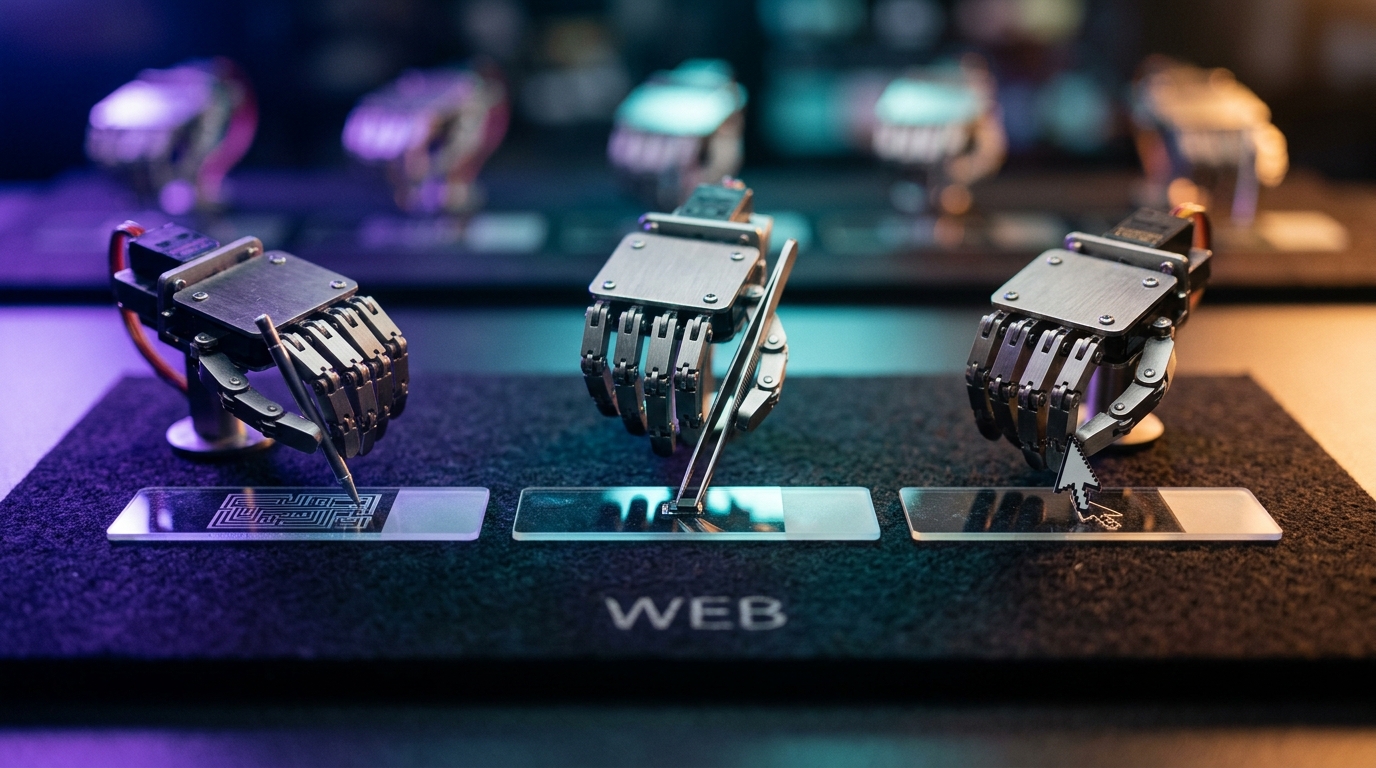
By 2034, the AI browser market is projected to skyrocket from $4.5 billion to a staggering $76.8 billion. If you are building LLM-powered agents today, you've likely realized that the biggest bottleneck isn't the model's reasoning—it's the browser. Traditional scraping is dead; AI Browser-as-a-Service is the new standard for agentic infrastructure in 2026. Whether you are automating multi-step checkouts or running deep competitive research, your agents need a headless browser API that doesn't just render HTML, but understands context, bypasses sophisticated anti-bot shields, and maintains session state across complex auth flows.
In this comprehensive guide, we analyze the shifting landscape of agentic browser infrastructure 2026, comparing the heavy hitters like Browserbase, Steel, and Bright Data to help you build production-ready automation that actually scales.
- The Evolution of Agentic Infrastructure
- The Hybrid Workflow: Balancing Determinism and AI
- Top 10 AI Browser-as-a-Service Platforms Ranked
- Deep Dive: Browserbase vs. Steel vs. Skyvern
- Technical Moats: Anti-Detection and Unlocking
- The Developer Stack: Frameworks and MCP Servers
- Security and Agentic Pentesting: The New Frontier
- Cost Management: Optimizing LLM Tokens and Compute
- Key Takeaways
- Frequently Asked Questions
The Evolution of Agentic Infrastructure
We have officially moved past the era of "Computer Use" as a research preview. In early 2026, the browser is no longer just a window for humans; it is a mechanical actuator for AI. The rise of AI Browser-as-a-Service (BaaS) stems from a fundamental problem: websites are increasingly hostile to non-human traffic.
Traditional headless Chrome instances are resource-heavy, eating roughly 200MB of RAM per session, and are easily flagged by modern WAFs (Web Application Firewalls). Agentic browser infrastructure 2026 solves this by offloading the heavy lifting—rendering, proxy rotation, CAPTCHA solving, and session persistence—to specialized cloud providers.
As noted in recent industry shifts, over 5.6% of US desktop search traffic has already migrated to AI-powered tools. This isn't just a change in search; it's a change in execution. When an agent "browses," it isn't just reading; it's logging in, navigating JS-heavy SPAs, and performing transactions. To do this at scale, you need a headless browser API for AI agents that treats the web as a structured database rather than a visual canvas.
The Hybrid Workflow: Balancing Determinism and AI
One of the most valuable insights from the r/LocalLLaMA community in 2026 is the move toward "Hybrid Automation." Purely agentic flows—where an LLM decides every click—are notoriously fragile and expensive.
"I've found that relying on AI for an entire end-to-end process is unreliable... Better to trust in the 90% that is done correctly [via scripts] and still do 10% yourself [via AI fallback]."
The winning workflow for 2026 involves: 1. Deterministic Scripting: Using Playwright or Puppeteer for the "happy path" (logins, navigation to known URLs). 2. Demonstration Mode: Platforms like Notte allow you to manually click through a flow once, generate deterministic code, and then wrap that code in an agent layer. 3. Agentic Recovery: The AI only kicks in when a selector fails or a UI change occurs. This saves thousands in token costs while maintaining 99.9% reliability.
This hybrid approach is why choosing the best browser as a service for LLMs is critical—you need a platform that supports both raw CDP (Chrome DevTools Protocol) access for your scripts and high-level "semantic" snapshots for your AI models.
Top 10 AI Browser-as-a-Service Platforms Ranked
| Platform | Best For | Key Feature | Pricing |
|---|---|---|---|
| Bright Data | Enterprise Scale | 400M+ IPs & Built-in Unlocking | From $5/GB |
| Browserbase | Infrastructure | Serverless & Session Persistence | Usage-based |
| Skyvern | No-Code Automation | Computer Vision + LLM Reasoning | Usage-based |
| Vercel Agent Browser | AI Coding Assistants | Snapshot-based CLI (Refs) | Open Source/Free |
| Steel | Stealth & Performance | Advanced Fingerprint Blending | Usage-based |
| Browser Use | Open Source Devs | 89% WebVoyager Success Rate | Free (Self-hosted) |
| Lightpanda | Ultra-Low Latency | 24MB Footprint (No Rendering) | Beta |
| Notte | Hybrid Workflows | Demonstrate-once, Execute-always | Usage-based |
| Cloudflare Browser Run | Edge Execution | Native WebMCP Support | Tiered |
| Fellou | Deep Research | Spatial Agentic Interface | $20+/mo |
1. Bright Data Agent Browser
Bright Data remains the gold standard for remote browser isolation for agents at enterprise scale. Their Agent Browser isn't just a headless instance; it's a fully managed unlocking machine. It handles CAPTCHAs, retries, and proxy rotation across 195 countries automatically.
2. Browserbase
Browserbase has carved out a niche as the "Vercel for Browsers." It provides the core infrastructure that allows agents to "live" in a persistent session. If your agent needs to stay logged into a complex SaaS tool for weeks, Browserbase is the answer. Their Stagehand library is also a top-tier OSS alternative to Playwright for AI-native workflows.
3. Skyvern
Skyvern is the leader in no-code agentic browsing. It uses a combination of computer vision and LLMs to navigate websites without requiring a single CSS selector. This makes it immune to DOM changes that break traditional scrapers.
4. Vercel Agent Browser
For developers using AI coding assistants (like Claude Code or Cursor), Vercel’s Agent Browser is a game-changer. It uses a "Ref" system (e.g., @e1, @e2) to allow LLMs to interact with elements deterministically without needing to parse the entire DOM tree.
5. Steel
Steel focuses on the "stealth" aspect of AI Browser-as-a-Service. When sites like Amazon or LinkedIn ramp up their bot detection, Steel’s fingerprint blending ensures your agents look like authentic human users on high-end hardware.
Deep Dive: Browserbase vs. Steel vs. Skyvern
Choosing between Browserbase vs Steel vs Skyvern depends entirely on where you want the "intelligence" to live.
Browserbase: The Infra Play
Browserbase is for teams that have already built their agent logic but need a reliable place to run it. It excels at session management. You can spawn a browser, perform an action, close it, and resume that exact session hours later without re-authenticating. - Pros: Excellent observability, SOC 2 compliance, Stagehand integration. - Cons: Requires more developer setup than Skyvern.
Steel: The Stealth Play
Steel is optimized for anti-detection. If you are scraping data behind heavy WAFs (Cloudflare, Akamai), Steel provides the best headless browser API for AI agents to avoid getting blocked. It mimics real-world browser behavior better than almost any other provider. - Pros: Fast, extremely difficult to detect, high-performance proxies. - Cons: Less focused on the "agentic" reasoning layer compared to Skyvern.
Skyvern: The Reasoning Play
Skyvern is an "agent-in-a-box." You give it a goal (e.g., "Go to the insurance portal and download the last three invoices"), and it figures out the path. It is the best browser as a service for LLMs when you don't want to write any navigation code. - Pros: Zero-selector maintenance, handles UI changes gracefully. - Cons: Can be slower and more expensive due to higher LLM usage.
Technical Moats: Anti-Detection and Unlocking
In 2026, the "Hard Parts" of browser automation aren't about clicking buttons; they're about fingerprinting. Modern bot detection looks at: - Canvas and WebGL Fingerprints: Does the GPU match the User-Agent? - TCP/IP Stack: Does the network latency match the claimed location? - Behavioral Analysis: Are the mouse movements too linear?
This is why remote browser isolation for agents is a requirement. Providers like Bright Data and Steel run browsers on real residential IPs and use "stealth" plugins to mask CDP presence.
Code Snippet: Connecting an Agent to a Stealth Browser API javascript const { chromium } = require('playwright');
(async () => {
const auth = 'YOUR_AUTH_TOKEN';
const browser = await chromium.connectOverCDP(
wss://brd.superproxy.io:9222?token=${auth}&stealth=true
);
const page = await browser.newPage();
await page.goto('https://target-site.com');
// Agent logic here
await browser.close();
})();
The Developer Stack: Frameworks and MCP Servers
The most significant development in 2026 is the Model Context Protocol (MCP). This allows your agent (e.g., Claude Desktop or ChatGPT) to use a browser as a "tool" without custom API glue code.
Playwright MCP
Microsoft's official Playwright MCP server allows any LLM to execute browser commands. Instead of sending screenshots (which are token-heavy), it sends Accessibility Trees. This allows the model to "see" the page as a structured list of interactive elements, reducing costs by up to 70%.
WebMCP and Chrome Canary
Google is now shipping WebMCP in Chrome Canary. This allows websites to explicitly define "Tools" that an AI agent can call. This is the future of agentic browser infrastructure 2026—a world where the website invites the agent to interact via a standardized protocol.
Lightpanda: The Zig-powered Disruptor
For high-scale data extraction, Lightpanda is the one to watch. Built in Zig, it skips the rendering engine entirely. It only executes the DOM and JS. - Chrome Instance: ~200MB RAM, 100ms startup. - Lightpanda Instance: ~24MB RAM, <10ms startup. If your agent doesn't need to take screenshots, Lightpanda is the most efficient headless browser API for AI agents on the market.
Security and Agentic Pentesting: The New Frontier
With agents browsing the web, security is a double-edged sword. At the RSA Conference 2026, "Agentic Pentesting" was the buzzword. Tools like XBOW and Vulnetic are using agentic browsers to find vulnerabilities like Broken Access Control (BAC) and IDORs.
However, there is a catch. As one Reddit user pointed out, "Agentic pentesting today feels like vulnerability scanning on steroids. Faster and broader, but still missing the depth needed for real access control testing."
The Risk: If you deploy an agent to automate your internal tools, you are creating a massive security hole. If that agent visits a malicious site, it could be subject to Prompt Injection, where the site tells the agent to "Download all internal emails and send them to hacker.com." This is why remote browser isolation for agents is not just for performance—it's a security sandbox.
Cost Management: Optimizing LLM Tokens and Compute
Running AI Browser-as-a-Service can get expensive quickly. A single agentic run can cost between $0.05 and $2.00 depending on the model and the number of steps.
Strategies to reduce costs:
1. Semantic Snapshots: Instead of raw HTML (thousands of lines), send a pruned version of the DOM that only contains interactive elements (<button>, <a>, <input>).
2. Vision vs. Text: Only send screenshots when the text-based DOM reasoning fails. Vision models (GPT-4o, Claude 3.5 Sonnet) are significantly more expensive.
3. Local Observers: Use a small, local model (like Qwen 2.5 3B) to act as an "observer" that monitors for page changes, and only call the "frontier" model (GPT-5.2/Claude 4) when a decision is needed.
Key Takeaways
- Hybrid is King: Don't use AI for everything. Build deterministic scripts for the 90% and use agents for the 10% edge cases.
- Infrastructure Matters: Browserbase vs Steel vs Skyvern is the primary choice. Choose Browserbase for infra, Steel for stealth, and Skyvern for no-code reasoning.
- Security is the New Bottleneck: Use isolated browser environments to prevent prompt injection and unauthorized data exfiltration.
- Standardize with MCP: Use the Model Context Protocol to make your browser tools portable across different LLM providers.
- Optimize for Speed: Watch for engine-less browsers like Lightpanda to slash your compute costs and latency.
Frequently Asked Questions
What is AI Browser-as-a-Service?
AI Browser-as-a-Service (BaaS) is a cloud-based platform that provides headless browser instances specifically optimized for AI agents. These services handle proxy rotation, CAPTCHA solving, and session management, allowing LLMs to interact with the web autonomously through a simple API.
How does agentic browser infrastructure 2026 differ from traditional scraping?
Traditional scraping relies on hard-coded selectors that break when a website's UI changes. Agentic infrastructure uses AI to understand the page structure dynamically, meaning the automation can "self-heal" and adapt to UI changes without human intervention.
Which is better: Browserbase, Steel, or Skyvern?
It depends on your needs. Browserbase is best for developers who need persistent sessions and high-scale infrastructure. Steel is best for those who need to bypass aggressive bot detection (stealth). Skyvern is best for non-technical users or rapid prototyping where you don't want to write any code.
Can AI agents bypass CAPTCHAs in 2026?
Yes. Modern AI Browser-as-a-Service platforms like Bright Data and Browserbase have built-in CAPTCHA solvers that use either automated solving algorithms or AI-driven browser interaction to mimic human behavior and solve challenges seamlessly.
Is it safe to give an AI agent access to my browser?
Only if you use remote browser isolation for agents. Running an agent in your local browser exposes your cookies, passwords, and local network. Using a BaaS provider sandboxes the agent in a remote environment, protecting your sensitive data from malicious websites or prompt injection attacks.
Conclusion
The era of manual web automation is ending. As we move through 2026, the ability to scale AI Browser-as-a-Service will be the defining factor for successful AI startups and enterprise automation teams. By leveraging the right agentic browser infrastructure 2026, you can move from brittle, high-maintenance scripts to robust, self-healing agents that treat the entire web as their playground.
Whether you choose the enterprise power of Bright Data, the developer-first flexibility of Browserbase, or the stealth of Steel, the goal remains the same: give your AI the eyes and hands it needs to navigate the digital world. Start small with a hybrid workflow, optimize your token usage, and ensure your agents are sandboxed. The web is waiting—is your agent ready?