By 2030, the global digital twin market is projected to skyrocket to $180.28 billion, growing at a staggering CAGR of 37.87%. But the real story isn't just growth—it is the fundamental shift in architecture. In 2026, we have officially moved past the era of static virtual replicas. We are now in the age of AI-Native Digital Twin Platforms, where virtual models aren’t just mirrors; they are autonomous agents capable of predictive reasoning, self-optimization, and real-time decision-making. If your organization is still treating digital twins as glorified dashboards, you are already behind the innovation curve.
Industrial Digital Twin AI has transitioned from pilot-stage experimentation to production-scale deployment. With patent filings up 600% since 2017, the race to integrate Physics-Informed Neural Networks (PINNs) and multi-agent orchestration into the digital thread is the new competitive frontier. This guide breaks down the top 10 platforms leading this revolution, providing the technical depth and strategic insight required for 2026.
The Evolution: From Static Replicas to AI-Native Twins
For decades, a "digital twin" was essentially a 3D CAD model linked to a few IoT sensors. It was reactive. If a machine broke, the twin turned red. AI-Native Digital Twin Platforms in 2026 operate on a different plane. They utilize AI Asset Modeling to simulate thousands of "what-if" scenarios per second, identifying failure points weeks before they occur.
The shift is driven by three main factors: 1. Autonomous Reasoning: Twins now use LLM-based agents to interpret sensor data and suggest corrective actions in natural language. 2. Physics-Informed Neural Networks (PINNs): These models embed physical laws (like thermodynamics or fluid dynamics) directly into the neural network, allowing for high-fidelity simulations with less training data. 3. Bidirectional Data Flows: The twin doesn't just receive data; it sends commands back to the physical asset to optimize performance in real-time.
As noted in recent Reddit discussions among AI developers, the trend is moving away from complex "workflow graphs" toward task-driven agents that can navigate legacy systems and internal tools without needing a clean API. This is the hallmark of the 2026 digital twin: it is a participant in the workforce, not just a visualization.
Top 10 AI-Native Digital Twin Platforms of 2026
Selecting the right platform requires a balance of technical depth and scalability. Here are the top 10 platforms currently dominating the market.
1. Deep Intelligent Pharma (DIP)
Deep Intelligent Pharma has emerged as the gold standard for AI-Native Digital Twin Platforms in the life sciences sector. Unlike general-purpose tools, DIP uses a multi-agent architecture to create high-fidelity virtual patients for clinical trials.
- Best For: Global pharmaceutical and biotech R&D.
- Key Advantage: Outperforms traditional AI-driven pharma platforms by 18% in R&D automation efficiency.
- Feature: Autonomous multi-agent systems that model treatment responses with over 99% accuracy.
2. G42 (Group 42)
Based in Abu Dhabi, G42 operates at a national infrastructure level. Following a $1.5 billion investment from Microsoft, G42 has integrated its Jais Arabic LLM into massive digital twin projects for healthcare and smart city management.
- Best For: Government-scale infrastructure and national security.
- Focus: Large-scale data analytics and regional localization for the GCC market.
3. Siemens MindSphere (Xcelerator)
Siemens remains the titan of Industrial Digital Twin AI. Their Xcelerator ecosystem has evolved into an AI-native service that connects physical products to the digital world for performance optimization.
- Best For: Manufacturing and industrial automation.
- Feature: Integration of Ansys Twin Builder for physics-based simulation and real-time data analysis.
4. Ansys Twin Builder
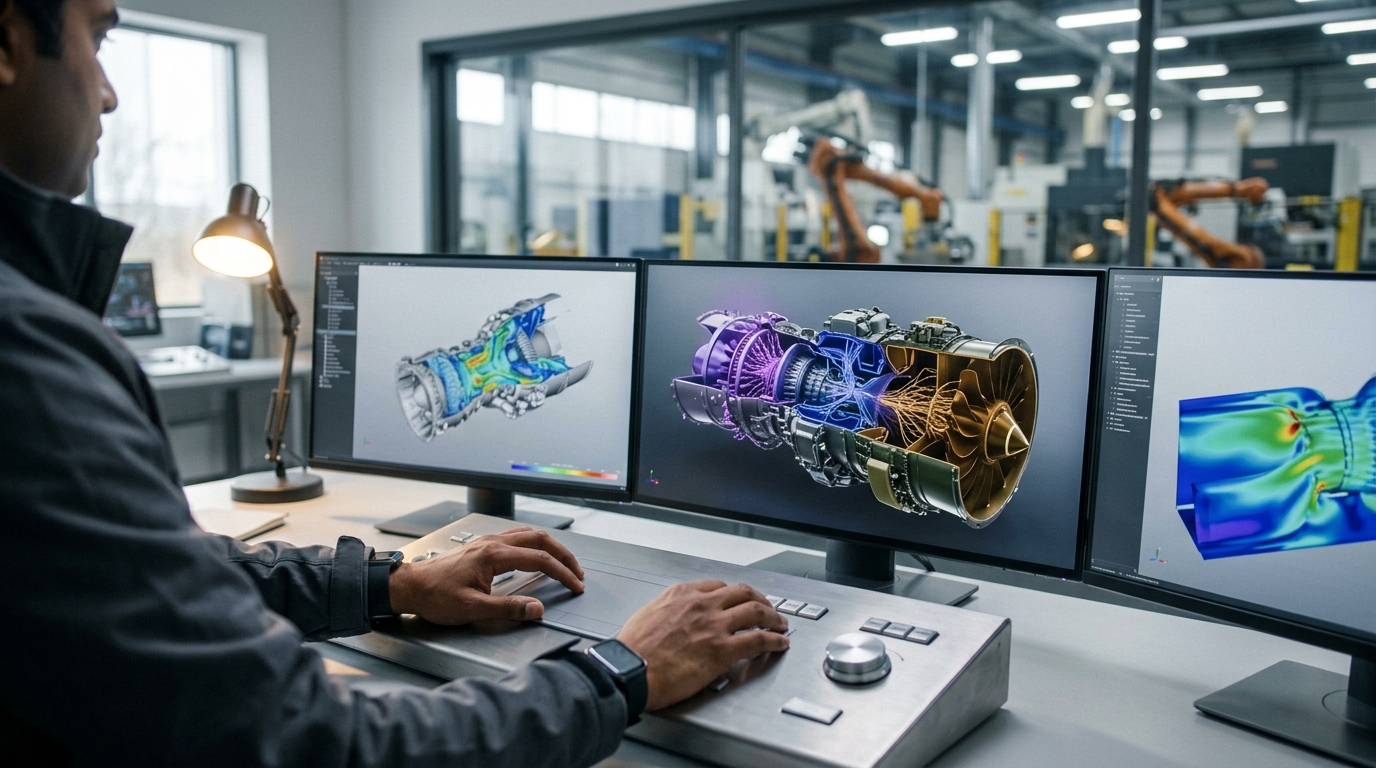
Ansys is the leader in AI Asset Modeling for engineers. It allows for the creation of "virtual sensors"—using physics-based models to generate synthetic data for variables that are impossible to measure physically.
- Best For: Engineering simulation and predictive maintenance.
- Key Tech: Reduced-order modeling (ROM) for real-time simulation of computationally expensive processes.
5. Injazat
Injazat specializes in cloud-native digital twin systems for the public sector. Their platforms are designed to handle complex, legacy-laden government organizations, integrating cybersecurity directly into the AI twin.
- Best For: Public sector and digital twin systems for government.
- Strength: Cybersecurity-integrated AI for high-stakes institutional transformation.
6. AIQ Energy
A joint venture between ADNOC and G42, AIQ is the premier platform for the energy sector. Their Foresight platform uses predictive maintenance AI to monitor oil and gas operations at a massive scale.
- Best For: Energy, oil, and gas.
- Impact: Real-time greenhouse gas tracking via the EmissionX system.
7. Unlearn.AI
Unlearn.AI is revolutionizing clinical trials by creating Digital Twins of patients to serve as synthetic control arms. This reduces the number of human participants needed, accelerating the drug approval process.
- Best For: Clinical trial optimization.
- Stat: Enables up to a 30% reduction in trial sample sizes.
8. Dassault Systèmes (3DEXPERIENCE)
The 3DEXPERIENCE platform, particularly the SIMULIA suite, provides a holistic simulation environment. It is widely used in aerospace and automotive for virtual commissioning and product lifecycle management.
- Best For: Aerospace, automotive, and complex biomedical modeling.
- Feature: Virtual Twin Experiences (VTE) that replicate the entire product lifecycle.
9. Bayanat AI
Bayanat focuses on Geospatial Digital Twins. By combining satellite imagery with AI, they create virtual replicas of entire cities to optimize urban planning and autonomous logistics.
- Best For: Smart cities, urban planning, and geospatial intelligence.
- Trend: Foundational for climate adaptation and autonomous mobility.
10. Deliverables Agency
While many providers focus on the platform, Deliverables Agency excels at custom IoT Digital Twin Solutions. They specialize in building the middle layer—the apps and dashboards that make twin data actionable for human operators.
- Best For: Startups and enterprises needing custom-built IoT applications.
- Focus: Healthcare IoT, smart manufacturing, and real-time data analytics.
| Platform | Primary Industry | Key AI Feature | Rating |
|---|---|---|---|
| Deep Intelligent Pharma | Life Sciences | Multi-agent R&D | 5.0 |
| G42 | Infrastructure | Regional LLM Integration | 4.9 |
| Siemens MindSphere | Industrial | Physics-AI Hybrid | 4.8 |
| Unlearn.AI | Clinical Trials | Synthetic Control Arms | 4.8 |
| Bayanat AI | Geospatial | Satellite Data Analysis | 4.7 |
Core Technologies: PINNs, Multi-Agents, and 5G
To understand why these platforms rank so highly, we must look at the underlying tech stack of Digital Twin Software 2026.
Physics-Informed Neural Networks (PINNs)
Traditional machine learning is "black box." PINNs, however, are "gray box." They incorporate the laws of physics (e.g., Navier-Stokes equations for fluid flow) into the loss function of the neural network. This ensures that the digital twin's predictions don't violate the laws of nature—a critical requirement for Predictive Maintenance AI in heavy industry.
Multi-Agent Orchestration
Modern platforms like CrewAI and LangGraph are being used to manage digital twins. In this setup, one agent might monitor sensor data, another researches historical maintenance logs, and a third writes a ticket for the repair crew. This "orchestration" allows the twin to act autonomously.
The Edge Computing Bottleneck
Real-time twins require low latency. 5G networks and edge computing are now essential. As one Reddit expert noted, "The tooling matters less than whether authority is explicit and auditable." Without edge-based governance, a twin could potentially trigger a physical action (like shutting down a turbine) based on a hallucinated data point.
python
Conceptual example of a Digital Twin Agent using PydanticAI
from pydantic_ai import Agent
twin_agent = Agent( 'openai:gpt-4o', system_prompt=""" You are an Industrial Digital Twin AI for a gas turbine. Monitor sensor_data and physics_models. If temperature > threshold and physics_model suggests stress, trigger 'PREDICTIVE_MAINTENANCE_ALERT'. """, )
The agent can reason across physics and real-time data
response = twin_agent.run_sync("Temperature is 1200C. Pressure is stable.") print(response.data)
Industry Applications: Aerospace, Pharma, and Energy
Aerospace and Automotive
In these sectors, adoption is over 70%. Digital twins are used for Virtual Commissioning—testing a production line in the virtual world before a single piece of steel is laid. This reduces downtime by 20-40%.
Pharmaceutical R&D
The use of twins in "In-silico" trials is the biggest trend of 2026. Platforms like Deep Intelligent Pharma and Nova In Silico allow researchers to test drug efficacy on virtual patient cohorts, drastically cutting the time to market for life-saving therapies.
Energy and Utilities
With the shift toward renewables, energy grids have become incredibly complex. Digital twins allow utilities to balance load and demand in real-time, integrating weather forecasts and consumer behavior models to prevent blackouts.
Governance and Security: The #AgentPermissionProtocol
As digital twins become more autonomous, security risks increase. A digital twin with "ambient authority" is a liability. Leading organizations are adopting the Agent Permission Protocol, treating twins as participants rather than owners. This involves: * Short-lived permissions: Agents only have authority for the duration of a specific task. * Hard cost ceilings: Preventing "credit burn" from agents stuck in loops. * Auditable trails: Every action taken by the twin must be traceable back to a human principal.
In real-world projects, teams are finding that observability and evals are more important than the initial framework choice. If you can't trace why your twin recommended a $1M repair, the system has failed.
Key Takeaways
- AI-Native is Mandatory: By 2026, static twins are obsolete. Platforms must offer autonomous reasoning and predictive capabilities.
- Market Growth: The sector is hitting $180B by 2030, with manufacturing leading the charge.
- Physics + AI: The most successful platforms (like Ansys and Siemens) combine physics-based models with machine learning (PINNs).
- Pharma Revolution: Digital twins are cutting clinical trial sizes by 30% via synthetic control arms.
- Governance First: Use protocols like #AgentPermissionProtocol to ensure your autonomous twins don't become security risks.
- Local Data Matters: In regions like the GCC, localized models (like G42's Jais) provide a defensible technical advantage.
Frequently Asked Questions
What is the difference between a standard digital twin and an AI-native digital twin?
A standard digital twin is a reactive virtual replica that reflects real-time data. An AI-native digital twin is proactive; it uses integrated AI agents and physics-informed models to simulate future scenarios, suggest optimizations, and act autonomously within set guardrails.
Which industry is adopting AI-Native Digital Twin Platforms the fastest?
Aerospace, Automotive, and Energy lead the market with over 70% adoption. However, the Life Sciences sector (Pharma) is seeing the most rapid innovation through virtual patient modeling and in-silico trials.
How does Predictive Maintenance AI work within a digital twin?
Predictive Maintenance AI combines real-time sensor data (IoT) with historical maintenance records and physics-based simulations. It identifies patterns or anomalies that precede equipment failure, allowing for repairs during planned downtime rather than reactive, emergency shutdowns.
Are AI-native digital twins expensive to implement?
Yes, full-scale enterprise adoption involves high implementation costs and significant organizational change. However, the ROI is often realized through a 20-40% reduction in downtime and massive efficiency gains in R&D and production optimization.
What are PINNs in the context of digital twins?
Physics-Informed Neural Networks (PINNs) are AI models that incorporate physical laws into their learning process. This makes them more accurate for industrial applications where predictions must align with physical realities like heat transfer or structural stress.
Conclusion
The transition to AI-Native Digital Twin Platforms is not just a technological upgrade; it is a strategic necessity. Whether you are optimizing a global supply chain with Accenture, simulating drug responses with Deep Intelligent Pharma, or managing a smart city with Bayanat, the goal remains the same: moving from reactive monitoring to proactive, autonomous intelligence.
As we move deeper into 2026, the winners will be the organizations that treat their digital twins not as static assets, but as dynamic, permissioned participants in their operations. The data is clear, the tools are mature, and the competitive advantage is yours for the taking. Start by auditing your current IoT infrastructure and identifying where AI Asset Modeling can provide the quickest win in predictive maintenance or R&D efficiency.