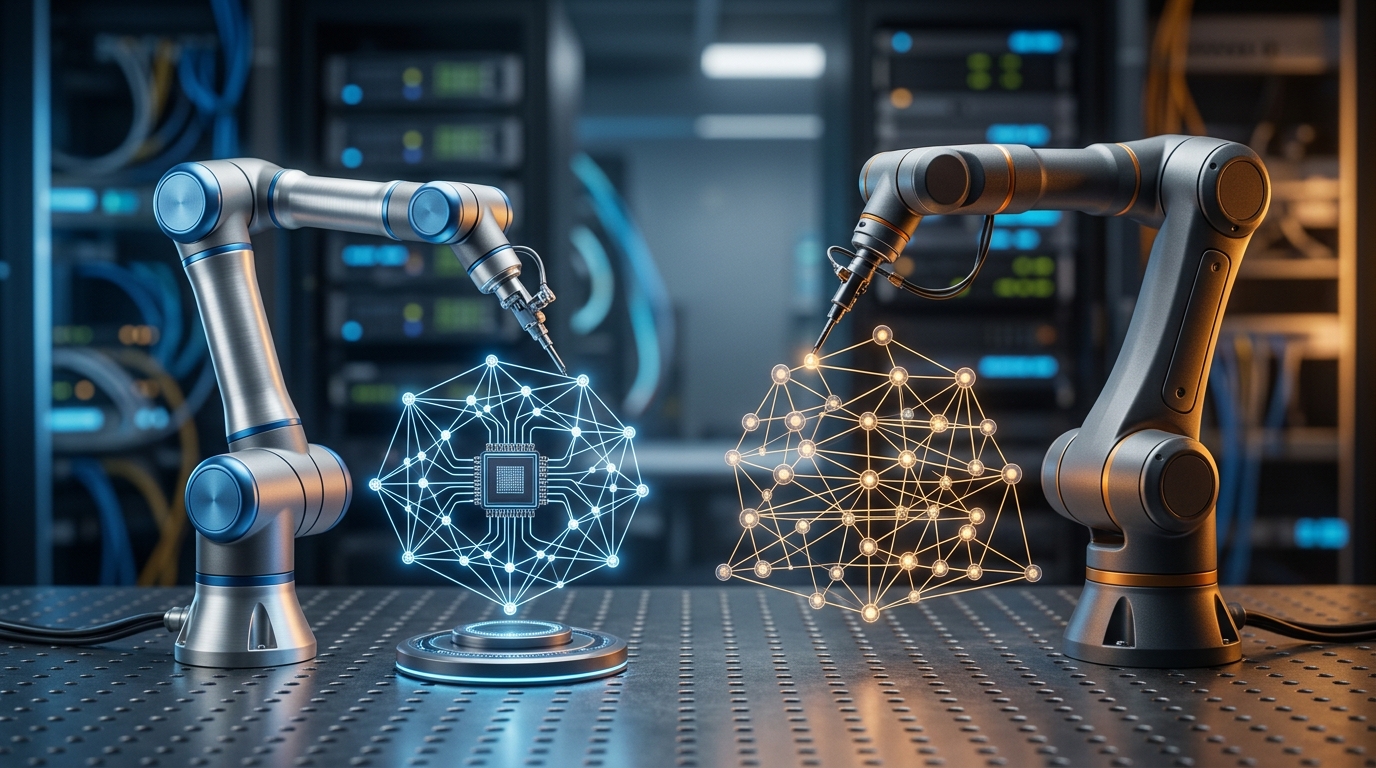
By 2026, the industry consensus is clear: if your connected hardware isn't thinking for itself, it’s already obsolete. Traditional device management—focused on simple heartbeat pings and manual firmware-over-the-air (FOTA) updates—is being replaced by AI-native IoT management. We are witnessing a paradigm shift where autonomous IoT orchestration isn't just a luxury; it is the only way to manage the projected 75 billion devices without hiring an army of SREs. In this guide, we analyze the elite platforms defining the AIoT landscape and how they handle the complexities of managing AI agents on IoT devices.
The Evolution of AI-Native IoT Management
For years, IoT management was a reactive discipline. You set a threshold, an alert fired, and a human intervened. AI-native IoT management flips this script. These platforms are built from the ground up to support high-frequency data loops and local decision-making.
In 2026, the focus has shifted from "connectivity" to "intelligence lifecycle." This involves managing the deployment of Large Language Models (LLMs) and Small Language Models (SLMs) to the edge, monitoring for model drift, and enabling federated learning across a fleet of devices. As we see in the rise of edge AI device management platforms, the goal is to minimize the "data tax"—the cost of sending raw data to the cloud—by processing everything locally and only syncing insights.
"The transition to AI-native systems is driven by the sheer scale of data. You cannot manage 10,000 cameras with humans; you need an autonomous system that identifies when a camera's vision model is degrading and retrains it on the fly."
Critical Features of Autonomous IoT Orchestration
When evaluating the best IoT device management 2026 solutions, look for these five non-negotiable pillars of autonomous IoT orchestration:
- Zero-Touch Provisioning (ZTP) with AI Identity: Devices should not only register themselves but also use AI-based behavioral profiling to verify their identity and security posture before joining the network.
- Model Ops & FOTA Integration: The ability to push binary firmware updates and AI model weight updates simultaneously, ensuring the software and the brain of the device are in sync.
- Self-Healing Networks: AI agents that monitor network health and automatically switch between 5G, satellite, or Wi-Fi 7 to maintain 99.999% uptime.
- Edge-to-Cloud Fluidity: The platform must treat the edge and cloud as a single continuum, moving workloads based on latency requirements and cost-optimization algorithms.
- Agentic Governance: As we begin managing AI agents on IoT devices, platforms must provide guardrails to ensure autonomous agents don't exceed their operational envelopes.
1. NVIDIA Fleet Command: The Gold Standard for Edge AI
NVIDIA has transitioned from a chipmaker to the premier provider of edge AI device management platforms. Fleet Command is specifically designed for the deployment and orchestration of AI applications across distributed environments like retail stores, factories, and smart cities.
- Key Strength: Unrivaled GPU orchestration. If your IoT deployment involves heavy computer vision or generative AI at the edge, Fleet Command is the industry standard.
- Autonomous Capabilities: It features "One-Click Deployment," but the real magic is in the remote management of the NVIDIA AI Enterprise software stack, ensuring that your edge containers are always optimized for the specific Tensor Core architecture of the local hardware.
- 2026 Update: Fleet Command now integrates seamlessly with NVIDIA Isaac for robotics, allowing for unified management of both static sensors and mobile autonomous agents.
2. AWS IoT Core & SageMaker Edge: The Hyperscale Powerhouse
Amazon’s ecosystem remains a dominant force in AI-native IoT management. By tightly coupling AWS IoT Core with SageMaker Edge, developers can build models in the cloud and deploy them to thousands of devices with built-in monitoring for model drift.
- Why it ranks: The sheer breadth of the AWS ecosystem. From Greengrass for local compute to TwinMaker for digital twins, AWS provides the most comprehensive toolset for complex AIoT architectures.
- Developer Productivity: For those using SEO tools or developer productivity frameworks, AWS’s SDKs and CLI tools are the most mature in the market.
- Technical Edge: AWS recently introduced "Autonomous Scaling Groups" for IoT, which automatically adjusts edge compute resources based on real-time inference demand.
3. Azure IoT Operations: The Adaptive Cloud Leader
Microsoft’s shift toward the "Adaptive Cloud" has made Azure IoT Operations a top contender for the best IoT device management 2026. It leverages Azure Arc to treat any edge device—whether it's running Linux, Windows, or Kubernetes—as an extension of the Azure cloud.
- Focus: Industrial interoperability. With native support for OPC UA and MQTT, it’s the bridge between legacy OT (Operational Technology) and modern AI.
- AI Integration: Deep integration with Copilot for Operations allows technicians to query device health using natural language, a massive leap in autonomous IoT orchestration accessibility.
4. Balena: The DevOps-First AIoT Platform
Balena (formerly Resin.io) has maintained its cult status among engineers by focusing on the developer experience. It treats IoT devices like microservices in a data center.
- Containerization: BalenaOS is a minimal Linux distro designed for containers. This makes it incredibly easy to package AI models (as Docker images) and deploy them to a fleet of heterogeneous hardware.
- BalenaCloud: Provides a robust dashboard for managing device states and "delta updates," which only send the changed bits of a container, saving massive bandwidth on remote AI model updates.
5. Particle: Integrated Hardware and Intelligence
Particle is unique because it provides the hardware (cellular/Wi-Fi modules), the connectivity, and the management platform. This "full-stack" approach eliminates the integration friction that plagues many AIoT projects.
- AI Strategy: Particle’s "Logic" engine allows for the deployment of edge-based AI scripts without deep firmware knowledge.
- Best For: Rapid scaling. If you need to go from 1 to 10,000 devices in months rather than years, Particle’s integrated approach is unbeatable.
6. ClearBlade: Ultra-Low Latency Edge Orchestration
ClearBlade has carved out a niche in high-stakes environments like rail and mining. Their platform is designed to run entirely offline if necessary, providing true edge AI device management.
- Performance: Their edge broker is legendary for its low overhead and high throughput.
- No-Code AI: ClearBlade offers an "Intelligent Asset" system that allows non-developers to create AI-driven rules for device behavior, democratizing autonomous IoT orchestration.
7. HiveMQ: The Backbone of AI-Driven Data Movement
While not a device management platform in the traditional sense, HiveMQ is the essential nervous system for any AI-native IoT management strategy. It is the world's most scalable MQTT broker.
- Role in AIoT: AI models are only as good as the data they receive. HiveMQ ensures that high-velocity data from millions of devices reaches AI engines with millisecond latency.
- Observability: Their new "AI Stream Processing" extension allows for data to be cleaned and transformed in-flight before it even hits the database.
8. Foundries.io: Security-Centric AIoT Lifecycle
Foundries.io provides the "FoundriesFactory," a cloud-based service that simplifies the building, testing, and deploying of secure, over-the-air updatable Linux-based IoT devices.
- Security First: In 2026, security is the biggest hurdle for managing AI agents on IoT devices. Foundries.io uses a TUF (The Update Framework) compliant system to ensure AI models cannot be tampered with during transit.
- Micro-Platform: Their subscription model gives you a maintained, secure OS base, allowing your team to focus 100% on the AI application logic.
9. Siemens Industrial Edge: The Factory Floor Authority
For those in manufacturing, Siemens is the undisputed king. Their Industrial Edge platform brings IT standards (Docker, Python, AI) to the shop floor (PLCs, Sensors).
- Industrial AI: Siemens provides pre-built AI apps for predictive maintenance and quality inspection that integrate directly with S7-1500 controllers.
- Ecosystem: The Siemens Mendix integration allows for low-code app development that consumes AI insights from the edge.
10. Edge Impulse: The ML Lifecycle Specialist
Edge Impulse has evolved from a simple ML training tool into a comprehensive edge AI device management platform. It covers the entire pipeline: data ingestion, labeling, training, optimization (EON Tuner), and deployment.
- Hardware Agnostic: It works on everything from an ESP32 to an enterprise-grade NVIDIA Jetson.
- Real-World Value: It’s the best platform for "TinyML"—running neural networks on extremely low-power microcontrollers.
AIoT Platform Comparison: 2026 Matrix
| Platform | Primary Focus | Best For | AI Capability |
|---|---|---|---|
| NVIDIA Fleet Command | High-Performance AI | Vision AI / LLMs at Edge | Native GPU Orchestration |
| AWS IoT Core | Cloud Integration | Massive Scalability | SageMaker Edge Manager |
| Azure IoT Ops | Industrial Hybrid | Enterprise OT/IT | Copilot & Adaptive Cloud |
| Balena | Developer Experience | Containerized AI | Delta Container Updates |
| Particle | Full-Stack Simplicity | Rapid Prototyping | Integrated Edge Logic |
| ClearBlade | Offline Reliability | Critical Infrastructure | No-Code Edge Rules |
| Edge Impulse | ML Lifecycle | TinyML / Sensor Fusion | Automated Model Optimization |
Managing AI Agents on IoT Devices: The 2026 Strategy
The most significant trend in 2026 is the shift from "dumb" firmware to "agentic" software. Managing AI agents on IoT devices requires a fundamentally different approach to DevOps.
The Shift to Agentic IoT
Unlike static code, an AI agent can change its behavior based on its environment. This introduces "non-deterministic" risks. To manage this, elite platforms now use Policy-Based Orchestration. Instead of telling a device what to do, you give it a goal (e.g., "Minimize energy consumption while maintaining 60fps video processing") and a set of constraints.
Code Snippet: Deploying an AI Agent via MQTT (Conceptual)
python
Example of an autonomous agent deployment payload
{ "agent_id": "vision-optimizer-v4", "intent": "object_detection", "constraints": { "max_latency_ms": 50, "max_power_mw": 200 }, "model_source": "s3://models/yolov10-tiny-quantized.wasm", "fallback_policy": "local_rule_engine" }
In this model, the AI-native IoT management platform doesn't just push the file; it monitors the agent's performance against the max_latency_ms constraint and automatically rolls back if the agent's "behavioral telemetry" deviates from the norm.
Key Takeaways
- Autonomy is Mandatory: By 2026, manual device management is a bottleneck. Look for platforms that support autonomous IoT orchestration.
- Edge AI is the Default: The best IoT device management 2026 platforms treat the edge as the primary compute location, not an afterthought.
- Security is the Foundation: With AI agents making decisions, zero-trust architecture and secure OTA for model weights are non-negotiable.
- Interoperability Wins: Platforms like Azure and Siemens that bridge the gap between industrial protocols (OPC UA) and AI (Python/Containers) offer the highest ROI.
- Specialization Matters: Choose NVIDIA for vision, Edge Impulse for sensor fusion/TinyML, and AWS or Azure for massive cloud-integrated ecosystems.
Frequently Asked Questions
What is AI-native IoT management?
AI-native IoT management refers to platforms designed specifically to handle the lifecycle of AI models and autonomous agents at the edge. Unlike legacy systems, they focus on model deployment, drift monitoring, and self-healing orchestration rather than just simple connectivity.
How does autonomous IoT orchestration differ from standard management?
Standard management requires human-defined rules and manual intervention for updates or troubleshooting. Autonomous IoT orchestration uses AI to monitor device health and environmental data, making real-time decisions to optimize performance, security, and connectivity without human input.
Why is managing AI agents on IoT devices difficult?
Managing agents is difficult because their behavior can be non-deterministic. Traditional monitoring looks for "up/down" status; agent monitoring requires tracking "intent fulfillment," model drift, and ensuring the agent stays within its safety and operational guardrails.
Which platform is best for Edge AI device management in 2026?
For high-performance vision and generative AI, NVIDIA Fleet Command is the leader. For low-power sensor applications (TinyML), Edge Impulse is the preferred choice. For general enterprise-scale deployments, AWS IoT Core and Azure IoT Operations remain the most robust options.
Can I use these platforms for legacy IoT devices?
Most AI-native platforms, particularly Azure IoT Operations and ClearBlade, are designed to be backwards compatible. They use gateway devices to translate legacy protocols (like Modbus or Zigbee) into modern MQTT or Sparkplug B formats that AI engines can process.
Conclusion
The landscape of AI-native IoT management is evolving at breakneck speed. As we move through 2026, the distinction between "device management" and "AI operations" will continue to blur. The platforms listed here represent the pinnacle of autonomous IoT orchestration, offering the tools necessary to manage the next generation of intelligent, agentic hardware.
Choosing the right platform depends on your specific use case—whether it's the raw GPU power of NVIDIA, the developer-centric flow of Balena, or the industrial heritage of Siemens. However, the underlying truth remains: the future of IoT belongs to those who can manage intelligence at scale.
Ready to optimize your AIoT stack? Explore our deep dives into developer productivity and AI writing tools to stay ahead of the curve in the rapidly changing tech ecosystem. The era of the autonomous edge is here—make sure your management platform is ready for it.