
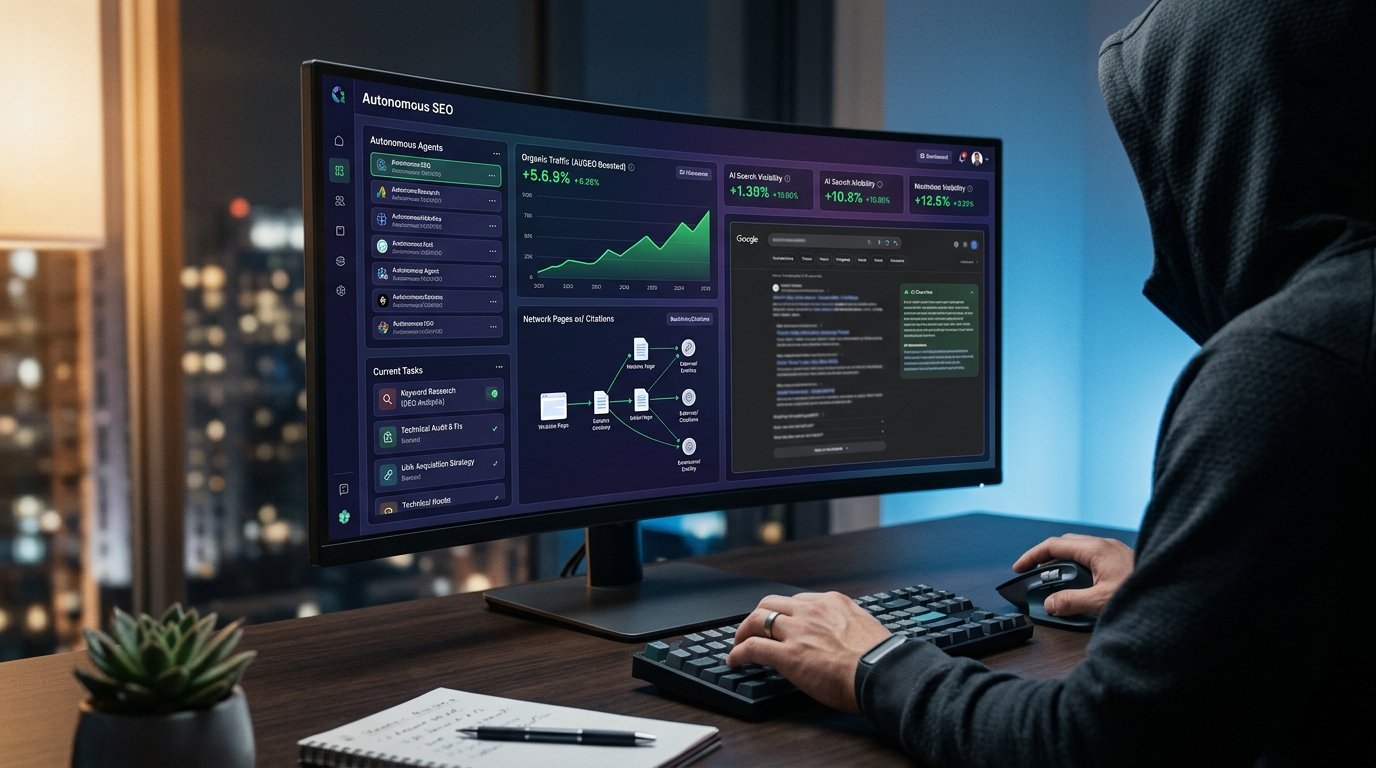
By 2026, the distinction between 'AI writing' and agentic SEO tools has become the line between stagnation and explosive growth. Data from early 2026 shows that multi-agent systems now outperform single-prompt AI approaches by a staggering 90.2%. We are no longer just prompting chatbots to write 1,500-word articles; we are deploying autonomous SEO platforms that perceive the search landscape, make strategic decisions, and execute technical fixes 24/7 without human intervention.
If you are still manually clustering keywords or copy-pasting meta descriptions, you aren't just behind—you are invisible. With AI Overviews appearing in over 13% of search queries and platforms like Perplexity and ChatGPT handling billions of monthly searches, the 'Silicon Mirage' of traditional search has shifted. To win in 2026, you need a self-optimizing website agent that understands Generative Engine Optimization (GEO) as deeply as it understands backlinks. This guide breaks down the elite stack of autonomous tools currently dominating the SERPs.
- The 2026 Paradigm Shift: From Writing Tools to SEO Agents
- 1. NoimosAI: The All-in-One Autonomous Marketing Workforce
- 2. EarlySEO: Data-First Multi-Model Execution
- 3. Surfer SEO: The AEO and Humanizer Specialist
- 4. Alli AI: The Technical Automation Sentinel
- 5. Vismore: The Citation and GEO Powerhouse
- 6. SEOBot: Programmatic SEO at Scale
- 7. Search Atlas (OTTO): The Enterprise Automation Engine
- The Holy Trinity: SEO vs. AEO vs. GEO
- Implementation Strategy: Deploying Your First Agentic Workflow
- Key Takeaways: The TL;DR for 2026
- Frequently Asked Questions
The 2026 Paradigm Shift: From Writing Tools to SEO Agents
Traditional SEO software was diagnostic. It told you what was broken and left you to fix it. Agentic SEO tools represent a move from 'assisted creation' to 'autonomous execution.' As one veteran SaaS developer noted on Reddit, we’ve moved past dashboards into 'SEO copilots' that ask whether you are targeting traditional SERP visibility or AI search visibility before they even start a workflow.
Why Autonomy is Non-Negotiable
The agentic market is projected to reach $93.20 billion by 2032. In 2026, the competitive advantage isn't just auto-written content; it’s the compression of iteration cycles. While a human team takes a week to audit, research, and update a content decay issue, an autonomous SEO platform identifies the drop in real-time, analyzes the new competitor intent, and deploys a refreshed version of the page within minutes.
The Data Layer
Modern agents don't hallucinate; they ground their logic in real-time data. They use APIs like DataForSEO, Firecrawl, and DeepResearch to scrape live SERPs before a single word is generated. This ensures that the content is based on what is currently ranking, not what was in a model's training data two years ago.
1. NoimosAI: The All-in-One Autonomous Marketing Workforce
NoimosAI has emerged as the leader for teams that want a 'hands-off' marketing department. It doesn't just suggest keywords; it acts as a comprehensive SEO agent that handles the entire pipeline—from semantic research to native CMS publication.
- Best For: Lean teams and solopreneurs who need enterprise-level execution without the headcount.
- Key Feature: 24/7 autonomous operation across SEO, GEO, and competitor monitoring.
- Pricing: Tier-based starting at approximately $99/month.
NoimosAI mimics a human team by conducting deep semantic keyword research and clustering intent. Beta users have reported reducing marketing costs by over $10,000 monthly while increasing organic traffic by 1000% within a two-month window. It is particularly effective for those who want to set a goal—like 'rank for biotech supply chain keywords'—and let the agent navigate the execution.
2. EarlySEO: Data-First Multi-Model Execution
EarlySEO stands apart in 2026 for its sophisticated data layer and its refusal to rely on a single LLM. By running GPT 5.4 and Claude Opus 4.6 in tandem, it eliminates the 'generic' feel that plagues single-model competitors.
- Best For: High-growth sites that prioritize content quality and automated publishing.
- Key Feature: Native auto-publishing to 10+ platforms including WordPress, Webflow, Shopify, and Ghost.
- Pricing: $79/month.
EarlySEO utilizes the DeepResearch API to analyze what is currently ranking before writing. This 'grounded' approach has resulted in an average traffic growth of 340% per account. Crucially, it includes a dashboard that tracks when ChatGPT, Perplexity, or Gemini references your content, providing a clear view of your AI citation share.
3. Surfer SEO: The AEO and Humanizer Specialist
Surfer SEO has evolved from a simple on-page tool into a sophisticated AI SEO automation software suite. Its core strength remains its ability to reverse-engineer the SERPs, but its 2026 'Humanizer' and AEO tracking features make it essential for modern visibility.
- Best For: Content teams that need a 'human-in-the-loop' workflow with high citation rates.
- Key Feature: AI Humanizer that achieves 40% higher citation rates in LLMs versus raw GPT output.
- Pricing: $89–$219/month.
Surfer’s correlation data is industry-leading, with an 89% correlation rate to top rankings. By focusing on Answer Engine Optimization (AEO), Surfer ensures your content isn't just a 'blue link' but a primary source for AI-generated answers. It integrates natively with Google Docs and WordPress, fitting perfectly into existing agency workflows.
4. Alli AI: The Technical Automation Sentinel
While other tools focus on content, Alli AI dominates the technical SEO space. It is the premier autonomous SEO platform 2026 for large-scale technical deployments.
- Best For: Enterprise sites and e-commerce platforms with thousands of pages.
- Key Feature: Live Editor that bypasses developers to deploy technical fixes instantly.
- Pricing: Enterprise-focused tiers.
Alli AI works via a code snippet that allows the agent to crawl, identify, and fix technical issues—such as schema markup, meta tags, and site speed optimizations—without requiring a ticket in your dev queue. For sites where 'technical debt' is the primary bottleneck, Alli AI provides the highest ROI by automating the 'boring' work that humans often neglect.
5. Vismore: The Citation and GEO Powerhouse
Vismore is built specifically for the 2026 reality where Generative Engine Optimization (GEO) is as important as traditional rankings. It focuses on 'extractable' content—data that AI systems love to cite.
- Best For: B2B SaaS and growth leads focused on Perplexity and ChatGPT mentions.
- Key Feature: Automated distribution to high-authority platforms (Reddit, Quora, Medium) that LLMs trust.
- Pricing: Custom tiers based on mention volume.
Testing shows that Vismore can move a brand from zero mentions to appearing in 30% of relevant AI prompts within a single quarter. It uses agents to generate 30+ pieces of 'citation-ready' content from a single research brief, then automates the distribution to the platforms that AI search engines use as 'ground truth' sources.
6. SEOBot: Programmatic SEO at Scale
For those looking to dominate through volume and best AI for organic traffic in niche categories, SEOBot is the go-to programmatic SEO (pSEO) agent. It is designed to generate thousands of unique, high-quality pages targeting long-tail clusters.
- Best For: Directories, local SEO, and large-scale affiliate sites.
- Key Feature: Automated keyword clustering and mass page generation with unique data variables.
- Pricing: Usage-based credits.
SEOBot eliminates the 'duplicate content' risk of mass generation by using multi-agent checks to ensure each page provides unique value. It is the ultimate tool for capturing 'bottom-of-the-funnel' local queries across thousands of zip codes or product variations simultaneously.
7. Search Atlas (OTTO): The Enterprise Automation Engine
OTTO, the automation engine within Search Atlas, represents the high-end of enterprise AI SEO reviews. It is an agentic layer that sits on top of your entire SEO strategy, executing everything from internal linking to backlink outreach.
- Best For: Enterprise agencies and large brands needing a unified automation stack.
- Key Feature: OTTO automation engine for site-wide technical and content refreshes.
- Pricing: Integrated with Search Atlas tiers starting at $199/month.
OTTO doesn't just report; it acts. If a page's rankings start to decay, OTTO automatically initiates a 'refresh' workflow, analyzing new SERP signals and updating the content. This 'self-healing' website approach is what separates enterprise-grade agents from simple writing assistants.
Comparison of Top Agentic SEO Tools 2026
| Platform | Primary Focus | Best Use Case | Starting Price |
|---|---|---|---|
| NoimosAI | All-in-One | Lean teams / Startups | $99/mo |
| EarlySEO | Data & Publishing | High-volume content | $79/mo |
| Surfer SEO | AEO & Scoring | Quality-focused teams | $89/mo |
| Alli AI | Technical SEO | Enterprise Technical | Custom |
| Vismore | GEO / Citations | B2B SaaS Growth | Custom |
| SEOBot | Programmatic | Local / Niche Scale | Usage-based |
| Search Atlas | Full Stack | Enterprise Agency | $199/mo |
The Holy Trinity: SEO vs. AEO vs. GEO
In 2026, you cannot afford to optimize for just one type of search. The most effective agentic SEO tools now balance three distinct optimization frameworks:
- SEO (Search Engine Optimization): Still targeting the 'blue links' on Google. This remains the foundation, as Google still drives nearly 50% of internet traffic.
- AEO (Answer Engine Optimization): Targeting featured snippets and 'Position Zero' results. This is about being the definitive answer to a specific question.
- GEO (Generative Engine Optimization): The new frontier. This involves structuring content so that LLMs (ChatGPT, Perplexity, Claude) extract your brand as a primary citation.
"The advantage isn’t just auto-written content. It’s faster feedback loops. If the model describes your category in a certain way, you must align or intentionally differentiate." — Reddit insight on agentic hacks.
Implementation Strategy: Deploying Your First Agentic Workflow
Don't attempt to automate your entire site overnight. The teams seeing 430% speed increases in content creation follow a systematic 'crawl, walk, run' approach.
Step 1: Identify the Bottleneck
Where are you losing the most time? If it's keyword research, start with NoimosAI. If it's technical fixes, deploy Alli AI. If it's content production, look at EarlySEO or Surfer.
Step 2: Set Clear Guardrails (Human-in-the-Loop)
As one expert warned on r/aiagents, 'let the agent draft, but don’t let it decide positioning.' Agents are excellent at structure and coverage, but they can drift toward generic, consensus-based content. Use a Chain-of-Verification (CoVe) protocol: 1. Agent drafts. 2. Human reviews for 'Brand Voice Sovereignty.' 3. Agent optimizes for technical signals and publishes.
Step 3: Monitor Citation Share
Traditional rank tracking is no longer enough. Use tools like Profound or the GEO layers in EarlySEO to track your 'Citation Share.' If you are ranking #1 but Perplexity is citing your competitor, your 'real' visibility is lower than you think.
Key Takeaways: The TL;DR for 2026
- Autonomy > Assistance: Move from AI writers to agents that execute the full research-to-publish workflow.
- Multi-Model is Mandatory: Use tools like EarlySEO that leverage both GPT and Claude to avoid 'AI-sounding' generic content.
- GEO is the New Frontier: Optimize for AI citations in Perplexity and ChatGPT to capture the growing segment of 'search-less' discovery.
- Technical SEO can be Automated: Tools like Alli AI remove the developer bottleneck for on-page fixes.
- Human-in-the-Loop for Strategy: Use agents for iteration and execution, but keep humans in charge of brand positioning and original experience (E-E-A-T).
Frequently Asked Questions
What are agentic SEO tools?
Agentic SEO tools are autonomous AI systems that don't just generate text but proactively manage SEO tasks. They can research keywords, analyze competitor shifts, deploy technical fixes, and publish content to a CMS without human prompting at every step.
How does GEO (Generative Engine Optimization) differ from SEO?
Traditional SEO focuses on ranking web pages in search engine results (blue links). GEO focuses on making your content the primary source cited by AI models like ChatGPT, Gemini, and Perplexity when they answer user queries directly.
Can AI SEO agents completely replace a human SEO team?
While they can handle 80% of repetitive tasks (audits, clustering, first drafts), they cannot replace human strategy, brand voice, or original expertise. The most successful teams use agents to compress work cycles while keeping a human 'architect' for high-level decision-making.
Is AI-generated content safe for Google rankings in 2026?
Yes, provided the content is helpful and grounded in real data. Google’s algorithms in 2026 focus on E-E-A-T (Experience, Expertise, Authoritativeness, and Trustworthiness). Using agentic tools that analyze real-time SERP data ensures your content meets these requirements better than generic AI writing.
What is the best AI for organic traffic growth?
For all-in-one automation, NoimosAI is highly recommended. For those focused on high-quality content and auto-publishing, EarlySEO is a top choice. For technical site-wide automation, Alli AI is the industry standard.
Conclusion
The shift to agentic SEO tools in 2026 isn't just a trend—it's a survival requirement. The digital landscape is being carved up by autonomous systems that can out-work and out-research any manual team. By deploying the right autonomous SEO platform, you move from being a 'vassal' of the search engines to a strategic architect of your own visibility.
Whether you start with the all-in-one power of NoimosAI, the data-heavy execution of EarlySEO, or the GEO-focus of Vismore, the goal is clear: automate the iteration, own the narrative, and dominate the citations. The silicon mirage is shifting; it's time to put your SEO on autopilot and focus on the strategy that only a human can lead.