
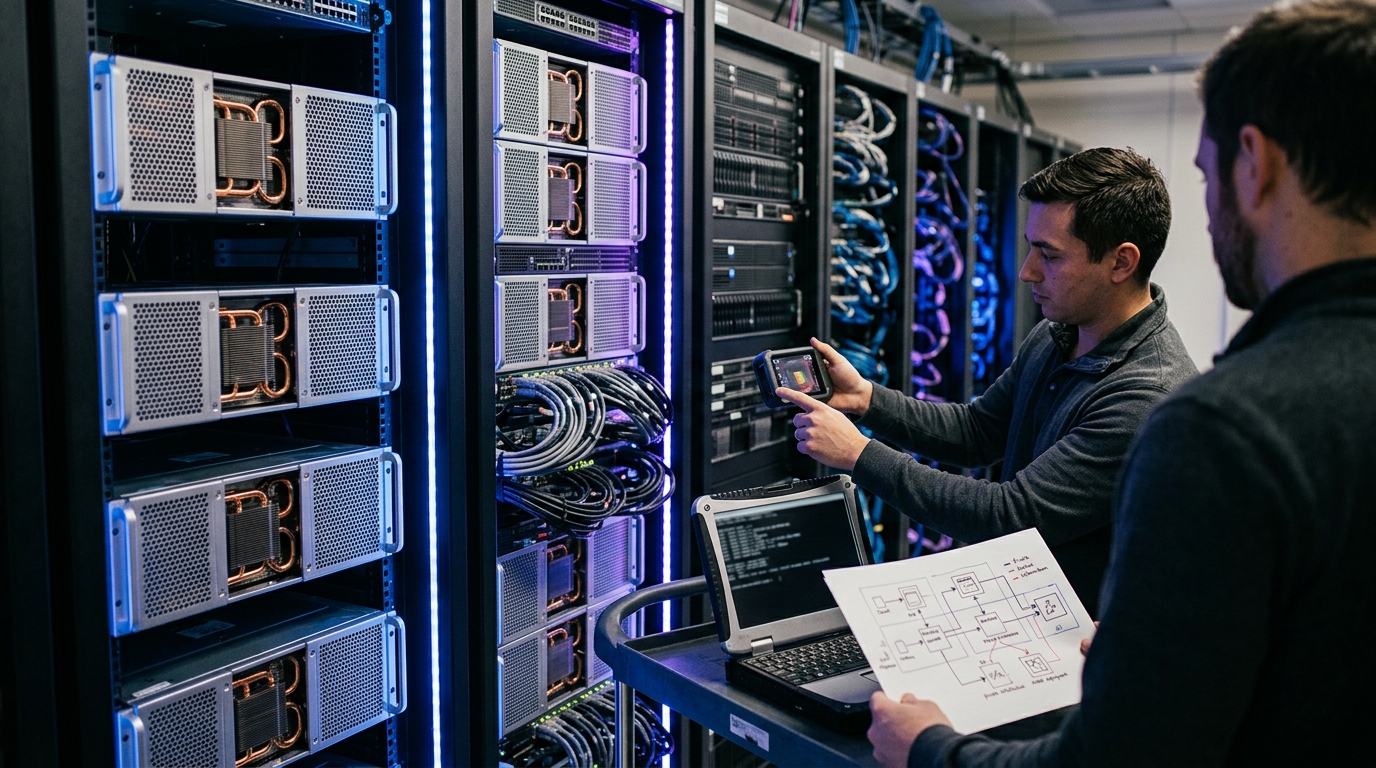
In 2024, the cloud was the only place to build AI; by 2026, it has become the most expensive place to run it. Recent industry data suggests that over 72% of mid-to-large enterprises have initiated or completed a move of their generative AI workloads from public clouds to private environments. The primary driver? A lethal combination of skyrocketing inference costs, data sovereignty concerns, and the realization that AI cloud repatriation platforms have finally matured enough to offer cloud-like agility on-premise.
If you are currently paying a 400% markup on NVIDIA H100 instances or watching your proprietary data leak into public training sets, it is time to look at the private AI infrastructure 2026 landscape. This guide breaks down the elite platforms enabling the shift from public model-as-a-service to self-hosted, sovereign intelligence.
- The Great AI Exodus: Why Repatriation is Trending
- What Defines a True AI-Native Repatriation Platform?
- 1. NVIDIA AI Enterprise: The Gold Standard
- 2. VMware Private AI Foundation: The Enterprise Bridge
- 3. Red Hat OpenShift AI: The Sovereign Kubernetes Champion
- 4. Dell APEX with Enterprise AI: Full-Stack Simplicity
- 5. HPE GreenLake for LLMs: Consumption-Based On-Prem
- 6. Run:ai (by NVIDIA): The Orchestration Powerhouse
- 7. Vultr Sovereign Cloud: The Hybrid Compromise
- 8. Canonical Ubuntu AI: The Open-Source Architect
- 9. Nebius AI: High-Performance Bare Metal
- 10. Nutanix GPT-in-a-Box: The Hyperconverged Choice
- The Hardware Layer: Best Hardware for Private AI
- Step-by-Step: Cloud to On-Prem AI Migration
- Economic Analysis: Cloud vs. Private AI TCO
- Key Takeaways
- Frequently Asked Questions
The Great AI Exodus: Why Repatriation is Trending
The honeymoon phase with public cloud AI is officially over. While AWS Bedrock and Azure OpenAI provided the perfect sandbox for 2023–2024 experimentation, the transition to production-scale LLMs has exposed a massive fiscal and security gap. AI cloud repatriation platforms are no longer a niche for hardware enthusiasts; they are a strategic necessity for the Fortune 500.
There are three main catalysts driving this trend: 1. The Inference Tax: As user bases grow, the cost of API-based inference scales linearly, whereas on-premise hardware costs are largely fixed. 2. Data Gravity and Sovereignty: Regulations like the EU AI Act have made it legally risky to process sensitive customer data on servers owned by third parties. 3. Latency for RAG: Retrieval-Augmented Generation (RAG) requires tight integration between your vector database and your LLM. If your data is on-prem but your model is in the cloud, the latency kills the user experience.
"We saw a 60% reduction in TCO by moving our Llama-3.1 70B inference from a major cloud provider to our own liquid-cooled racks," says a lead DevOps engineer on a prominent Reddit r/MachineLearning thread. This sentiment is echoed across the industry as enterprise AI sovereignty tools become more accessible.
What Defines a True AI-Native Repatriation Platform?
Not every server management tool is an AI platform. To successfully move from a cloud environment like SageMaker to an on-premise setup, your platform must handle the unique complexities of the private AI infrastructure 2026 stack.
Key features to look for include: - GPU Virtualization & Partitioning: The ability to slice a single H100 into multiple instances (MIG) or aggregate multiple GPUs for large model training. - Model Catalog Integration: Native support for Hugging Face, vLLM, and Triton Inference Server. - Automated Scaling: Bringing cloud-like elastic scaling to your local hardware clusters. - Security Hardening: Built-in tools for model weight encryption and secure enclaves.
1. NVIDIA AI Enterprise: The Gold Standard
NVIDIA is no longer just a chipmaker; they are the primary software layer for on-premise LLM hosting tools. NVIDIA AI Enterprise is the operating system for the modern data center. It provides the frameworks, libraries, and pretrained models necessary to replicate the cloud experience locally.
By using NIM (NVIDIA Inference Microservices), developers can deploy models in containers that are optimized for specific hardware configurations. This eliminates the "it worked on my machine" problem when moving from a developer's workstation to a production cluster.
Best for: Organizations that want the highest possible performance and are already invested in the NVIDIA ecosystem.
2. VMware Private AI Foundation: The Enterprise Bridge
VMware (now part of Broadcom) partnered with NVIDIA to create the Private AI Foundation. This platform is designed for the thousands of companies that already run their business on vSphere. It allows IT admins to manage GPUs with the same tools they use for virtual machines.
This platform is a leader in cloud to on-prem AI migration because it minimizes the learning curve for existing IT staff. You don't need a PhD in Kubernetes to get started; you just need your existing VMware dashboard.
3. Red Hat OpenShift AI: The Sovereign Kubernetes Champion
For those who prefer open-source flexibility with enterprise-grade support, Red Hat OpenShift AI is the premier choice. It provides a consistent hybrid cloud experience, meaning you can train in the cloud and deploy on-premise seamlessly.
OpenShift AI excels at enterprise AI sovereignty tools by providing a completely transparent stack. It includes integrated Jupyter notebooks, model serving via KServe, and powerful monitoring tools to ensure your private LLMs are performing as expected.
4. Dell APEX with Enterprise AI: Full-Stack Simplicity
Dell has pivoted aggressively toward AI. Their APEX offering allows companies to "lease" AI infrastructure that sits in their own data center but is managed like a cloud service. This is the "as-a-service" model applied to on-premise hardware.
Dell’s partnership with Meta (Llama) and Hugging Face ensures that their hardware comes pre-validated for the most popular open-weights models. If you want a "turnkey" solution for private AI infrastructure 2026, Dell is a top contender.
5. HPE GreenLake for LLMs: Consumption-Based On-Prem
HPE GreenLake offers a similar value proposition to Dell but with a stronger focus on high-performance computing (HPC) heritage. Their "GreenLake for LLMs" provides access to massive Cray supercomputing power on a consumption basis.
For companies dealing with massive datasets—think climate modeling or genomic sequencing—HPE provides the scale that standard enterprise servers cannot match. It is a critical player in the AI cloud repatriation platforms market for heavy-duty R&D.
6. Run:ai (by NVIDIA): The Orchestration Powerhouse
Recently acquired by NVIDIA, Run:ai specializes in GPU orchestration. In a typical cloud environment, GPU utilization is often inefficient. Run:ai fixes this on-premise by creating a pooled resource of all your GPUs.
It allows for "fractional GPU" usage, meaning a researcher can take 10% of a GPU for testing, while a production model takes the other 90%. This level of efficiency is what makes the ROI of on-premise LLM hosting tools actually work.
yaml
Example Run:ai GPU Allocation Policy
apiVersion: run.ai/v1 kind: GPUProject metadata: name: research-team spec: gpuQuota: 8 allowFractionalGpu: true priority: High
7. Vultr Sovereign Cloud: The Hybrid Compromise
Vultr has carved out a niche by offering "Sovereign Cloud" locations. While technically a provider, they allow you to deploy dedicated bare-metal GPU clusters in specific geographic regions with no shared infrastructure.
This is a form of "managed repatriation" where you get the benefits of data center management without the overhead of building your own facility. It’s an excellent middle ground for cloud to on-prem AI migration.
8. Canonical Ubuntu AI: The Open-Source Architect
If your goal is to avoid vendor lock-in at all costs, Canonical (the makers of Ubuntu) offers a complete AI stack built on MicroK8s, Kubeflow, and MLFlow. Their "Charmed Kubeflow" distribution is one of the most stable ways to run a private AI stack.
Canonical focuses on the long-term maintainability of the stack. Because it is built on standard Ubuntu, it is compatible with almost every hardware accelerator on the market, not just NVIDIA.
9. Nebius AI: High-Performance Bare Metal
Nebius is a rising star in the AI infrastructure space, focusing on ultra-high-speed networking (InfiniBand) which is crucial for multi-node training. While they offer cloud services, their architectural blueprints for best hardware for private AI are industry-leading.
They specialize in "AI-ready" data center designs that handle the extreme heat and power requirements of the Blackwell (B200) generation of chips.
10. Nutanix GPT-in-a-Box: The Hyperconverged Choice
Nutanix simplifies the private AI infrastructure 2026 by treating AI like any other workload in their hyperconverged infrastructure (HCI). "GPT-in-a-Box" is a software-defined solution that includes everything from the storage layer (optimized for vector DBs) to the model management UI.
It is particularly well-suited for edge AI applications where you need to run inference in a factory or a hospital without a full IT team on-site.
The Hardware Layer: Best Hardware for Private AI
Software is only half the battle. To successfully repatriate, you need the right "iron." In 2026, the market has expanded beyond just the H100.
| Hardware Component | Recommended Option | Why It Matters |
|---|---|---|
| Primary GPU | NVIDIA B200 (Blackwell) | 20x performance increase for LLM inference over H100. |
| Alternative GPU | AMD Instinct MI325X | Massive 288GB HBM3E memory for running huge models on fewer chips. |
| Networking | NVIDIA Quantum-2 InfiniBand | Low latency is non-negotiable for distributed training. |
| Storage | Pure Storage FlashBlade//S | AI training requires massive parallel read speeds (checkpointing). |
| CPU | AMD EPYC 9004 Series | High PCIe lane count to support multiple GPUs per socket. |
Selecting the best hardware for private AI requires balancing your specific model size against your power budget. A single rack of B200s can pull over 100kW, necessitating specialized cooling solutions.
Step-by-Step: Cloud to On-Prem AI Migration
Moving your AI stack isn't as simple as a git clone. Follow this high-level framework for a successful cloud to on-prem AI migration:
- Audit Data Gravity: Identify where your primary data resides. If your customer data is in an on-prem SQL database, moving the AI next to it will eliminate egress fees.
- Containerize Everything: Use Docker or Apptainer to wrap your models, dependencies, and inference engines (like vLLM).
- Benchmark in the Cloud: Run a final performance test in the cloud to establish a baseline for latency and throughput.
- Set Up the Orchestration Layer: Deploy a tool like Run:ai or OpenShift on your local hardware.
- Establish a Model Registry: Use a local instance of MLFlow or Hugging Face TGI to manage model versions.
- Implement a Hybrid Phase: Keep the cloud as a failover (burst capacity) while you ramp up local production.
Economic Analysis: Cloud vs. Private AI TCO
Is it actually cheaper to build your own? For small-scale testing, no. For production, yes.
Consider an enterprise running a Llama-3 405B model for internal RAG. In the cloud, a cluster of 8x H100s might cost $30,000–$40,000 per month. Over three years, that is $1.08M–$1.44M.
A physical server with the same specs costs roughly $350,000 upfront. Even with power, cooling, and maintenance, the AI cloud repatriation platforms pay for themselves in less than 14 months.
Key Takeaways
- Cost is the primary driver: Repatriation is fueled by the desire to escape the linear scaling of cloud inference costs.
- NVIDIA is the leader, but not the only choice: While NVIDIA AI Enterprise is the most mature, Red Hat and VMware offer better integration for existing IT teams.
- Hardware matters: The shift to Blackwell (B200) and AMD MI325X is making on-premise AI more powerful than ever.
- Data Sovereignty is a competitive advantage: Being able to tell customers their data never leaves your four walls is a massive selling point in 2026.
- Hybrid is the reality: Most companies will keep a "cloud burst" capability while running 90% of their steady-state AI on-premise.
Frequently Asked Questions
What are AI cloud repatriation platforms?
AI cloud repatriation platforms are software suites designed to help organizations move their artificial intelligence workloads (like LLM training and inference) from public clouds back to private data centers or on-premise hardware. They provide cloud-like management tools for local GPU clusters.
Is it hard to maintain private AI infrastructure in 2026?
While it requires more specialized knowledge than using a cloud API, modern platforms like VMware Private AI and Nutanix GPT-in-a-Box have automated much of the complexity. However, you will still need expertise in power management and high-speed networking.
Which is the best hardware for private AI?
Currently, the NVIDIA B200 (Blackwell) is the performance leader for inference and training. However, the AMD Instinct MI325X is a strong contender for organizations that need massive amounts of VRAM for large language models at a potentially lower price point.
How much can I save by moving AI on-premise?
Most enterprises report a 40% to 70% reduction in Total Cost of Ownership (TCO) over a three-year period when moving high-utilization AI workloads from the cloud to a private AI stack.
Can I still use open-source models on these platforms?
Yes, almost all AI cloud repatriation platforms are built specifically to host open-weights models like Llama-3, Mistral, and Falcon. They often include optimized kernels to run these models faster than generic cloud instances.
Conclusion
The shift toward AI cloud repatriation platforms represents the natural maturation of the enterprise AI market. In the early days, speed-to-market was everything, and the cloud was the fastest path. Today, sustainability, security, and cost-efficiency are the priorities.
By investing in a robust private AI stack, you aren't just saving money—you are gaining full control over your organization's most valuable asset: its intelligence. Whether you choose the turnkey simplicity of Dell APEX or the open-source power of Red Hat OpenShift, the move toward AI sovereignty is the most important infrastructure decision you will make this decade.
If you're ready to take control of your AI future, start by auditing your current cloud spend and exploring how these enterprise AI sovereignty tools can fit into your 2026 roadmap.


