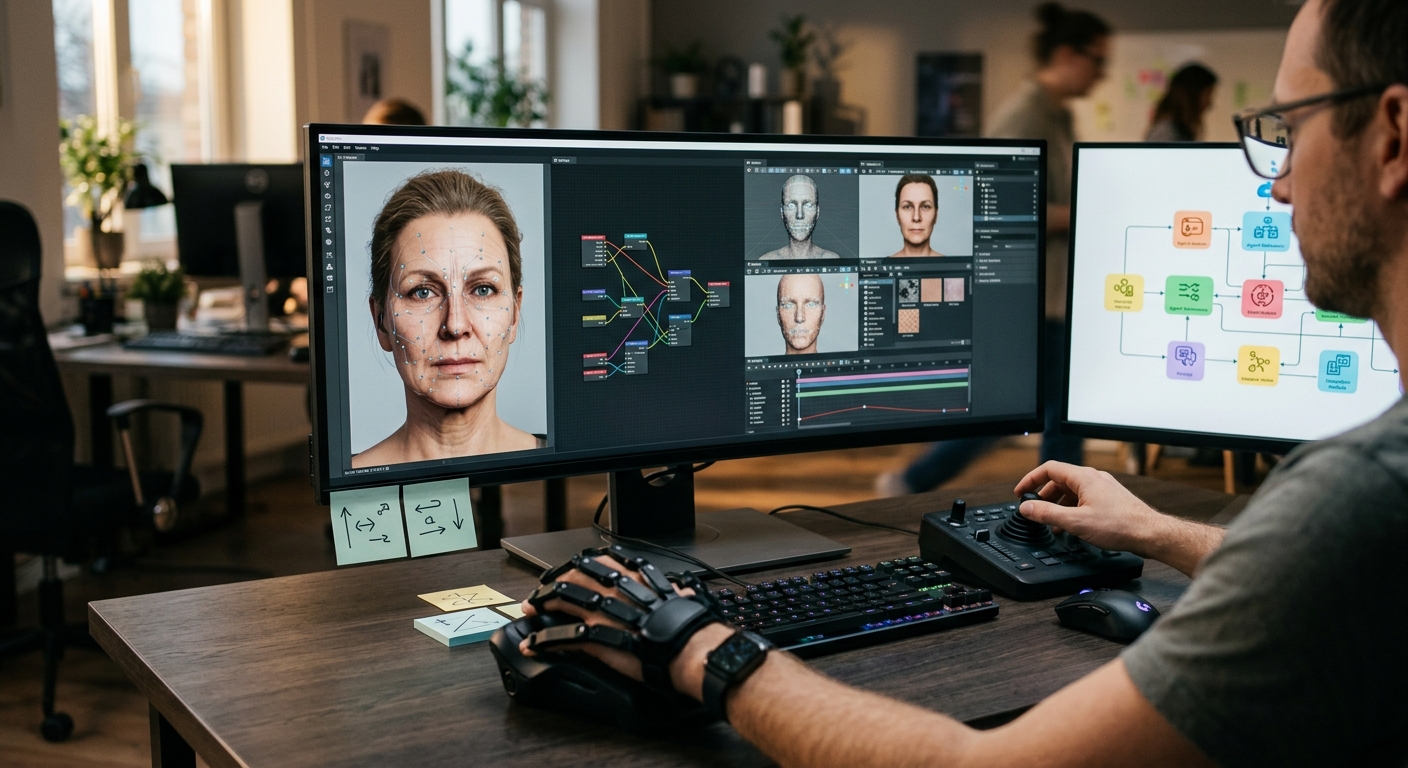
Organizations using interactive AI avatars in 2026 are reporting a staggering 300% increase in customer engagement compared to traditional text-based chatbots. As we move deeper into the era of spatial computing and autonomous agents, the demand for a high-performance AI digital human SDK has shifted from 'experimental' to 'mission-critical.' With the sudden exit of industry pioneer Soul Machines in February 2026, the landscape has consolidated around a few elite providers capable of delivering sub-second latency and emotionally intelligent CGI.
If you are a developer or product leader looking to build the next generation of interactive 3D agents, you need more than just a 'talking head'—you need a robust framework that handles LLM orchestration, real-time animation, and multi-platform deployment. This guide breaks down the best digital human API 2026 options to help you navigate the 'uncanny valley' and deliver real ROI.
The CGI vs. Deepfake Divide: Choosing Your Tech Stack
Before selecting a real-time avatar SDK, you must understand the fundamental technological split: CGI vs. Deepfake. In 2026, the choice usually depends on whether you value 'conversation' or 'content.'
CGI-Powered Digital Humans (Real-Time Interactive) These agents are built using game engines like Unreal Engine 5. They respond in real-time with sub-second latency. Because they are artist-designed, they successfully avoid the 'uncanny valley' by not trying to be too photorealistic, focusing instead on emotional resonance and micro-expressions. - Best for: Customer experience (CX), brand ambassadors, immersive training. - Key Advantage: Genuine two-way dialogue.
Deepfake-Based AI Avatars (Pre-recorded & Beta Interactive) Platforms like Synthesia and HeyGen use neural networks to synthesize video from human likenesses. While historically used for one-way video, their 2026 'Interactive API' offerings are bridging the gap, though they often struggle with the 'uncanny valley' effect in high-stakes environments. - Best for: Scalable video production, social media content, low-cost internal training. - Key Advantage: Rapid deployment from a single photo or video clip.
1. UneeQ: The Enterprise Gold Standard for Synanim™ Animation
UneeQ has emerged as the primary active steward of the original real-time CGI vision. Following the wind-down of Soul Machines, UneeQ’s AI digital human SDK is the most mature option for enterprises like Qatar Airways and Deutsche Telekom.
Their proprietary Synanim™ animation technology allows for lifelike facial expressions that are procedurally generated based on the sentiment of the LLM response. This isn't just lip-sync; it’s emotional intelligence in 3D.
"UneeQ reports 95% training effectiveness compared to 20-30% for traditional e-learning. Their City of Amarillo deployment saw 98% user satisfaction and $1.8M in projected annual savings."
Key Features: - LLM-Agnostic: Plug in Claude 3.5, GPT-5, or your own fine-tuned Llama 4 model. - Sub-Second Latency: Critical for maintaining the flow of human conversation. - SOC 2 Type II & GDPR Compliant: Essential for the 'Fortune 100' security protocols mentioned in recent developer discussions.
2. NVIDIA ACE: The Infrastructure Powerhouse for Digital Humans
If you are looking for NVIDIA ACE alternatives, you’ll find that few can match NVIDIA’s raw infrastructure. NVIDIA ACE (Avatar Cloud Engine) is a suite of digital human technologies that includes Riva for speech, Audio2Face for animation, and Nemotron for LLM logic.
In 2026, ACE is less of a 'plug-and-play' SDK and more of a 'build-your-own' toolkit for high-end developers. It is the backbone for many other 3D agent SDKs on this list.
Why choose NVIDIA ACE? - Edge Deployment: Run digital humans locally on RTX-powered kiosks for zero-latency interactions. - Microservices Architecture: Only use the components you need (e.g., just Audio2Face if you have your own speech-to-text stack). - Ray-Traced Realism: The highest visual fidelity possible in Unreal Engine 5.
3. Inworld AI: The Leader in Autonomous Character Logic
Inworld AI has moved beyond gaming into the enterprise sector, offering a 3D agent SDK that focuses on 'Character Brains.' While UneeQ excels at the 'Body' (animation), Inworld excels at the 'Mind' (memory, personality, and goal-oriented behavior).
Key Features: - Long-term Memory: Characters remember previous interactions across sessions, a feature highly requested in Reddit's r/AI_Agents community. - Safety Filters: Robust NSFW and brand-safety layers that work with 100% accuracy, unlike some video-gen platforms. - Scene Intelligence: The avatar knows its 3D environment and can point to objects or move to specific locations.
4. Microsoft Copilot Studio & AutoGen: Multi-Agent Orchestration
For teams deep in the Microsoft ecosystem, Microsoft Copilot Studio is the most logical best digital human API 2026 candidate. By leveraging the AutoGen framework, developers can build 'crews' of agents that work together to power a single 3D avatar.
Comparison Table: Enterprise Readiness
| Feature | UneeQ | Microsoft Copilot | NVIDIA ACE |
|---|---|---|---|
| Primary Tech | CGI / Synanim | LLM / Multi-Agent | Microservices / RTX |
| Deployment | Web, App, Kiosk | Azure / M365 | Cloud / Edge |
| Ease of Use | High (White Glove) | Medium (Low-code) | Low (Technical) |
| Security | SOC 2 Type II | Enterprise Grade | Developer Defined |
5. Voiceflow: The Low-Code Bridge to Interactive Avatars
Voiceflow has become the 'Figma for Conversational AI.' While it isn't a 3D engine itself, its real-time avatar SDK integrations allow you to design complex conversation flows and push them directly to a UneeQ or NVIDIA ACE avatar.
Pros: - Visual drag-and-drop builder. - Real-time testing and version control. - Massive community of 'vibe coders' and prompt engineers.
6. HeyGen Interactive API: The Deepfake-to-Realtime Contender
HeyGen’s Interactive AI avatars have made massive strides in 2026. Using their 'Avatar IV' technology, they have reduced the latency of deepfake video generation to near-real-time levels. While it still lacks the spatial awareness of CGI, it is the best choice for those who need a digital twin of a specific real-world executive.
Cons: - Uncanny Valley Risk: As noted in Reddit research, deepfake avatars can trigger trust concerns if the lip-sync or micro-expressions glitch. - Limited Immersion: You cannot easily have a HeyGen avatar pick up a 3D object or walk around a virtual store.
7. Botpress: Customizing Technical 3D Agents
Botpress is the preferred choice for developers who want a 'technical' best digital human API 2026. It provides an open-source composable framework that integrates seamlessly with 3D engines.
Developer Insight:
"Botpress enables us to test, deploy, and iterate agents in real time. We use it to handle the logic layer, then pipe the output to Unreal Engine for the visual representation."
8. Jotform AI Agents: Streamlining Data-Driven Interactions
If your digital human’s primary job is data collection or lead generation, Jotform AI Agents provide a specialized SDK. It transforms boring forms into conversational 3D experiences. This is particularly useful for 'Kiosk Agents' in retail or 'Hospice Care Coordinator Agents' in healthcare where structured data is vital.
9. Mursion: Human-in-the-Loop Training SDKs
Mursion offers a unique 'Simulation Specialist' approach. Their SDK allows for a hybrid model where AI handles the basic interaction, but a human can 'jump in' to handle complex emotional nuances during high-stakes training (like DE&I or leadership coaching).
10. Virti: VR-First Immersive Learning Agents
Virti is the go-to 3D agent SDK for Virtual Reality. Their virtual humans are optimized for Quest 4 and Apple Vision Pro 2, focusing on 'Virtual Human' roleplay for healthcare and sales. They prioritize 'functional realism' over photorealism to ensure high performance on mobile VR chipsets.
The Developer Workflow: Using Claude Code and Gemini CLI
In 2026, building with an AI digital human SDK rarely happens in a vacuum. Industry research shows that the 'bottleneck' is often the person, not the model. To accelerate development, top engineers are using a specific stack:
- Orchestration: Claude Code is currently the 'Senior Developer' of choice for writing the complex logic required to sync LLM streams with animation frames.
- Context Management: Gemini Pro 3.0 is used via CLI for its massive 2M+ context window, allowing developers to feed an entire 3D project’s codebase and documentation into the AI for debugging.
- Vibe Coding: The rise of 'vibe coding' means that even non-technical PMs are using tools like Cursor and Replit Agent to scaffold the initial API connections between the avatar and the database.
javascript // Conceptual Digital Human Stream Initialization import { DigitalHumanSDK } from '@uneeq/synanim-sdk';
const avatar = new DigitalHumanSDK({ apiKey: process.env.DIGITAL_HUMAN_API_KEY, avatarId: 'enterprise-ambassador-01', llm: 'claude-3-5-sonnet', voiceId: 'eleven-labs-professional-01' });
avatar.on('speech_start', () => { console.log('Avatar is generating Synanim micro-expressions...'); });
await avatar.startSession();
Key Takeaways
- CGI is King for CX: For 24/7 customer-facing brand ambassadors, CGI-based SDKs like UneeQ are superior to deepfakes due to trust and lack of 'uncanny valley' triggers.
- Latency Matters: A response time of over 1.5 seconds kills the illusion of life. Look for SDKs with sub-second real-time avatar SDK capabilities.
- LLM Agnostic is Safer: Avoid vendor lock-in. Choose an SDK that allows you to swap GPT-5 for Claude or a local Llama model as the market evolves.
- ROI is Proven: The City of Amarillo case study ($1.8M savings) proves that digital humans are now a viable cost-cutting and revenue-generating tool.
- Developer Tools have Evolved: Use Claude Code and Gemini CLI to manage the integration of these complex SDKs into your existing tech stack.
Frequently Asked Questions
What is the difference between a digital human and an AI avatar?
In 2026, 'digital human' usually refers to a real-time, interactive 3D character powered by a CGI engine (like Unreal Engine). 'AI avatar' often refers to deepfake-based video presenters (like Synthesia) that are primarily used for one-way content creation, though the lines are blurring as video-gen APIs become faster.
Which AI digital human SDK is best for small businesses?
For small businesses with limited budgets, HeyGen or D-ID offer the best digital human API 2026 entry points. They allow you to create an avatar from a photo and use a self-service platform. For enterprise-grade security and quality, UneeQ is the preferred choice.
Can I run a digital human SDK locally (On-Premise)?
Yes. NVIDIA ACE and UneeQ offer hybrid or on-premise deployment options. This is critical for industries with strict data privacy requirements, such as healthcare or finance, where sending data to a public cloud is not permitted.
How long does it take to build an interactive 3D agent?
Using a low-code platform like Voiceflow combined with a stock avatar from UneeQ, you can deploy a 'Proof of Concept' in days. A fully bespoke, artist-designed brand ambassador typically takes 3 to 6 months to perfect facial rigging and brand-specific micro-expressions.
What is the 'Uncanny Valley' and why should I care?
The uncanny valley is the psychological discomfort humans feel when a digital character looks almost human but has slight glitches in its eyes or mouth movements. In a business context, this triggers 'distrust,' which can lead to lower conversion rates. CGI digital humans avoid this by using stylized but emotionally accurate animation.
Conclusion
The choice of an AI digital human SDK in 2026 will define your brand's digital presence for the next decade. As the market moves away from simple text bots toward 'embodied AI,' the winners will be those who prioritize sub-second latency, emotional intelligence, and enterprise-grade security.
Whether you choose the raw power of NVIDIA ACE, the white-glove enterprise excellence of UneeQ, or the agile orchestration of Voiceflow, the goal remains the same: creating a human-centric interface for an AI-driven world. Start by defining your use case—if it’s high-stakes customer trust, go CGI. If it’s high-volume video content, go deepfake. The tools are ready; it's time to build.