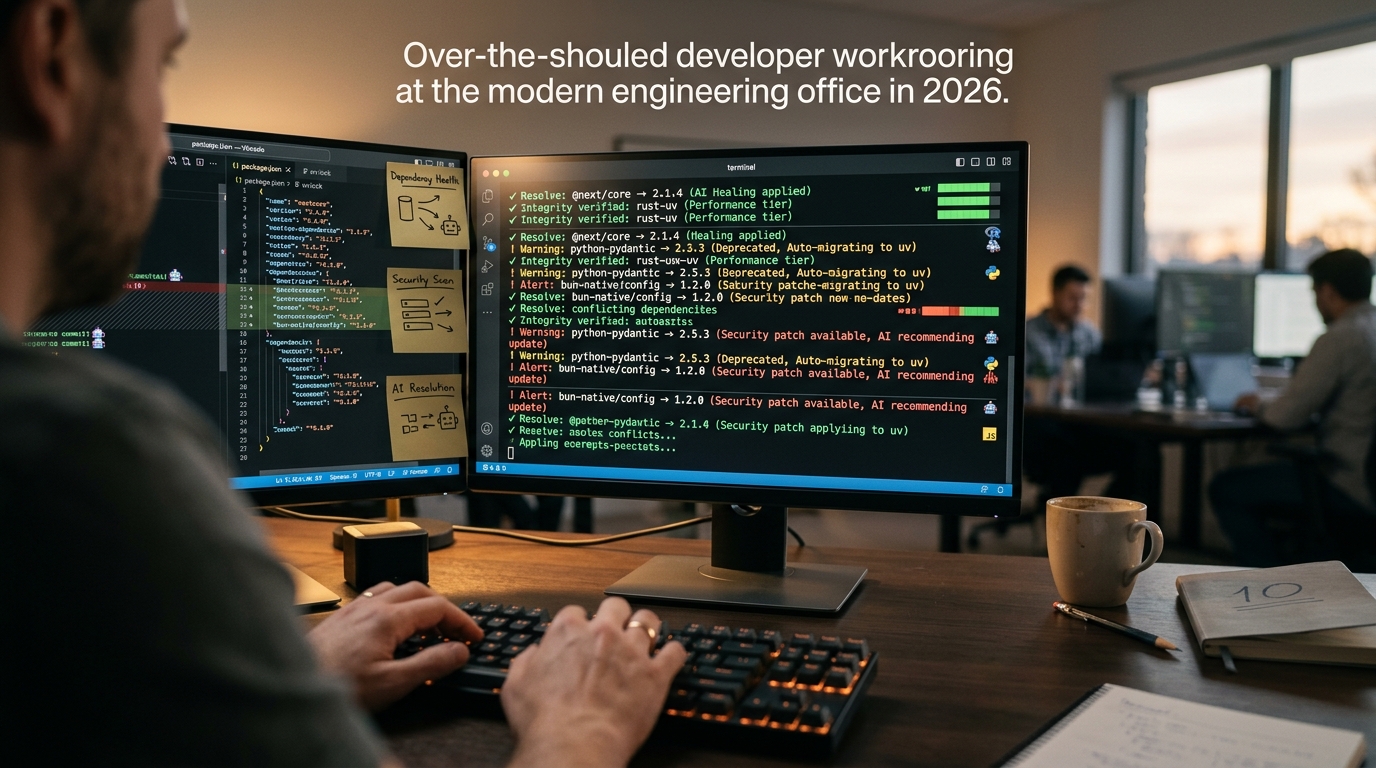
In 2025, a seismic shift occurred in the GitHub Language Report: TypeScript officially overtook Python in terms of developer activity. This wasn't just a win for front-end enthusiasts; it signaled the birth of the agentic frontend development stack. By 2026, 92.6% of developers are using AI assistants, and over 26% of production code is AI-generated. The traditional 'glue code' era of Next.js and Remix is being challenged by a new breed of AI-native web frameworks designed specifically for LLM orchestration, generative UI, and low-token-count maintainability. If you are still building AI apps by stitching together raw fetch calls and manual state management, you are already behind.
The Rise of the AI-Native Web Architecture
For years, we treated AI as an 'add-on'—a simple API endpoint called from a standard React component. But in 2026, the AI-first web architecture has moved the goalposts. Modern frameworks must now handle non-deterministic outputs, multi-step agentic workflows, and real-time streaming as first-class citizens.
As noted in recent Reddit discussions on r/AI_Agents, the biggest challenge isn't just calling an LLM; it's managing long-running state and failure retries when an agent hangs mid-task. Traditional frameworks like Next.js, while powerful, often feel 'clunky' when managing complex multi-step logic. We are moving toward a 'vibe coding' era where the framework's primary job is to provide a 'bird's-eye view' for AI coding assistants like Cursor and Claude Code to reason about the entire stack without hallucinating glue code.
1. Vercel AI SDK: The Streaming-First Standard
If you're building in the React ecosystem, the Vercel AI SDK remains the primary keyword in your vocabulary. It has evolved from a simple hook library into a comprehensive toolkit for generative UI web frameworks.
Why it's a Top Pick for 2026
- Unified Provider API: Switch between OpenAI, Anthropic, and Google Gemini with a single line of code.
- Structured Outputs: Using
generateObject, developers can force LLMs to return type-safe JSON that maps directly to UI components. - Streaming Primitives: The SDK handles the complexities of partial text rendering and progressive UI updates out of the box.
"Vercel AI SDK works really well with Next.js. Streaming is super easy and smooth. But it starts feeling clunky when you need more complex multi-step agent logic." — Reddit user in r/AI_Agents
For developers seeking Next.js 17 alternatives for AI, the SDK is still highly portable, but its deepest optimizations remain within the Vercel edge runtime.
2. Mastra: Production-Grade TypeScript Agents
While the Vercel SDK handles the 'view,' Mastra handles the 'brain.' Mastra is a TypeScript-native framework built specifically for the production requirements of 2026: type safety, observability, and deterministic workflows.
Core Features
- Built-in RAG: Native abstractions for vector stores like Pinecone and Qdrant.
- Agentic Workflows: A workflow engine that handles multi-agent coordination without the 'spaghetti code' often found in LangChain implementations.
- Tracing & Observability: Every step of an agent's thought process is logged, making it the best web framework for AI agents 2026 when debugging complex failures.
Mastra stands out because it treats state persistence as a first-class feature, addressing the common complaint that most frameworks 'die in weird ways' when a server restarts mid-run.
3. Reflex: The Pure Python Full-Stack Disruptor
Reflex (formerly Pynecone) is the ultimate answer for teams that want to avoid the 'two-language problem.' By allowing developers to build full-stack apps in pure Python, Reflex eliminates the context-switching that causes AI coding assistants to hallucinate.
The AI Governance Advantage
Reflex is built on the premise that AI tools reason better when they only have to look at one language. In a split-stack (React + FastAPI), an AI agent often struggles to coordinate the REST API between the two. Reflex provides 60+ built-in components that the AI can simply 'compose.'
| Feature | Reflex | Traditional (Next.js + Python) |
|---|---|---|
| Language | Pure Python | TS + Python |
| Token Usage | Low (Single Codebase) | High (Coordination Overhead) |
| Hallucination Risk | Minimal | High |
| Stars | 28k+ | N/A |
Reflex is currently used by 40% of Fortune 500 companies for internal AI tools because it allows data science teams to ship production UIs without hiring a dedicated frontend engineer.
4. Wasp: The Declarative AI-Coding King
Wasp is a unique full-stack framework that uses a declarative .wasp config file to describe your app's soul. Because the config file gives AI a 'bird's-eye view' of the entire application, it has the lowest token count for generating working features.
Why AI Assistants Love Wasp
- Zero Boilerplate: Auth, background jobs, and database schemas are defined in a few lines of config.
- Full-Stack Type Safety: Types flow from the Prisma schema through the Node.js backend to the React frontend automatically.
- Vibe Coding Optimized: In benchmarks, Wasp requires significantly fewer tokens to implement features like 'Google Auth' or 'Stripe Integration' compared to Next.js.
As one contributor on r/FullStack noted: "Wasp rated highest... the config file gives AI a bird's-eye view of the entire app, and there's less boilerplate for it to mess up."
5. LangGraph.js: Complex Agentic Orchestration
For developers building a complex agentic frontend development stack, LangGraph.js is the industry standard for stateful, multi-actor applications. Unlike linear chains, LangGraph allows for loops and conditional logic, which are essential for 'researcher' or 'coder' agents that need to self-correct.
Key Capabilities
- Cycles & Loops: Agents can iterate on a task until a specific quality threshold is met.
- Persistence: Built-in check-pointing allows agents to 'sleep' and resume later.
- Human-in-the-loop: Easily pause execution to wait for a user's approval before a critical tool call.
While it has a steeper learning curve than Mastra, LangGraph.js is the most powerful tool for building 'autonomous' features that go beyond simple chat interfaces.
6. Arvo: The Breakthrough in Agentic Resumables
Arvo is the 'new kid on the block' that has taken the AI community by storm in early 2026. It introduces a concept called agentic resumables, which solves the biggest headache in AI development: long-running state.
The Arvo Edge
- Testing-First: Built-in primitives for testing non-deterministic agent outputs.
- Multi-Agent Coordination: Orchestrates dozens of agents as if they were a single system.
- Human Collaboration: It treats human input as just another 'node' in the graph, making it perfect for complex enterprise systems.
If you've ever had an agent fail at step 9 of a 10-step process and had to restart the whole thing (and pay the tokens again), Arvo is the solution you've been waiting for.
7. TanStack Start: The Next.js 17 Alternative
With the recent volatility in the Remix ecosystem (merging into React Router 7 and then pivoting away from React), many developers are flocking to TanStack Start. It is a full-stack React framework built on top of the legendary TanStack Router.
Why it's AI-Native
- Fine-Grained Control: Unlike Next.js, which hides a lot of 'magic' behind the App Router, TanStack Start is explicit. This explicitness makes it easier for AI agents to write correct code without guessing internal framework behavior.
- Type-Safe Everything: From search params to data loading, everything is strictly typed, reducing runtime hallucinations.
- SSR + SPA Hybrid: It offers the performance of SSR with the simplicity of a client-side SPA.
For those seeking a stable, high-performance Next.js 17 alternative for AI, TanStack Start is the most promising contender in the React space.
8. Astro 5.0: Islands Architecture for Generative UI
Astro has moved far beyond its roots as a static site generator. With Astro 5.0 and its 'Server Islands' architecture, it has become a powerhouse for generative UI web frameworks.
The Astro Advantage
- Zero JS by Default: Only ship JavaScript for the interactive AI components (the 'islands').
- Multi-Framework Support: Use React for your AI chat, Svelte for your dashboard, and Solid for your performance-critical bits—all in one project.
- Content Collections: Perfect for building RAG-based documentation sites or AI-powered knowledge bases.
Astro is the consensus choice for content-heavy AI applications where SEO and performance are non-negotiable.
9. Qwik: O(1) Resumability for AI Agents
In markets with varying network speeds (like Southeast Asia), Qwik offers a unique technical advantage: resumability. Traditional frameworks require 'hydration,' which can be slow for heavy AI-powered UIs. Qwik serializes the state into the HTML itself.
Why this matters for AI
- Instant TTI (Time to Interactive): Even a massive AI dashboard feels instant because there is zero hydration cost.
- Granular Lazy Loading: Qwik only downloads the code needed for the specific button the user clicks.
For developers building the next generation of AI-first web architecture 2026, Qwik ensures that the 'weight' of AI libraries doesn't kill the user experience.
10. Elysia + Bun: The High-Performance AI Backbone
If your AI app needs to handle 20,000 requests per second, you aren't using Express. You're using Elysia running on Bun. This stack is the cutting edge of JavaScript performance.
The Performance Stats
- 2-3x Throughput: Elysia consistently outperforms Express and even Fastify in raw API benchmarks.
- Native TypeScript: No build steps are required; Bun runs TS natively.
- Type-Safe Documentation: Automatically generates Swagger/OpenAPI docs from your code, which AI agents can then use to 'self-document' or 'self-integrate.'
Elysia is the 'engine' under the hood of many agentic frontend development stacks, providing the speed needed for real-time AI interactions.
Comparing the Best Web Frameworks for AI Agents 2026
Choosing a framework is no longer just about 'React vs. Vue.' It's about how the framework interacts with the AI that is writing it.
| Framework | Primary Language | Best For | AI Friendliness |
|---|---|---|---|
| Reflex | Python | Data Apps / Internal Tools | 10/10 (Single Language) |
| Wasp | TS / Node.js | Rapid Prototyping / SaaS | 10/10 (Declarative) |
| Mastra | TypeScript | Production Agents / RAG | 9/10 (Production-Ready) |
| TanStack Start | TypeScript | High-Perf React Apps | 8/10 (Explicit Types) |
| Vercel AI SDK | TypeScript | Generative UI / Chat | 9/10 (Streaming-First) |
Key Takeaways
- The Two-Language Problem is Real: Frameworks like Reflex are gaining ground because they allow AI to reason about a single codebase, reducing hallucinations.
- Declarative is Better for AI: Wasp proves that giving an AI a high-level configuration results in more stable code than imperative 'glue' code.
- State Persistence is the New Frontier: Frameworks like Mastra and Arvo are solving the 'hanging agent' problem with resumable workflows.
- Next.js is No Longer the Only Choice: While the Vercel AI SDK is dominant, frameworks like TanStack Start and Astro offer better stability and performance for specific AI use cases.
- TypeScript is the AI Backbone: Despite Python's dominance in ML models, TypeScript is now the preferred language for building the agentic frontend development stack.
Frequently Asked Questions
What is an AI-native web framework?
An AI-native web framework is built from the ground up to support LLM-specific requirements like streaming, non-deterministic state management, multi-agent orchestration, and generative UI primitives. Unlike traditional frameworks, they often prioritize low-token-count maintainability for AI coding assistants.
Is Next.js still good for AI apps in 2026?
Yes, Next.js remains a solid choice, especially when paired with the Vercel AI SDK. However, for complex multi-step agents or pure Python teams, frameworks like Mastra or Reflex offer more specialized features that reduce the 'clutter' of the App Router.
Why is Reflex considered better for AI than Django?
Reflex allows for a single-language full-stack (Python). In Django, you still need a separate JavaScript frontend. AI coding tools like Cursor struggle to coordinate the API layer between two languages, whereas in Reflex, they can see the entire stack in one context, leading to fewer errors.
What is 'agentic resumability'?
Agentic resumability, popularized by frameworks like Arvo, is the ability for an AI agent's state to be saved and resumed across server restarts or long pauses. This is critical for tasks that take minutes or hours to complete and require human-in-the-loop approval.
Which framework has the lowest token usage for AI coding?
Wasp currently leads in this category. Because it uses a declarative configuration file to define the app's structure, the AI assistant doesn't have to write (or read) hundreds of lines of boilerplate to implement standard features like authentication or database hooks.
Conclusion
The era of 'Next.js or nothing' is officially over. As we move into the heart of 2026, the best web framework for AI agents is the one that stays out of the way of your AI coding assistant while providing the robust state management your agents need.
Whether you choose the pure Python simplicity of Reflex, the declarative power of Wasp, or the production-grade reliability of Mastra, the goal remains the same: build an AI-first web architecture that is scalable, maintainable, and ready for the agentic future.
Ready to build your first agent? Start with a framework that understands the 'vibe' of 2026. Your token budget—and your sanity—will thank you. For more insights on developer productivity and the latest SEO tools for tech-first companies, stay tuned to our latest deep dives.