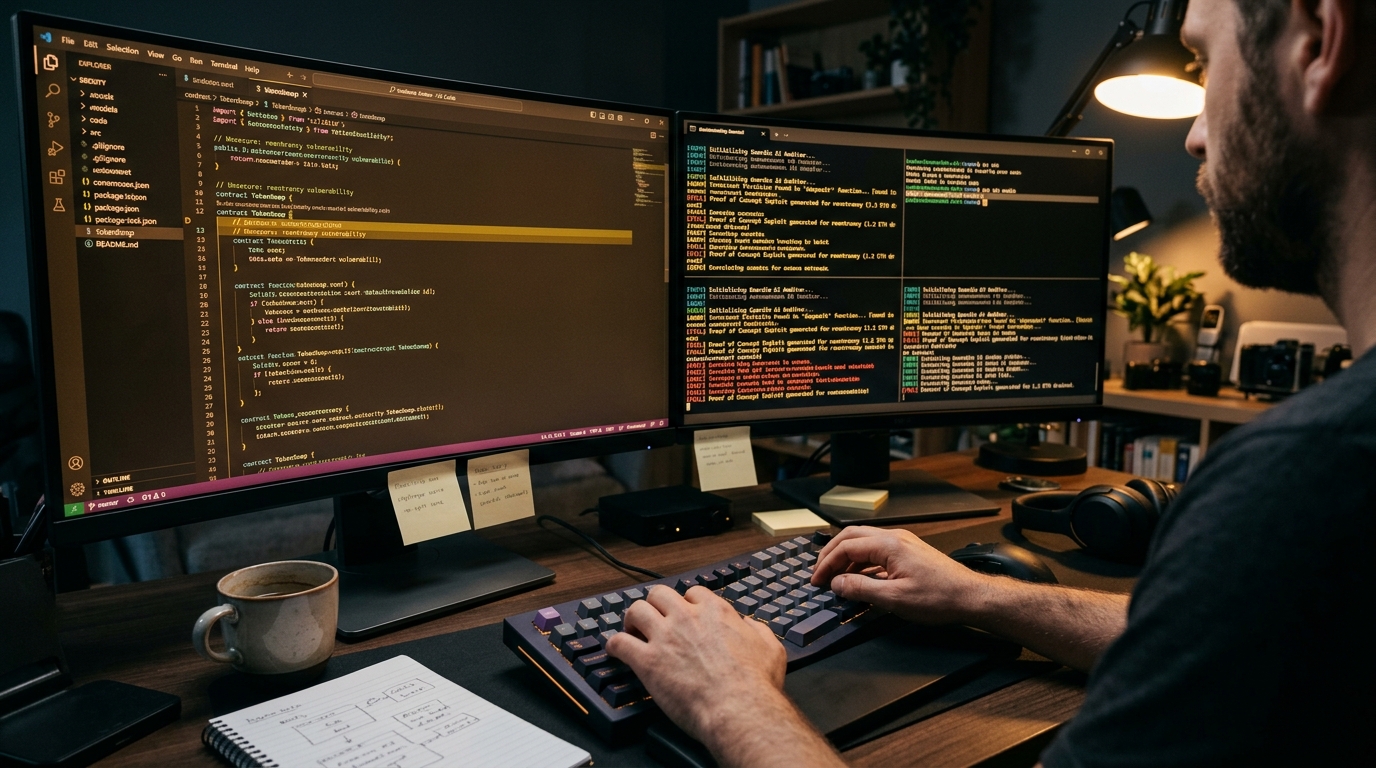
In 2023 alone, over $1.7 billion was siphoned from DeFi protocols due to preventable code vulnerabilities. By 2026, the stakes have scaled exponentially as autonomous AI agents now manage billions in TVL (Total Value Locked) across fragmented L2 and L3 ecosystems. The question is no longer if you should use an ai smart contract audit tool, but which autonomous auditor can actually detect the subtle economic trajectories that lead to a total drain. As Web3 moves from static code to dynamic, agent-led interactions, the security stack must evolve from simple pattern matching to deep adversarial simulation.
- The Evolution of Smart Contract Security: From Detection to Validation
- Top 10 AI Smart Contract Audit Tools for 2026
- Benchmarking Signal vs. Noise: Why EVMBench and Guardix Matter
- Foundry, Echidna, and the Rise of Invariant Testing
- Economic Exploits vs. Code Bugs: The 2026 Security Frontier
- Integrating AI Audits into the CI/CD Pipeline
- The Human-in-the-Loop: Why AI Auditors Still Need Senior Devs
- Key Takeaways
- Frequently Asked Questions
The Evolution of Smart Contract Security: From Detection to Validation
For years, the industry relied on "eyeballing" code and running basic static analyzers. If a tool flagged a reentrancy pattern, it was a win. But as Reddit's r/ethdev community has noted, we are seeing a massive shift from simple detection to automated validation. It is no longer enough for an ai solidity scanner to say, "This line looks risky." In 2026, the best tools generate a functional Proof of Concept (PoC) exploit to prove the vulnerability exists.
Traditional tools like Slither and Oyente laid the groundwork, but they often buried developers under a mountain of false positives. The new generation of web3 ai security tools uses symbolic execution and agentic reasoning to simulate how an attacker would actually extract profit. This "adversarial mindset" is critical because, as many post-mortems show, the code often behaves exactly as written, but the economic design allows for value extraction via pricing curves or liquidity shifts.
"Most audits are 'snapshots' of code safety, but economic exploits are 'trajectories' over time. In L2/L3 infra, I often see teams obsess over bridge code security but completely ignore the economic cost of liveness or DA congestion." — Industry Insight from Reddit r/CryptoTechnology
Top 10 AI Smart Contract Audit Tools for 2026
Choosing the right tool requires a balance of speed, depth, and integration capabilities. Below is the definitive list of the best smart contract audit tools 2026, categorized by their primary analysis engine.
1. Guardix.io (Best for Actionable Signal)
Guardix has gained significant traction in 2025 and 2026 by focusing on reducing "noise." Unlike legacy scanners that flag every public function as a potential risk, Guardix uses an autonomous smart contract auditor engine that validates findings against a fork of the mainnet. It doesn't just find bugs; it reproduces them.
- Core Strength: High signal-to-noise ratio and public benchmarking.
- Best For: Teams that need to move fast without triaging 500 false positives.
2. Slither (The Industry Standard Static Analyzer)
Built by Trail of Bits, Slither remains the foundation of any security pipeline. It is an open-source static analysis framework that runs in seconds. While it lacks the deep reasoning of newer AI agents, its ability to catch 80+ vulnerability patterns instantly makes it the perfect pre-commit hook.
- Core Strength: Speed and comprehensive pattern matching.
- Best For: CI/CD integration and catching "low-hanging fruit."
3. MythX (Deep Symbolic Execution)
ConsenSys’ MythX is the heavyweight of symbolic analysis. It explores all possible execution paths by treating inputs as mathematical symbols. In 2026, its cloud-based fuzzing has become more intelligent, allowing it to find complex reentrancy bugs that span multiple contracts.
- Core Strength: Deep path exploration and integration with Remix/Hardhat.
- Best For: Final-stage audits before mainnet deployment.
4. Certora (Formal Verification)
Certora doesn't just look for bugs; it proves their absence. By using the Certora Prover, developers can write "rules" (invariants) that the contract must follow. The tool then uses mathematical logic to check if those rules can ever be broken.
- Core Strength: Mathematical certainty for high-TVL protocols.
- Best For: Blue-chip DeFi protocols like Aave or Uniswap.
5. Echidna (The Fuzzing King)
Echidna is a Haskell-based fuzzer designed for Ethereum smart contracts. It uses property-based testing to generate millions of random transactions to see if any combination can break the contract's internal logic. In 2026, Echidna is often paired with AI agents to define more complex test invariants.
- Core Strength: Finding edge cases through brute-force simulation.
- Best For: Testing complex state transitions in DeFi.
6. Aderyn (The Rust/Solana Specialist)
With the explosion of Solana and Sui, Aderyn has emerged as the premier blockchain vulnerability detection tool for Rust-based contracts. It specifically targets the unique pitfalls of the Anchor framework and Solana's account model.
- Core Strength: Specialized for non-EVM chains and Rust.
- Best For: Solana and Aptos developers.
7. GoPlus AI Agent Security API
As Web3 AI agents (like those built on ElizaOS or Fetch.ai) become more common, GoPlus provides a real-time security API. It acts as a middleware that checks if a contract is a "honeypot" or has a "rug-pull" bytecode pattern before an AI agent interacts with it.
- Core Strength: Real-time, API-driven threat detection.
- Best For: Developers building autonomous trading agents.
8. Cyfrin Aderyn (Solidity Focus)
Cyfrin has expanded its suite to include a lightning-fast static analyzer that focuses on the most common developer mistakes. It’s highly opinionated and designed to be used alongside their world-class security courses.
- Core Strength: Developer-centric reporting and educational integration.
- Best For: Junior to mid-level devs looking to improve their security posture.
9. Forta Network (Post-Deployment Monitoring)
Security doesn't end at deployment. Forta uses decentralized AI bots to monitor every transaction on-chain. If it detects a "flash loan attack" pattern in real-time, it can trigger an emergency pause via a protocol's multisig.
- Core Strength: Real-time runtime protection.
- Best For: Live protocols with high TVL.
10. Sherlock (AI-Human Hybrid Platform)
Sherlock isn't just a tool; it's a marketplace that uses AI to pre-screen code before human "Watsons" (auditors) compete to find bugs. This hybrid approach ensures that the AI catches the basics while humans focus on the $10M logic flaws.
- Core Strength: Competitive auditing with AI-assisted screening.
- Best For: Projects ready for a full professional audit.
| Tool | Analysis Type | Speed | Best For |
|---|---|---|---|
| Guardix.io | Agentic / Validation | Medium | Actionable PoC Exploits |
| Slither | Static Analysis | Fast | Pre-commit Hooks |
| MythX | Symbolic / Fuzzing | Slow | Deep Vulnerability Scans |
| Certora | Formal Verification | Slow | Mathematical Invariants |
| Echidna | Fuzzing | Medium | State Machine Testing |
Benchmarking Signal vs. Noise: Why EVMBench and Guardix Matter
One of the biggest complaints in the developer community is the lack of public benchmarking. Every tool claims to find 99% of vulnerabilities, but as one Reddit user put it: "It usually becomes reputation + vibes + who has the best landing page."
In 2026, EVMBench has become the gold standard for evaluating ai smart contract audit tools. It uses a standardized test harness of known vulnerable contracts to see which tools actually find the bugs without flagging 1,000 safe lines of code.
Tools like Guardix.io have led the charge by publishing their benchmark results openly. This transparency is crucial because it allows lead engineers to choose tools based on data rather than marketing. When evaluating a tool, look for:
1. Reproducibility: Can the tool generate a Foundry test that fails?
2. Context Awareness: Does the tool understand the difference between a transfer in an ERC-20 and a custom vault logic?
3. Integration: Does it plug into your existing GitHub Actions or GitLab CI/CD?
Foundry, Echidna, and the Rise of Invariant Testing
If you are still using Hardhat for security testing in 2026, you are behind the curve. Foundry has completely taken over the industry because it allows developers to write tests in Solidity, making it easier to reason about the contract's state.
However, the real "pro" move is invariant testing. An invariant is a property that must always be true. For example, in a lending protocol, the total collateral must always be greater than the total debt.
Echidna is the premier tool for this. Instead of writing specific test cases, you define the invariant and let Echidna try to break it.
solidity // Example Echidna Invariant function echidna_test_collateral_ratio() public view returns (bool) { return totalCollateral >= totalDebt; }
By running this for millions of transactions, Echidna can find the one specific sequence of actions—perhaps involving a flash loan, a price oracle update, and a liquidation—that breaks the protocol. This is how the "best of the best" auditors find bugs today.
Economic Exploits vs. Code Bugs: The 2026 Security Frontier
We have reached a point where AI can catch reentrancy and integer overflows with 99% accuracy. But the next frontier of web3 ai security is economic exploit detection.
Major incidents, like the Euler Finance hack, didn't happen because of a typo in the code. They happened because the economic logic allowed an attacker to create a "bad debt" scenario that was profitable.
Newer tools are beginning to use Agent-Based Modeling (ABM). These tools deploy multiple AI agents into a simulated environment—one acting as a regular user, one as a whale, and one as a malicious attacker. They then play out thousands of scenarios to see if the attacker agent can extract more value than intended. This is the only way to secure complex DeFi primitives like concentrated liquidity or cross-chain yield aggregators.
Integrating AI Audits into the CI/CD Pipeline
To be effective, an ai solidity scanner must be part of your daily workflow, not just a one-off check before launch. This is known as the "Shift-Left" approach—moving security as far left (early) in the development process as possible.
The Ideal 2026 Security Workflow:
- Local Development: Use VS Code extensions (like MythX or Slither) to catch errors as you type.
- Pre-Commit: Run Slither to ensure no common patterns are introduced.
- Pull Request: Trigger a Guardix or MythX scan on every PR. If the tool finds a critical vulnerability, the "Merge" button is disabled.
- Nightly Builds: Run Echidna fuzzing for 8-12 hours to search for deep state-machine bugs.
- Pre-Deployment: Conduct a formal verification run with Certora for core logic.
- Post-Deployment: Enable Forta monitoring and launch an Immunefi bug bounty.
By the time you pay $50,000 for a manual audit, the human auditors should find nothing. You are paying them to verify your logic, not to find typos that a machine could have caught for $5.
The Human-in-the-Loop: Why AI Auditors Still Need Senior Devs
Despite the power of an autonomous smart contract auditor, AI has a fatal flaw: it is "agreeable." As noted in developer discussions, AI often assumes its own assertions are flawed if the code looks professional.
AI lacks professional skepticism. It can't "smell" a rug-pull or understand the intent of a developer. If you tell an AI, "This function is supposed to allow the owner to withdraw all funds," the AI will check if the owner can withdraw all funds and say, "Pass!" A human auditor will ask, "Wait, why can the owner withdraw all funds? Is this a centralized risk for the users?"
E-E-A-T (Experience, Expertise, Authoritativeness, and Trustworthiness) in auditing comes from the human ability to judge context. The AI is your tireless assistant that handles the 100% transaction testing, but the human is the judge who signs the report.
Key Takeaways
- Validation > Detection: In 2026, the best tools (like Guardix.io) provide reproducible PoC exploits rather than just highlighting lines of code.
- Invariant Testing is Mandatory: Use Foundry and Echidna to define properties that must never be broken.
- Economic Security is the New Goal: Focus on how value can be extracted, not just how the code can be broken.
- Shift-Left: Integrate Slither and MythX into your CI/CD pipeline to catch bugs at the commit level.
- AI Agents Need Protection: If you are building Web3 agents, use GoPlus or similar APIs to vet contract interactions in real-time.
- Human Oversight: AI catches the "how," but humans still need to verify the "why."
Frequently Asked Questions
Can AI fully replace smart contract auditors in 2026?
No. While AI can automate 90% of the mechanical work (finding known patterns, fuzzing, and symbolic execution), it cannot reason about business intent or complex economic incentives. A human senior auditor is still required to sign off on high-value protocols.
What is the difference between static analysis and symbolic execution?
Static analysis (like Slither) scans the code for known patterns without running it. Symbolic execution (like MythX) treats inputs as mathematical variables to explore every possible path the code could take, making it much more thorough but slower.
Why is Foundry preferred over Hardhat for security testing?
Foundry allows you to write tests in Solidity, offers faster execution, and has built-in support for fuzzing and invariant testing. It is the preferred tool for modern security researchers.
How much does an AI smart contract audit cost?
Automated AI audits can range from free (open-source tools like Slither) to a few hundred dollars per month for SaaS platforms like MythX or Guardix. This is significantly cheaper than manual audits, which can cost between $5,000 and $150,000.
What is invariant testing in smart contracts?
Invariant testing involves defining a property that must always remain true (e.g., "The vault balance should never be less than the sum of user deposits"). Tools like Echidna then try millions of random transaction combinations to see if that property can ever be violated.
Conclusion
As we navigate the complexities of 2026, the integration of ai smart contract audit tools is no longer a luxury—it's a survival requirement. The transition from manual "eyeballing" to autonomous, agent-led validation has redefined what it means to be "secure." By leveraging the top 10 tools mentioned—from the static speed of Slither to the agentic reasoning of Guardix—you can build a layered defense that protects not just your code, but your users' capital.
Don't wait for a $100M hack to rethink your security. Start by integrating an ai solidity scanner into your workflow today, embrace invariant testing, and remember that the most secure protocols are those that treat security as a continuous trajectory, not a one-time snapshot. Stay safe, and keep building the future of decentralized finance.