By the end of 2026, it is estimated that over 90% of digital content will be either generated or augmented by artificial intelligence. We have moved past the era of simple filters and entered the age of full-scale AI video generation API integration, where developers can synthesize cinematic-quality footage from a single JSON request. If you aren't building with programmatic video generation yet, you are effectively coding for the past. This guide explores the best generative video APIs 2026 has to offer, providing a deep dive into the technical specs, pricing, and latency benchmarks that matter to senior engineers.
The Paradigm Shift: From Editing to Synthesis
In the early 2020s, video automation meant using a programmatic video generation tool like FFmpeg or Shotstack to stitch together pre-existing clips. In 2026, the industry has shifted toward real-time AI video synthesis. We no longer just "edit" video; we "prompt" reality.
Modern text to video APIs for developers leverage Diffusion Transformers (DiT) and massive world models to understand physics, lighting, and temporal consistency. This allows for the creation of completely original assets that were previously impossible to produce without a multi-million dollar studio budget. For developers, this means the ability to build apps that generate personalized movies, interactive advertisements, and dynamic educational content on the fly.
Building in this space requires a deep understanding of GPU orchestration, latency management, and the specific strengths of each provider. Let's dive into the top 10 players dominating the landscape.
1. OpenAI Sora API: The World Model Benchmark
OpenAI’s Sora remains the gold standard for high-fidelity, physically accurate video generation. While initially released as a research preview, the 2026 API version provides robust controls for camera movement, character consistency, and resolution up to 4K.
Sora’s primary advantage is its "world model" approach. It doesn't just predict pixels; it simulates the physics of the scene. If a character bites a cookie, the cookie shows teeth marks. This level of detail is critical for high-end production environments.
Key Features for Developers: - Temporal Consistency: Best-in-class ability to keep objects stable over long durations (up to 2 minutes). - Advanced Prompting: Supports complex multi-stage prompts and negative prompting. - Resolution Scaling: Native support for various aspect ratios without stretching.
Pricing Note: As the premium option, Sora sits at the higher end of the AI video API pricing spectrum, often billed per second of generated footage.
2. Runway Gen-3 Alpha: The Creative’s Choice
Runway has consistently pioneered the creative application of AI video. Their Gen-3 Alpha API is built for creators who need granular control over the aesthetic. Unlike more "black box" models, Runway offers a suite of "Director Tools" via API.
Developers can programmatically control the camera's pan, tilt, and zoom through specific API parameters, making it a favorite for SEO tools that generate high-quality background videos for landing pages.
Technical Highlight:
Runway’s API provides a unique motion_bucket parameter, allowing developers to define exactly how much movement should occur in a scene, from a static portrait to a high-octane chase sequence.
3. Luma AI Dream Machine: The Speed King
If your application requires fast turnaround times, Luma AI’s Dream Machine is the industry leader in inference speed. In 2026, Luma has optimized its pipeline to offer near real-time AI video synthesis for short-form clips.
Luma is particularly effective at generating realistic human movement and fluid transitions. It is frequently used in the gaming industry to generate cutscenes or dynamic environmental backgrounds based on player actions.
"Luma’s API was a game-changer for our interactive storytelling app. We reduced our generation latency by 40% compared to previous models." — Senior Developer at a Top 50 Gaming Studio.
4. HeyGen API: The Avatar & Personalization Leader
HeyGen has carved out a massive niche in the enterprise sector by focusing on digital twins and talking avatars. Their API is the backbone of thousands of personalized sales and marketing platforms.
In 2026, HeyGen’s "Instant Avatar" technology allows developers to create a 4K digital twin with just 30 seconds of footage. Their API handles everything from lip-syncing to emotional inflection based on the input text.
Use Case: Integrating HeyGen with a CRM to automatically send a personalized video message to every lead that signs up, addressing them by name and mentioning their specific company needs.
5. Synthesia: Enterprise-Grade Training Video API
Synthesia is the enterprise workhorse. While HeyGen focuses on marketing, Synthesia dominates the L&D (Learning and Development) space. Their API is designed for stability, security, and massive scale.
Synthesia’s 2026 update introduced "Live Avatars" that can react in real-time to user input, making them ideal for AI-driven customer service kiosks or interactive training modules. Their compliance features (SOC2, GDPR) make them the safest bet for Fortune 500 integrations.
6. Kling AI: The High-Fidelity Challenger
Originating from the Chinese tech ecosystem, Kling AI has taken the global market by storm with its ability to generate ultra-realistic human features and complex interactions. Kling’s API is particularly strong at handling "complex physics," such as liquid pouring or fabric flowing.
For developers, Kling offers a highly competitive AI video API pricing model, often undercutting US-based competitors while maintaining (and sometimes exceeding) quality benchmarks. It is a top choice for developers building social media automation tools.
7. Tavus: The Programmatic Video Personalization Engine
Tavus is not a general-purpose text-to-video tool. It is a specialized engine for video cloning and large-scale personalization. Their "Phoenix" model, released in late 2025, allows for the programmatic generation of millions of unique videos where the speaker's lip movements and facial expressions are perfectly synced to variable data.
Key Developer Advantage: Tavus provides a robust SDK that handles the heavy lifting of data injection, making it the premier text to video API for developers focused on 1-to-1 communication at scale.
8. Pika Labs: Stylized Animation and FX
Pika Labs remains the leader for stylized, non-photorealistic video. If your project requires an anime aesthetic, 3D animation, or specific cinematic filters, Pika’s API is the best fit.
In 2026, Pika introduced "Sound-to-Video," where the API can take an audio track and generate a video that perfectly matches the rhythm and mood of the sound. This is a massive boon for developer productivity in the music and entertainment sectors.
9. Shotstack: The Infrastructure Layer for AI Video
Shotstack is different from the others on this list. It is a cloud-based video editing API that integrates with all the major generative models. Think of it as the "glue" for your video pipeline.
With Shotstack, you can use Sora to generate a background, HeyGen to generate a talking head, and then use Shotstack’s API to layer them, add text overlays, transitions, and export the final file. It is the ultimate tool for programmatic video generation workflows.
10. Creatomate: Automated Social Media Workflows
Creatomate focuses on the "last mile" of video automation. Their API is optimized for creating social-ready content (TikToks, Reels, Shorts). It features a powerful template editor where you can define placeholders for AI-generated video, text, and images.
For developers building marketing automation platforms, Creatomate offers the most straightforward path to generating high-volume, high-quality video content without needing a deep background in video engineering.
Technical Comparison: AI Video API Pricing and Specs
Choosing the best generative video APIs 2026 requires a side-by-side look at the technical requirements and costs.
| API Provider | Max Resolution | Latency (avg) | Primary Strength | Pricing Model |
|---|---|---|---|---|
| OpenAI Sora | 4K | 2-5 mins | Physical Realism | Usage-based (High) |
| Runway Gen-3 | 4K | 60-90 secs | Creative Control | Monthly + Credits |
| Luma AI | 1080p | 30-45 secs | Speed/Motion | Subscription |
| HeyGen | 4K | 2-3 mins | Avatars/Lip-sync | Per Minute |
| Kling AI | 4K | 1-2 mins | Realism/Physics | Credit-based |
| Tavus | 1080p | Variable | Personalization | Enterprise/API Tier |
| Shotstack | 4K | N/A (Editor) | Infrastructure | Per Export |
Implementing a Text to Video API for Developers
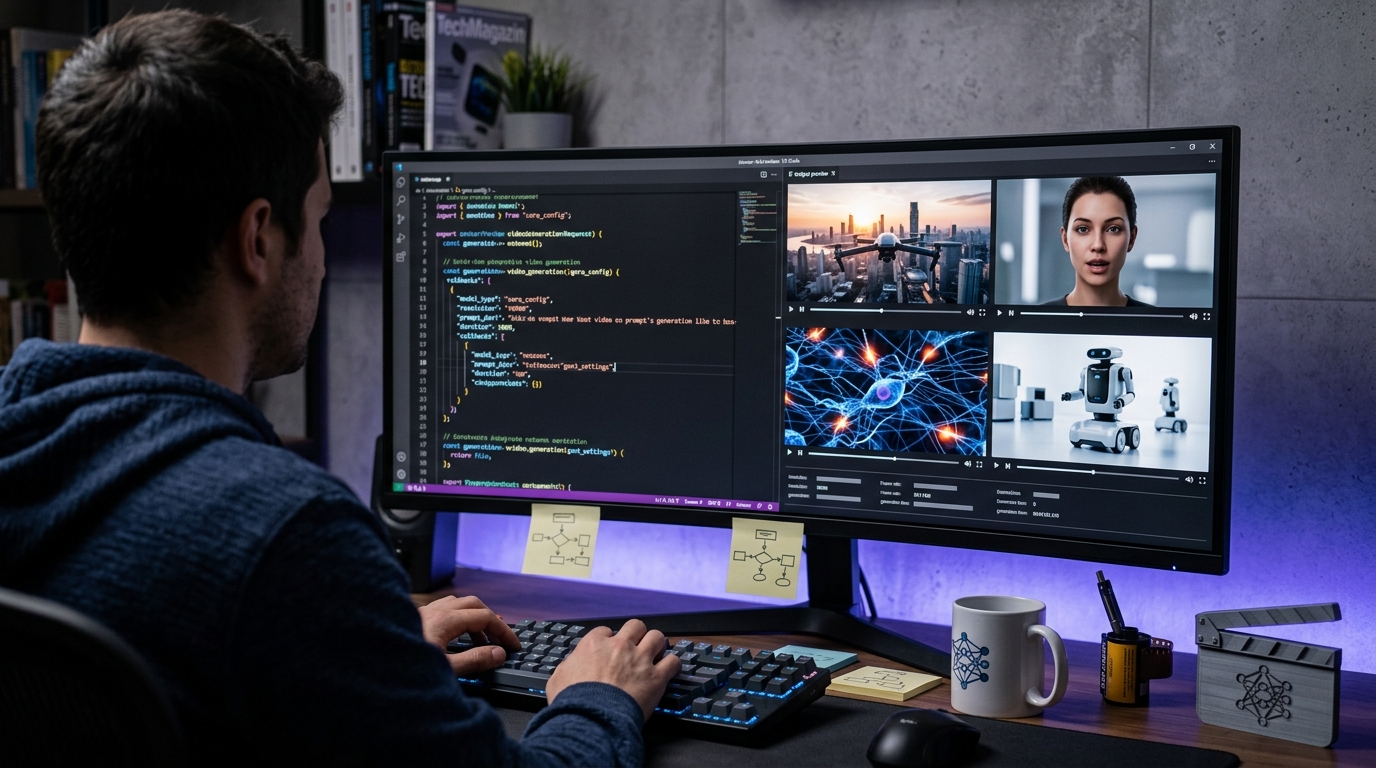
Integrating these tools into your stack is becoming increasingly standardized. Most providers offer a RESTful API. Below is a conceptual example of how to trigger a generation using a modern AI video generation API (Node.js example).
javascript const axios = require('axios');
async function generateVideo(prompt) {
const response = await axios.post('https://api.genvideo-provider.com/v1/generate', {
prompt: prompt,
resolution: "1080p",
aspect_ratio: "16:9",
motion_intensity: 5,
webhook_url: "https://your-app.com/webhooks/video-ready"
}, {
headers: {
'Authorization': Bearer ${process.env.API_KEY},
'Content-Type': 'application/json'
}
});
return response.data.job_id; }
// Usage generateVideo("A futuristic city with flying cars in a cyberpunk style, 4k, cinematic lighting");
Pro Tip: Always use webhooks. Video generation is an asynchronous process. Don't leave your user hanging on a loading screen; notify them via a push notification or email once the webhook_url is triggered.
Real-Time AI Video Synthesis: The 2026 Frontier
We are on the cusp of true real-time AI video synthesis. In 2026, "real-time" generally refers to a latency of less than 5 seconds for a 5-second clip. This is achieved through a combination of model distillation and edge computing.
Providers like Luma and Livepeer are leading this charge. For developers, this opens up possibilities for: - Interactive AI Avatars: Digital assistants that don't just talk, but move and react to you in real-time. - Dynamic Gaming Environments: Worlds that generate around the player as they explore. - Live Stream Augmentation: Adding AI-generated effects or characters to a live broadcast with minimal delay.
This level of performance requires optimized GPU orchestration. If you are building for real-time, prioritize APIs that offer WebSocket connections rather than standard REST polling.
Key Takeaways
- Sora is the Benchmark: For the highest quality and physical accuracy, OpenAI remains the leader, though at a higher cost.
- Speed vs. Quality: Luma AI offers the best balance for developers needing quick turnaround times.
- Specialization Matters: Use HeyGen or Synthesia for avatars, Tavus for personalization, and Pika for stylization.
- Infrastructure is Essential: Tools like Shotstack are necessary to build a complete, production-ready video pipeline.
- Pricing is Evolving: Most AI video API pricing has shifted from flat monthly fees to more granular, usage-based credit systems in 2026.
- Webhooks are Mandatory: Due to the compute-heavy nature of video, asynchronous workflows are the industry standard.
Frequently Asked Questions
What is the best AI video generation API for a startup on a budget?
Kling AI and Luma AI currently offer the most competitive pricing for high-quality output. If you are just starting, look for providers that offer a generous free tier or a "pay-as-you-go" model without high monthly retainers.
How do I handle temporal consistency in programmatic video generation?
Temporal consistency (preventing flickering or morphing) is handled by the model itself. Sora and Runway Gen-3 currently lead the market in this area. If you experience issues, try increasing your prompt detail or using the "Image-to-Video" feature, which uses a static image as a stable reference frame.
Can I generate 4K video using these APIs?
Yes, most top-tier providers (OpenAI, Runway, Kling, HeyGen) support 4K resolution in 2026. However, be aware that 4K generation typically costs 2x-4x more than 1080p and takes significantly longer to process.
Are there ethical concerns with using a text to video API for developers?
Absolutely. Most reputable API providers have strict content moderation filters and require watermarking or metadata tagging to identify AI-generated content. When building your app, ensure you comply with the "Deepfake" laws in your jurisdiction, such as the EU AI Act.
Is real-time AI video synthesis actually possible in 2026?
For short, lower-resolution clips (720p), we are seeing latencies under 3 seconds, which feels "live." However, full 4K cinematic synthesis still requires minutes of compute time. The industry is moving toward "streaming" generation where the first few frames are delivered almost instantly.
Conclusion
The landscape of AI video generation API technology in 2026 is vastly different from the experimental days of 2023. We now have the tools to generate, edit, and personalize video at a scale that was once the stuff of science fiction.
Whether you are building a marketing automation platform, a next-gen gaming experience, or an enterprise training tool, the APIs listed above provide the infrastructure you need to succeed. The key is to choose the tool that aligns with your specific needs for speed, quality, and cost.
Ready to start building? Grab an API key from one of these providers and start synthesizing the future today. For more insights on developer productivity and the latest in SEO tools, stay tuned to our latest deep dives into the AI stack.