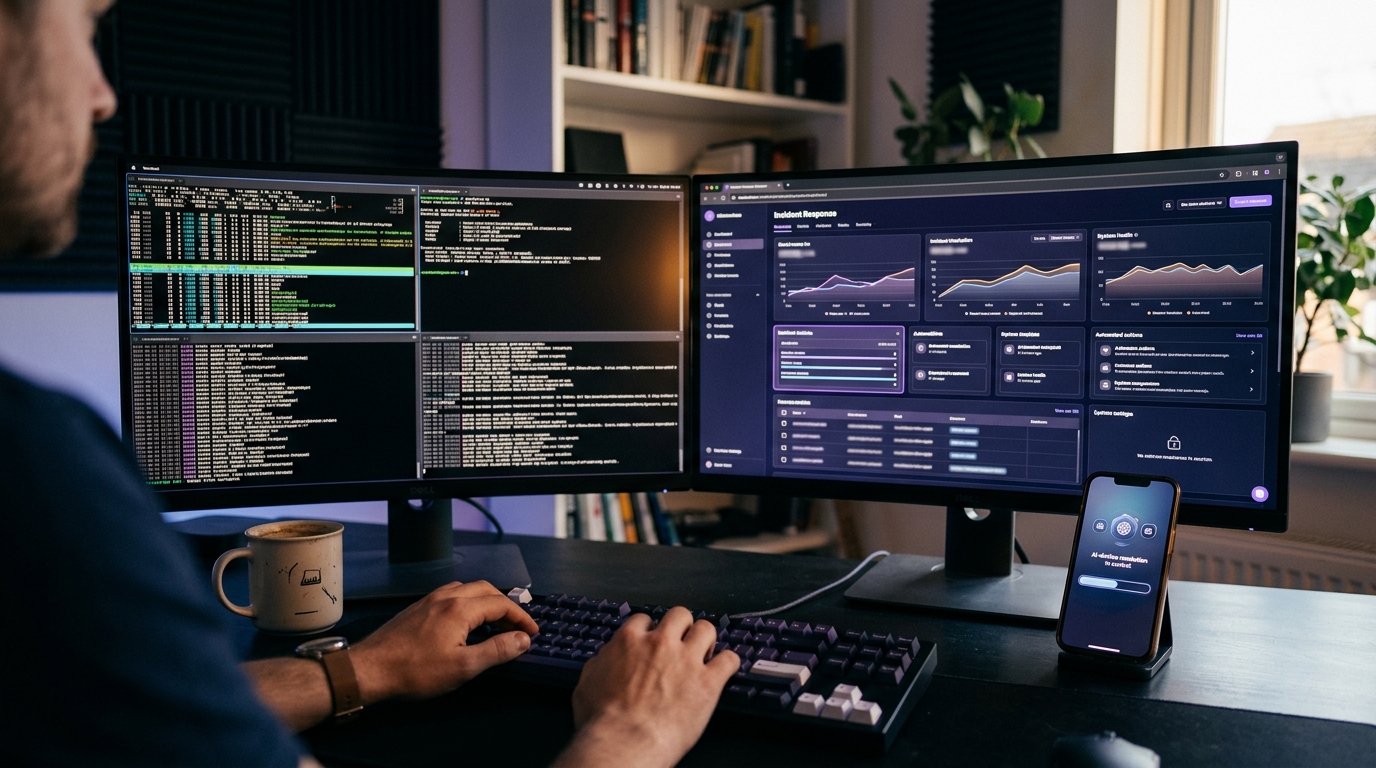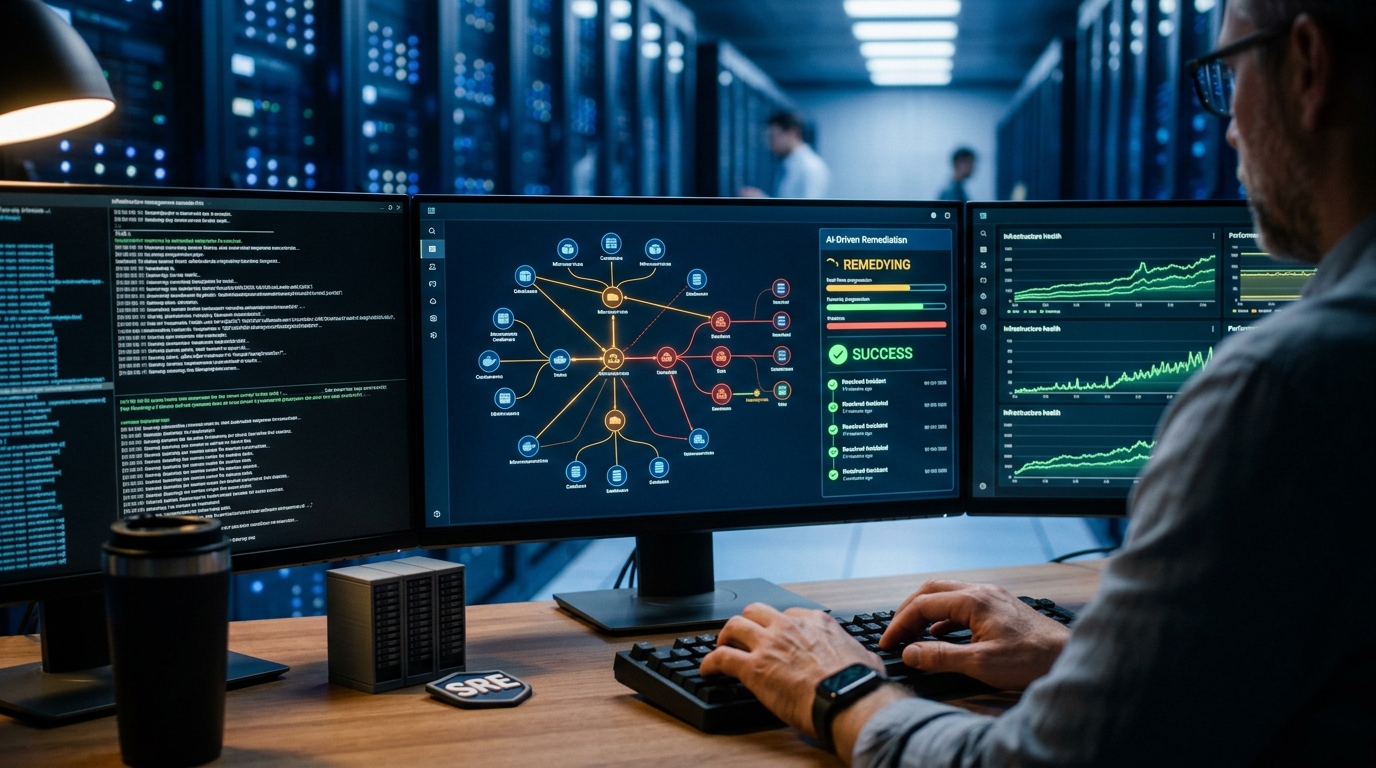
By 2026, the 2 AM pager isn't just an annoyance; it's a failure of architectural foresight. We have officially entered the era of self-healing infrastructure, where the delta between an incident's inception and its resolution is measured in milliseconds, not hours. For senior engineers and SREs, the shift is seismic: we are moving from a world of manual execution to a world of autonomous orchestration. With the rise of AI-driven DevOps tools, the industry is no longer asking if a system can fix itself, but how fast it can do so without human intervention. This guide explores the best autonomous SRE platforms 2026 has to offer and the technical frameworks required to build a resilient, intelligent stack.
The Shift to Autonomous Operations
Traditional DevOps was built on the foundation of "You build it, you run it." However, as microservices architectures have exploded in complexity, the cognitive load on human operators has reached a breaking point. In 2026, intelligent infrastructure automation is the only way to manage the sheer volume of telemetry data produced by modern cloud-native environments.
As noted in recent industry discussions, the role of the DevOps engineer is shifting from writing YAML to designing systems that possess "holistic intelligence." We are no longer stitching together fragmented tools; we are deploying AIOps self-healing solutions that see the entire lifecycle—from the first code commit to the final production trace—as a single, connected organism. This transition is driven by three core capabilities: 1. Predictive Observability: Identifying patterns that lead to failure before the failure occurs. 2. Causal Analysis: Moving beyond simple correlation to understand the actual root cause using eBPF and deep kernel telemetry. 3. Autonomous Action: Executing remediations, such as rolling back a canary deployment or scaling resources, based on real-time risk assessments.
Top 7 AI-Driven DevOps Tools for 2026
The landscape of AI-driven DevOps tools has matured significantly. The following platforms represent the gold standard for teams seeking to implement best autonomous SRE platforms 2026.
1. Metoro: The AI SRE for Kubernetes
Metoro has emerged as a leader by bringing its own eBPF-based telemetry to the table. Unlike legacy tools that require complex manual instrumentation, Metoro provides instant root cause analysis (RCA) and deployment verification. It doesn't just tell you something is wrong; it investigates the alert, correlates it with recent code changes, and suggests a fix.
2. Harness: AI-Powered CI/CD and Verification
Harness continues to dominate the automated incident remediation space with its AI-driven deployment verification. It uses machine learning to analyze the health of a new release in real-time. If the AI detects a regression that human-defined tests missed, it triggers an automatic rollback, ensuring zero-impact deployments.
3. Datadog: Watchdog AI and Predictive Monitoring
Datadog's Watchdog AI has evolved into a proactive hunter. In 2026, it excels at detecting "silent failures"—anomalies that don't trigger traditional thresholds but indicate underlying systemic rot. Its ability to correlate infrastructure metrics with application logs makes it a staple for full-stack observability.
4. Snyk: AI-Driven Security Remediation
Security is no longer a separate silo. Snyk's AI-driven platform scans code, containers, and IaC templates for vulnerabilities. Its "DeepCode" engine doesn't just flag issues; it provides auto-remediation PRs that are context-aware, ensuring that security fixes don't break functional logic.
5. PagerDuty AIOps: Noise Reduction and Event Correlation
PagerDuty has moved from being a notification service to an intelligent orchestration layer. Its AIOps features reduce alert noise by up to 80% by clustering related events into a single incident, providing SREs with the "story" of the outage rather than a flood of disconnected pings.
6. Amazon Q Developer: The Cloud-Native Assistant
Specifically tuned for AWS environments, Amazon Q Developer assists in everything from writing CloudFormation templates to debugging Lambda execution errors. It integrates directly into the CLI, allowing engineers to ask natural language questions about their infrastructure state.
7. Spacelift: Intelligent IaC Orchestration
Spacelift leverages AI to manage the complexities of Infrastructure as Code. It provides proactive guardrails, ensuring that AI-generated Terraform or Pulumi code adheres to organizational policies and security standards before it ever reaches a plan stage.
| Tool | Primary AI Strength | Best For |
|---|---|---|
| Metoro | eBPF-based RCA | Kubernetes-native environments |
| Harness | Deployment Verification | Continuous Delivery at scale |
| Datadog | Anomaly Detection | Full-stack observability |
| Snyk | Auto-Remediation | DevSecOps and vulnerability management |
| PagerDuty | Event Correlation | Incident response orchestration |
| Amazon Q | AWS Optimization | Cloud-specific management |
| Spacelift | IaC Policy Enforcement | Infrastructure automation |
Architecting Self-Healing Systems: The eBPF and MCP Advantage
To build a truly self-healing infrastructure, you must look beyond simple scripts. The most advanced systems in 2026 leverage eBPF (Extended Berkeley Packet Filter) and the Model Context Protocol (MCP) to gain unprecedented visibility and control.
The Role of eBPF
eBPF allows you to run sandboxed programs in the Linux kernel without changing kernel source code or loading kernel modules. For DevOps, this means you can observe every system call, network packet, and file access with near-zero overhead. AI models fed with eBPF data can distinguish between a network timeout caused by a noisy neighbor and one caused by a faulty application logic change.
Leveraging MCP Servers
The Model Context Protocol (MCP) has become the standard for connecting LLMs to production environments securely. By deploying an MCP server with read-only permissions, you can allow an AI agent to "troll through logs," query Prometheus metrics, and inspect Kubernetes events.
"Using MCP to interact with your cloud in read-only mode provides a level of abstraction beyond the CLI. The AI can investigate an issue, provide the results, and then suggest an IaC update based on actual API responses."
Sample: Conceptual Self-Healing Logic Loop
python def self_healing_loop(incident_event): # 1. Context Gathering via MCP logs = mcp_client.query_logs(service=incident_event.service, timeframe="5m") metrics = mcp_client.query_prometheus("rate(http_requests_total{status='500'}[1m])")
# 2. AI Root Cause Analysis
analysis = ai_engine.analyze(logs, metrics)

if analysis.root_cause == "OOMKill":
    # 3. Automated Remediation
    iac_patch = ai_engine.generate_terraform_patch(service=incident_event.service, memory_increase="512Mi")
    vcs_client.create_pr(branch="fix/oom-remediation", patch=iac_patch)
    return "Fix PR Created"

return "Human Escalation Required"
Automated Incident Remediation: From Alert to Fix PR
The ultimate goal of automated incident remediation is to close the loop between detection and repair. In 2026, the workflow for a production incident often looks like this:
- Detection: An AI-driven observability tool (like Metoro or Datadog) detects a latency spike that deviates from the historical baseline.
- Correlative Investigation: The agent automatically inspects the CI/CD pipeline and identifies that a new microservice version was deployed 10 minutes ago.
- Trace Analysis: Using eBPF, the agent traces the 500 errors to a specific database query that is missing an index.
- Drafting the Fix: The AI generates a Terraform or Liquibase migration script to add the missing index.
- Human-in-the-Loop Approval: The SRE receives a notification in Slack: "Incident resolved via automated index creation. Review the PR here."
This "risk-tiered autonomy" ensures that while the AI handles the heavy lifting of investigation and drafting, the human remains the final gatekeeper for destructive operations. As one senior engineer on Reddit noted, "AI can't own outages, but it can make sure that by the time I'm awake, the solution is already 90% ready."
Infrastructure as Code (IaC) in the Age of LLMs
Intelligent infrastructure automation has fundamentally changed how we write and maintain IaC. In 2026, we no longer start with a blank main.tf file. Instead, we use natural language to describe our intent, and AI agents generate the modules based on organizational best practices.
However, this comes with new challenges. AI-generated IaC can suffer from "config drift" if the models aren't grounded in the current state of the cloud. The best teams are now using Vector Databases to store an embedded copy of their remote Terraform state. This allows the AI to "see" the current architecture before suggesting changes, significantly reducing hallucinations.
Best Practices for AI-Generated IaC:
- Schema Validation: Always run
terraform validateandtflintas automated gates for AI-generated code. - Policy as Code: Use Open Policy Agent (OPA) to ensure that AI-suggested security groups don't accidentally open port 22 to the entire internet.
- Small Iterations: Don't ask an AI to build a 2,000-line script. Ask for modular components that you can verify individually.
The Risks of AI Autonomy: Hallucinations and Security Guardrails
While AIOps self-healing solutions offer massive productivity gains, they are not without risk. The "AI velocity paradox" suggests that as we increase the speed of deployment through AI, we also increase the potential for "spaghetti code" and architectural technical debt.
The Hallucination Problem
LLMs can occasionally "make up" cloud provider attributes or suggest deprecated API versions. In a production environment, this can lead to failed deployments or, worse, insecure configurations. To mitigate this, engineers must treat AI as a "fast copier" rather than a source of truth.
Security and IP Concerns
Many organizations are hesitant to send proprietary infrastructure metadata to third-party LLMs. In 2026, the trend is moving toward Private LLMs and RAG (Retrieval-Augmented Generation). By keeping the knowledge base (logs, state files, docs) on-premise or within a VPC and only using the LLM for reasoning, companies can maintain strict data sovereignty.
Risk-Tiered Autonomy Levels:
- Level 1 (Read-Only): AI queries logs and metrics to provide summaries.
- Level 2 (Suggestions): AI drafts PRs for code and infrastructure changes.
- Level 3 (Gated Action): AI executes non-destructive changes (e.g., scaling up) automatically but requires approval for destructive ones (e.g.,
terraform destroy). - Level 4 (Full Autonomy): AI manages the entire lifecycle of ephemeral environments.
The Future of the DevOps Career: Judgment vs. Execution
A common fear in the community is: "Will AI reduce DevOps roles significantly?" The consensus among industry leaders is that the role isn't disappearing—it's evolving.
DevOps killed the traditional sysadmin and release engineer by merging their roles into a more efficient automation-first approach. AI is doing the same to "low-skill" DevOps tasks. If your job is primarily writing YAML templates or manually checking logs, you are at risk. However, if your job is designing resilient systems, cost optimization, and security trade-offs, you are more valuable than ever.
In the next 5-10 years, we will see the rise of the "One-Man Army" engineer—a professional who uses a suite of AI-driven DevOps tools to perform at a Staff level. The bottleneck is no longer how fast you can type kubectl commands, but how well you understand the underlying architecture and the "why" behind system decisions.
"DevOps isn't going away; the bar is just being raised. The job shifts from writing YAML to being the architect of an autonomous ecosystem."
Key Takeaways
- Self-healing infrastructure is now a baseline requirement for managing the complexity of 2026 cloud-native environments.
- Metoro, Harness, and Datadog are leading the charge in providing autonomous observability and deployment verification.
- eBPF and MCP are the critical technical components that give AI agents the context they need to perform deep root cause analysis.
- Risk-tiered autonomy is the safest way to implement AI, keeping humans in the loop for destructive operations while automating the "toil."
- The DevOps career path is shifting from execution (writing code) to judgment (architecting systems and managing AI agents).
- Private RAG systems are the solution for organizations that need AI power without compromising security or intellectual property.
Frequently Asked Questions
What is self-healing infrastructure?
Self-healing infrastructure refers to IT systems that can automatically detect, diagnose, and remediate issues without human intervention. By using AI-driven DevOps tools, these systems monitor telemetry data and execute pre-defined or AI-generated scripts to restore service health.
Which are the best AI-powered DevOps tools in 2026?
Some of the top tools include Metoro for Kubernetes RCA, Harness for deployment verification, Datadog for predictive monitoring, and Snyk for automated security remediation. These tools help teams move from reactive to proactive operations.
Will AI replace DevOps engineers?
AI is unlikely to replace the DevOps role entirely, but it will automate repetitive tasks like pipeline creation and log analysis. The role is evolving toward "Platform Engineering," where engineers focus on orchestration, architecture, and setting the guardrails for autonomous systems.
How does eBPF help in self-healing systems?
eBPF provides deep, kernel-level visibility into system performance and security with minimal overhead. This rich data source allows AI models to perform highly accurate root cause analysis, distinguishing between application bugs and infrastructure failures.
Is it safe to let AI manage production infrastructure?
Safety is achieved through risk-tiered autonomy. Most organizations allow AI to perform read-only tasks and suggest fixes (PRs), but they maintain a "human-in-the-loop" requirement for destructive actions like deleting databases or changing core network configurations.
Conclusion
The journey toward self-healing infrastructure is no longer a futuristic dream—it is the operational standard for 2026. By integrating AI-driven DevOps tools like Metoro and Harness into your stack, you can transform your team from a group of reactive firefighters into a strategic force of system architects.
As you begin your transition to intelligent infrastructure automation, remember that the goal isn't to remove the human from the equation, but to empower the human with the speed and precision of machine intelligence. Start small, implement strict security guardrails, and focus on building an autonomous ecosystem that learns and grows with your application. The future of DevOps is here; it’s time to let your infrastructure start healing itself.
Ready to upgrade your stack? Explore our latest reviews of [SRE automation platforms] and [AI security tools] to stay ahead of the curve.