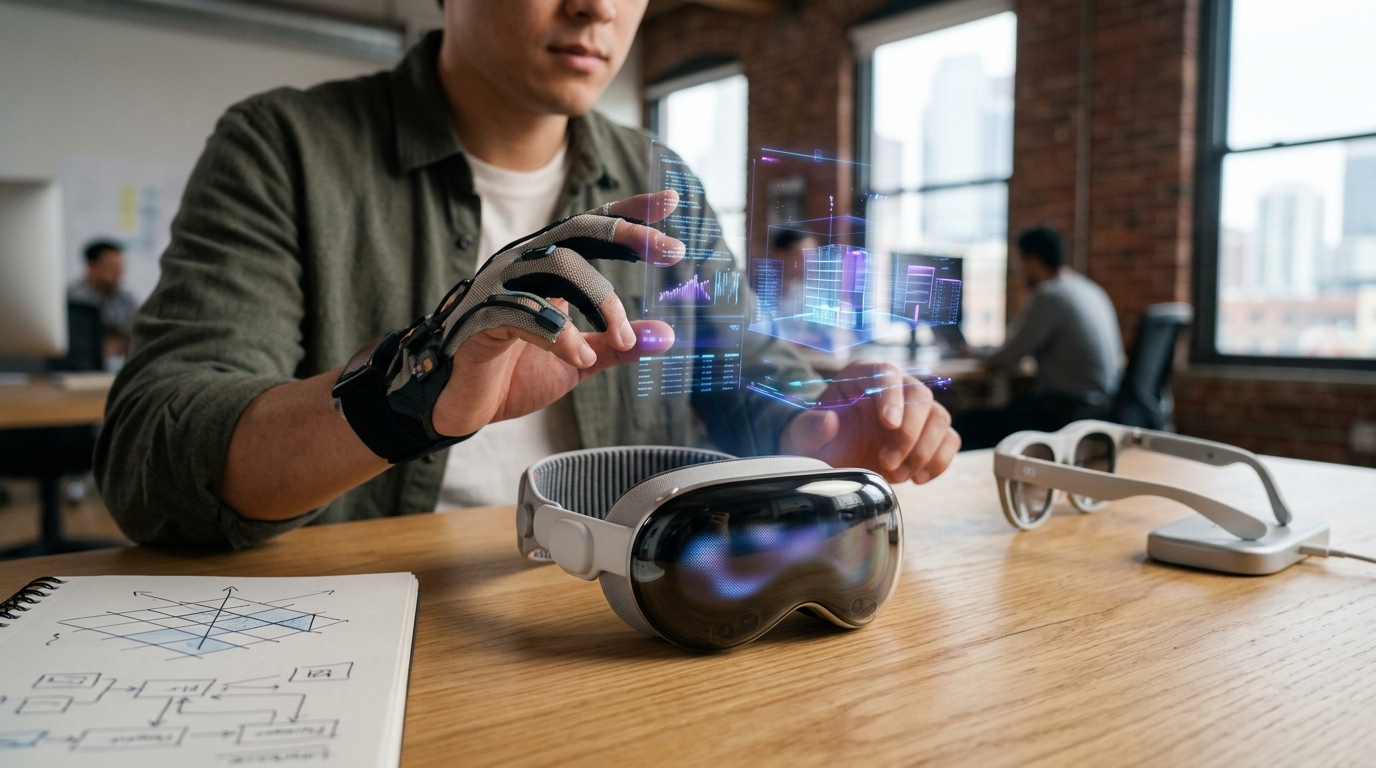
In 2026, the bottleneck for innovation is no longer raw compute—it is context. We have officially moved past the era of 'Chatbot-in-a-Box' and entered the age of world-aware intelligence. If you are a developer today, you aren't just writing code for a flat screen; you are architecting experiences that live in the physical gaps between people and their environments. To succeed, you need to master the Spatial AI SDKs that bridge the gap between multimodal LLMs and the 3D world. Whether you are targeting the high-fidelity ecosystem of Apple Vision Pro or the lightweight, always-on utility of Meta Orion, your choice of framework will determine if your app is a gimmick or an essential tool.
The Paradigm Shift: Why Spatial AI SDKs Matter in 2026
Spatial AI is the convergence of Simultaneous Localization and Mapping (SLAM) and Multimodal Large Language Models (LLMs). In 2026, a standard AI agent doesn't just know what you said; it knows where you are looking, what objects are on your desk, and the physical dimensions of the room you're standing in.
For developers, this means the traditional "prompt-response" loop is dead. It has been replaced by a "perceive-reason-act" loop. Vision Pro AI development 2026 is centered around Apple’s Neural Engine, while the Meta Orion SDK for agents focuses on low-latency, EMG-triggered interactions. These SDKs handle the heavy lifting of plane detection, semantic segmentation, and mesh reconstruction, allowing you to focus on the "intelligence" layer of your application.
"The most successful spatial apps of 2026 aren't the ones with the best graphics, but the ones with the best 'world-logic'—the ability for an AI to understand that a virtual coffee cup shouldn't fall through a physical table." — Lead Architect, Spatial Compute Forum
1. Apple RealityKit & visionOS SDK: The Gold Standard
Apple’s ecosystem remains the most lucrative and technically polished environment for spatial computing. By 2026, RealityKit has evolved into a fully AI-integrated engine. It doesn't just render pixels; it interprets the scene through the Object Tracking API and Spatial Personas.
- Key Features: High-resolution passthrough, eye-and-gesture tracking, and the new Semantic Scene Completion which predicts what's behind a physical object.
- Best For: High-end productivity, medical visualization, and premium gaming.
- Vision Pro AI development 2026 focus: Apple has unlocked the Neural Engine for third-party developers, allowing for real-time, on-device model fine-tuning without cloud latency.
RealityKit’s strength lies in its deep integration with CoreML. You can deploy a transformer model that reacts to the user's emotional state by analyzing micro-expressions captured by the Vision Pro’s internal cameras.
2. Meta Presence Platform: Building for Orion & Quest
If Apple is about fidelity, Meta is about ubiquity. The Meta Orion SDK for agents is the breakthrough of 2026. Unlike the Quest, Orion (Meta’s AR glasses) relies on the Presence Platform to facilitate "Always-On AI."
- Key Features: Interaction SDK, Movement SDK, and the Contextual Intelligence API.
- Orion Specifics: The SDK now supports the EMG (Electromyography) wristband, allowing users to control AI agents with subtle neural signals rather than large hand gestures.
- AI Integration: Meta’s Llama 4 (Spatial Edition) is baked directly into the SDK, providing native support for world-aware queries like "Where did I leave my keys?"
Meta’s SDK is highly modular. Developers can use the Scene Script feature to automatically turn a physical room into a 3D layout for AI pathfinding in seconds.
3. Niantic Lightship ARDK 4.0: World-Scale Spatial AI
While Apple and Meta fight for the living room, Niantic owns the streets. The Lightship ARDK (Augmented Reality Development Kit) is the premier choice for building AR AI agents that operate at a city-wide scale.
- Visual Positioning System (VPS): Lightship’s VPS is the most accurate in the world, providing centimeter-level localization using a crowdsourced 3D map of the planet.
- Semantic Segmentation: The SDK can distinguish between "sky," "water," "ground," and "buildings" in real-time, allowing AI agents to navigate complex outdoor environments.
- 2026 Update: Lightship now includes "Shared AR," enabling 100+ users to interact with the same spatial AI agent simultaneously in a public park.
4. NVIDIA Omniverse & Isaac Sim: The Industrial Powerhouse
For industrial and enterprise developers, NVIDIA is the undisputed leader. Their spatial AI frameworks are less about entertainment and more about "Digital Twins."
- Omniverse Cloud: Allows for real-time collaboration on massive 3D datasets.
- Isaac Sim: Used to train AI agents (robots or virtual assistants) in a physically accurate simulation before deploying them to the real world.
- Edge AI: NVIDIA’s SDKs are optimized for Jetson Orin modules, making them the go-to for spatial computing AI frameworks in warehouse automation and smart city infrastructure.
| Feature | Apple RealityKit | Meta Presence Platform | Niantic Lightship |
|---|---|---|---|
| Primary Device | Vision Pro | Meta Orion / Quest 3/4 | Mobile / AR Glasses |
| Tracking Tech | Lidar / Vision | SLAM / EMG | VPS / GPS |
| AI Logic | CoreML / On-Device | Llama 4 / Hybrid | Cloud-Based Multimodal |
| Best Use Case | Luxury Productivity | Social / Daily Utility | Outdoor / World-Scale |
5. Unity Sentis: On-Device Neural Inference
Unity remains the engine of choice for cross-platform development. With Unity Sentis, developers can bridge the gap between AI models and real-time 3D engines.
Unity Sentis allows you to take any ONNX-compatible model (like YOLO for object detection or Whisper for speech) and run it directly on the device's GPU/NPU. This is critical for reducing latency in building AR AI agents. In 2026, Sentis has been optimized specifically for the Vision Pro’s R1 chip and Meta’s custom AR silicon.
6. Google Geospatial API: The Semantic World Map
Google’s entry into the world-aware AI APIs space leverages their massive Google Maps data. The Geospatial API allows developers to "anchor" AI content to any latitude, longitude, and altitude on Earth with high precision.
In 2026, Google has integrated "Street View AI," which provides semantic metadata for almost every storefront and landmark globally. If your AI agent needs to know that the building in front of the user is a "Pharmacy open until 9 PM," Google is your best bet.
7. Snap Lens Studio: GenAI-Powered AR Agents
Don't let the "Snapchat" branding fool you. Lens Studio is one of the most advanced spatial computing AI frameworks for rapid deployment.
- GenAI Suites: Snap has integrated real-time generative AI, allowing users to transform their environment with a voice command ("Make this room look like a cyberpunk forest").
- Bitmoji AI: The SDK allows for the creation of "Spatial Bitmojis"—AI-driven avatars that recognize and react to the user’s physical environment and speech patterns.
8. 8th Wall: Web-Based Spatial AI
Accessibility is the primary hurdle for AR. 8th Wall (owned by Niantic) solves this by bringing Spatial AI SDKs to the browser.
In 2026, WebAssembly and WebGPU have matured enough that 8th Wall can run complex SLAM algorithms and AI inference directly in Chrome or Safari. This is the "SEO tool" of the spatial world—it’s how you get your AI experience in front of users without requiring an app store download.
9. OpenAI World-Aware API: The Brain for Your SDK
OpenAI doesn't have a headset, but they have the "brain." Their World-Aware API is designed to be the logic layer that plugs into RealityKit or Meta’s Presence Platform.
- Multimodal Context: It can ingest a stream of frames from a headset and return a JSON-structured understanding of the scene.
- Example: "The user is holding a screwdriver and looking at a broken IKEA shelf. Provide step-by-step repair instructions based on the visual state of the shelf."
- 2026 Latency: With the rollout of 6G and edge-compute partnerships, OpenAI’s spatial inference latency has dropped below 100ms.
10. Microsoft Mesh & Azure Spatial Anchors
Microsoft has pivoted from HoloLens hardware to the "Mesh" software layer. This is the enterprise backbone for collaborative spatial AI.
- Azure Spatial Anchors: Allows for persistent 3D content that stays in the same physical spot across different devices (e.g., a Vision Pro user and a Quest user seeing the same AI whiteboard).
- Copilot Integration: Microsoft has integrated Copilot directly into Mesh, allowing for AI-driven project management within a 3D workspace.
Technical Comparison: Choosing Your Stack
When selecting from these spatial computing AI frameworks, you must consider the "Privacy vs. Power" tradeoff.
- On-Device (Apple/Unity Sentis): Best for privacy and low latency. The data never leaves the headset. Ideal for sensitive enterprise work.
- Cloud-Hybrid (Meta/OpenAI): Best for complex reasoning and large-scale world knowledge. Requires a constant 5G/6G connection.
- Web-Based (8th Wall): Best for marketing and short-form engagement. Low friction but limited access to advanced hardware sensors.
Implementation Guide: Building Your First Spatial Agent
To build a world-aware agent in 2026, you generally follow this workflow. Here is a simplified example using a hypothetical Swift/RealityKit snippet for Vision Pro AI development 2026:
swift import RealityKit import SpatialAI
// 1. Initialize the World-Aware Engine let spatialAgent = SpatialAgent(configuration: .highPrecision)
// 2. Define a Semantic Target spatialAgent.onObjectDetected("CoffeeMachine") { object in // 3. Trigger AI Logic let prompt = "How do I clean this specific model?" AIProvider.query(prompt, visualContext: object.image) { response in // 4. Render Spatial UI self.displayHoverText(response, at: object.position) } }
This snippet demonstrates the core of building AR AI agents: detecting a physical object, passing that context to an AI provider, and anchoring the result back in 3D space.
Key Takeaways
- Context is King: The best SDKs in 2026 focus on semantic understanding (knowing what an object is) rather than just geometry (knowing where it is).
- Apple vs. Meta: Choose Apple for high-fidelity, single-user depth; choose Meta for social, lightweight, and always-on AR (Orion).
- Cross-Platform is Standard: Unity Sentis and 8th Wall are essential for reaching users across different hardware ecosystems.
- On-Device AI: 2026 is the year of NPU-accelerated spatial AI, significantly reducing the need for cloud round-trips.
- Industrial Growth: NVIDIA Omniverse is the leader for non-consumer, industrial spatial applications.
Frequently Asked Questions
What is the best SDK for building AR AI agents in 2026?
For high-end consumer apps, Apple’s RealityKit is the leader due to its deep integration with Vision Pro. For lightweight, wearable AR like Meta Orion, the Meta Presence Platform is the superior choice for its low-power optimization and EMG support.
Can I use OpenAI with Vision Pro development?
Yes. While Apple prefers CoreML for on-device tasks, most developers use OpenAI’s World-Aware API via a REST bridge to handle complex multimodal reasoning that exceeds on-device capabilities.
How does Meta Orion differ from Quest 3 in terms of SDKs?
While both use the Presence Platform, the Meta Orion SDK emphasizes "Glanceable AI" and subtle interactions via an EMG wristband, whereas the Quest SDK focuses on immersive, controller-based or hand-tracked VR/MR.
Do I need to be an AI expert to use these Spatial AI SDKs?
No. Most 2026 SDKs have abstracted the AI layer. You provide the "intent," and the SDK handles the computer vision, SLAM, and model inference. However, understanding developer productivity tools and basic prompt engineering for vision is highly recommended.
Is WebAR powerful enough for Spatial AI?
With 8th Wall and the 2026 updates to WebGPU, WebAR can now handle basic semantic segmentation and SLAM. It is ideal for retail and education but lacks the raw sensor access of native Vision Pro or Orion apps.
Conclusion
The transition from 2D to 3D interfaces is the most significant shift in computing since the smartphone. By mastering these Spatial AI SDKs, you are positioning yourself at the forefront of the next technological gold rush. Whether you are building for the immersive power of Vision Pro or the daily utility of Meta Orion, the goal remains the same: to create AI that doesn't just talk to us, but lives with us in our world.
As you begin your journey, remember that the most successful spatial experiences are those that respect the user's physical reality while enhancing it with digital intelligence. Start experimenting with these frameworks today—the world is waiting to be programmed.