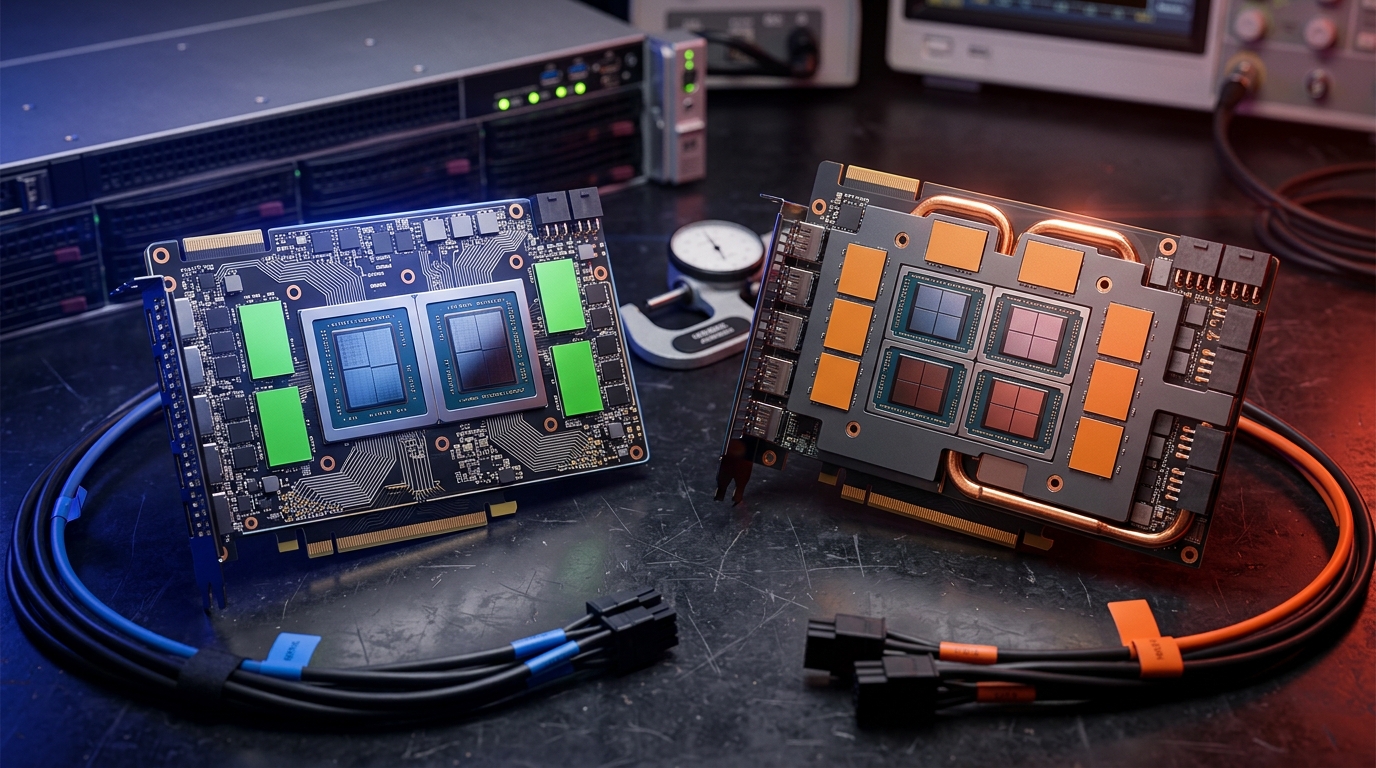
In the high-stakes arena of generative AI, memory capacity and compute density are the ultimate arbiters of enterprise survival. As LLMs scale past the trillion-parameter mark, the race to secure high-performance silicon has evolved from a hardware procurement task into a core strategic battle. If your enterprise is planning its compute footprint for the next three to five years, the decision comes down to a critical head-to-head match-up: nvidia blackwell vs amd instinct.
Historically, NVIDIA's proprietary CUDA ecosystem has maintained a virtual monopoly on AI workloads. However, AMD's aggressive chiplet-based strategy and massive memory capacities have positioned the Instinct MI325X as a disruptive force. In this comprehensive architectural and financial analysis, we will dissect these two powerhouse architectures to help you determine the best enterprise ai gpu 2026 has to offer.
Table of Contents
- The Battle for AI Supremacy: NVIDIA Blackwell vs AMD Instinct in 2026
- Architectural Deep Dive: Blackwell B200 vs Instinct MI325X
- Raw Performance: Blackwell B200 vs MI325X Benchmarks
- The Memory Battle: HBM3e Memory Bandwidth Comparison
- Interconnects & Scaling: NVLink 5 vs Infinity Fabric
- Software Ecosystem: CUDA vs AMD ROCm 6.2+
- Financials & TCO: AMD Instinct MI325X vs NVIDIA B200 Price
- Selecting the Best Enterprise AI GPU 2026 for Your Workload
- Key Takeaways
- Frequently Asked Questions
- Conclusion
The Battle for AI Supremacy: NVIDIA Blackwell vs AMD Instinct in 2026
To understand the state of AI hardware in 2026, one must look at the physical limitations of silicon manufacturing. We have reached the limits of the traditional monolithic die; TSMC's physical reticle size limit prevents chipmakers from simply making larger single chips. To bypass this bottleneck, both NVIDIA and AMD have pivoted to advanced packaging technologies, albeit with radically different design philosophies.
+-------------------------------------------------------------------------+ | Enterprise AI Landscape | +------------------------------------+------------------------------------+ | NVIDIA Blackwell | AMD Instinct | +------------------------------------+------------------------------------+ | * Focus on unified system-scale | * Focus on massive onboard memory | | architectures (GB200 NVL72). | capacity (256GB HBM3e). | | * Ultra-fast chip-to-chip links. | * Cost-effective, open-standard | | * Deeply integrated proprietary | ecosystem scaling via UALink | | software stack (CUDA). | and ROCm. | +------------------------------------+------------------------------------+
NVIDIA's Blackwell architecture, specifically the B200 and the dual-die GB200 Superchip, represents a systemic approach to computing. Rather than treating the GPU as an isolated accelerator, NVIDIA designs entire racks—like the NVL72—as a single, giant, liquid-cooled logical GPU. This approach aims to maximize communication speeds across thousands of nodes, targeting massive-scale training and low-latency inference on Mixture-of-Experts (MoE) models.
Conversely, AMD's Instinct MI325X is a masterclass in chiplet engineering. By utilizing TSMC's 3D CoWoS (Chip-on-Wafer-on-Substrate) packaging, AMD has packed an unprecedented 256GB of HBM3e memory onto a single package. AMD's strategy is clear: bypass the network bottleneck by keeping larger models entirely resident on a single GPU's local memory. This direct assault on NVIDIA's market share has forced a massive shift in how enterprise architects calculate their total cost of ownership (TCO) and compute density.
Architectural Deep Dive: Blackwell B200 vs Instinct MI325X
To appreciate the performance differentials between these two silicon giants, we must look at how they manage data flow, execution units, and precision formats.
NVIDIA Blackwell Architecture (B200 & GB200)
NVIDIA’s Blackwell B200 is not a single die; it consists of two reticle-limited dies manufactured on a custom TSMC 4NP process. These two dies are linked by a high-bandwidth, bi-directional NVLink Chip-on-Wafer (CoW) interconnect operating at an astonishing 10 TB/s. To the operating system and developer, this dual-die package behaves as a single unified GPU, eliminating the software overhead typically associated with multi-GPU programming.
Key architectural innovations in Blackwell include: * Second-Generation Transformer Engine: This subsystem dynamically adjusts precision formats. It introduces native FP4 (4-bit floating point) support, doubling the effective compute throughput and memory capacity for models trained or quantized to ultra-low precision without sacrificing model accuracy. * Decompression Engines: Blackwell features dedicated hardware decompression engines capable of offloading data decompression at up to 800 GB/s. This directly accelerates database queries and data pipeline preparation for AI training. * Secure AI: Advanced confidential computing capabilities protect intellectual property and sensitive customer data directly within the GPU's memory space during execution.
AMD Instinct MI325X Architecture
AMD's Instinct MI325X relies on the mature, highly efficient CDNA 3 architecture. Built using a mix of TSMC's 5nm and 6nm process nodes, the MI325X employs a modular chiplet design that separates the compute engines (Matrix Core Engines) from the memory interfaces.
Key architectural features of the MI325X include: * Unmatched Density of Matrix Cores: AMD has optimized its execution units specifically for matrix math operations, which are the backbone of transformer-based neural networks. * Massive SRAM Cache: By placing high-speed SRAM directly adjacent to the compute chiplets, AMD reduces the need to access external HBM3e memory for repetitive operations, saving significant power and reducing execution latency. * Enhanced FP8 and BF16 Support: While AMD does not natively support FP4 to the same degree as Blackwell's second-generation Transformer Engine, its raw FP8 and BF16 execution pipelines are exceptionally wide, allowing for massive throughput on standard enterprise models.
Raw Performance: Blackwell B200 vs MI325X Benchmarks
When evaluating blackwell b200 vs mi325x benchmarks, it is vital to distinguish between raw theoretical peak compute and real-world, system-level performance. AI workloads are rarely limited solely by raw floating-point operations (FLOPs); they are heavily constrained by memory access and communication latencies.
Below is a detailed comparison of the peak theoretical performance metrics for both architectures:
| Specification / Metric | NVIDIA Blackwell B200 | AMD Instinct MI325X | Winner (On Paper) |
|---|---|---|---|
| Manufacturing Process | TSMC 4NP (Custom 4nm) | TSMC 5nm / 6nm (Chiplet) | NVIDIA (Density) |
| Transistor Count | 208 Billion (Dual-Die) | ~153 Billion | NVIDIA |
| Memory Capacity | 192GB HBM3e | 256GB HBM3e | AMD |
| Memory Bandwidth | 8.0 TB/s | 6.0 TB/s | NVIDIA |
| FP16 / BF16 Compute | 2.5 PFLOPS (5.0 PFLOPS Tensor) | 1.3 PFLOPS | NVIDIA |
| FP8 Compute | 5.0 PFLOPS (10.0 PFLOPS Tensor) | 2.6 PFLOPS | NVIDIA |
| FP4 Compute | 20.0 PFLOPS (Tensor) | Not Natively Supported | NVIDIA |
| Peak TDP (Thermal Design Power) | 1000W - 1200W | 1000W | AMD (Slightly cooler) |
Real-World Benchmark Analysis
In standard synthetic benchmarks, NVIDIA's B200 holds a clear lead in raw processing throughput, particularly when leveraging its FP4 Tensor Cores. For instance, in LLM inference tasks utilizing FP4 quantization, a single Blackwell B200 can achieve up to 4x the throughput of an Hopper-generation H100, and roughly 1.8x to 2.2x the throughput of an MI325X running the same model in FP8.
However, the story changes dramatically when we benchmark massive models that exceed the memory capacity of a single GPU. For example, when running a model like Llama 3.1 405B in FP16 or FP8 precision, the memory footprint is too large to fit on a single B200 (192GB). To run this model on NVIDIA hardware, you must shard the model across multiple GPUs, introducing inter-GPU communication overhead.
Because the AMD Instinct MI325X boasts 256GB of HBM3e, you can fit significantly larger model segments on a single GPU. In multi-tenant environments or high-concurrency inference systems, this high memory capacity allows the MI325X to deliver superior token-generation efficiency per dollar, as fewer total GPUs are required to host the model.
"For memory-bound LLM inference workloads, the MI325X's massive 256GB frame buffer allows us to run larger batch sizes without spilling over to network interconnects, effectively leveling the playing field against NVIDIA's superior raw FP8 compute speeds."
— Senior Infrastructure Architect, Tier-1 Cloud Service Provider
The Memory Battle: HBM3e Memory Bandwidth Comparison
To fully understand why memory is the defining battleground of 2026, we must conduct a detailed hbm3e memory bandwidth comparison.
+-------------------------------------------------------------------------+ | Memory Architecture Comparison | +-------------------------------------------------------------------------+ | | | NVIDIA Blackwell B200 | | [192GB HBM3e] <============= 8.0 TB/s Bandwidth =============> Compute | | (Faster transfer speeds, smaller storage bucket) | | | | AMD Instinct MI325X | | [256GB HBM3e] <============= 6.0 TB/s Bandwidth ============> Compute | | (Slower transfer speeds, much larger storage bucket) | +-------------------------------------------------------------------------+
- NVIDIA Blackwell B200: Features 192GB of HBM3e running across an 8192-bit memory interface, delivering an industry-leading 8.0 TB/s of memory bandwidth. This ultra-fast pipeline ensures that the execution units are rarely starved of data, which is critical for memory-bound tasks like the pre-fill phase of LLM inference.
- AMD Instinct MI325X: Features 256GB of HBM3e with a memory bandwidth of 6.0 TB/s. While the bandwidth is lower than Blackwell's, the 33% increase in capacity is a massive architectural advantage.
Why Capacity vs. Bandwidth Matters
In AI workloads, we categorize execution phases into two distinct bottlenecks: 1. Compute-Bound (FLOP-limited): Typically occurs during model training and the pre-fill phase of inference (when the prompt is processed). Here, NVIDIA's superior raw compute and 8.0 TB/s memory bandwidth give it a substantial edge. 2. Memory-Bound (Bandwidth & Capacity-limited): Typically occurs during the autoregressive decoding phase of inference (generating tokens one by one). Each generated token requires loading the entire model's weights from memory to the processor. Here, having more memory capacity allows you to increase the KV (Key-Value) Cache size, enabling larger context windows and higher batch sizes.
If your enterprise focuses heavily on deploying long-context-window models (e.g., analyzing 100,000-word documents), the MI325X's 256GB capacity allows it to handle massive KV caches natively. This makes the AMD Instinct an incredibly strong contender for enterprise-scale retrieval-augmented generation (RAG) pipelines.
Interconnects & Scaling: NVLink 5 vs Infinity Fabric
No single GPU can train a modern foundation model alone. To scale to thousands of cards, GPUs must communicate with minimum latency. This brings us to the core of cluster design: the cost per token nvlink vs infinity fabric debate.
NVIDIA NVLink 5 and the NVL72 Architecture
NVIDIA's proprietary NVLink 5 is the gold standard of GPU interconnects. On the B200, NVLink provides a bidirectional bandwidth of 1.8 TB/s per GPU.
When deployed within the GB200 NVL72 liquid-cooled rack, NVIDIA uses a passive copper backplane to connect 72 Blackwell GPUs in a single non-blocking NVLink domain. This allows all 72 GPUs to access each other's memory pools with ultra-low latency, essentially acting as a single 13.5 TB unified memory pool.
This system-level integration drastically reduces communication overhead, driving down the cost per token for massive Mixture-of-Experts models like GPT-4 or customized enterprise models with hundreds of billions of parameters.
+-------------------------------------------------------------------------+ | NVIDIA NVLink 5 Rack Topology | | | | [GPU 1] <---> [GPU 2] <---> [GPU 3] <---> ... <---> [GPU 72] | | |====================== NVLink Copper Backplane ====================| | | (1.8 TB/s Bidirectional / Low Latency) | +-------------------------------------------------------------------------+
AMD Infinity Fabric and the Push for Open Standards
AMD utilizes its proprietary Infinity Fabric for node-level communication, delivering high-bandwidth connectivity within an 8-GPU server chassis (such as the industry-standard OAM platform).
To scale beyond a single node, AMD has championed the Ultra Accelerator Link (UALink) consortium, an open industry standard designed to rival NVLink. UALink aims to provide a high-speed, low-latency interconnect protocol that allows GPUs from different vendors (AMD, Intel, and custom ASIC manufacturers) to communicate seamlessly.
While Infinity Fabric and UALink offer fantastic scaling within a standard ethernet or InfiniBand fabric, they lack the tight physical integration of NVIDIA's copper-backplane NVL72 rack. Consequently, for massive, highly distributed training runs, AMD clusters may experience higher communication latency, which can increase the overall cost per token compared to a fully optimized NVLink cluster.
However, for standard enterprise deployments (e.g., 8-GPU or 16-GPU nodes used for fine-tuning and inference), the difference in interconnect latency is negligible, making AMD's open-standard approach highly attractive and significantly cheaper to implement.
Software Ecosystem: CUDA vs AMD ROCm 6.2+
Historically, the software stack was AMD's Achilles' heel. NVIDIA's CUDA ecosystem, developed over nearly two decades, created an incredibly deep moat. However, in 2026, that moat has narrowed significantly due to industry-wide pushes for open software and compiler abstraction layers.
NVIDIA's Software Dominance: CUDA and TensorRT-LLM
NVIDIA's software suite is polished, highly optimized, and universally supported. Tools like TensorRT-LLM allow developers to squeeze every ounce of performance out of Blackwell GPUs.
Furthermore, NVIDIA provides pre-packaged containers, microservices (NVIDIA Inference Microservices, or NIMs), and deep integration with enterprise platforms like VMware and Red Hat OpenShift. This ensures high developer productivity, allowing enterprise software engineers to deploy models with minimal low-level troubleshooting.
AMD's Modern Alternative: ROCm 6.2 and PyTorch Integration
AMD's open-source software stack, ROCm, has undergone a massive transformation. With the release of ROCm 6.2, AMD has achieved near-feature parity for mainstream AI frameworks.
+-------------------------------------------------------------------------+ | Software Integration Stack | +-------------------------------------------------------------------------+ | | | Enterprise Application (PyTorch, vLLM, Hugging Face Transformers) | | | | [CUDA Layer] (NVIDIA) | [ROCm 6.2 Layer] (AMD) | | - Proprietary Closed Source | - Open-Source / HIP | | - Hand-optimized for B200 | - Direct PyTorch Support | | | | =================================================================== | | Result: Most standard models run out-of-the-box on both platforms. | +-------------------------------------------------------------------------+
Key software advancements for AMD include: * Day-Zero PyTorch Support: Major frameworks like PyTorch, JAX, and DeepSpeed now support ROCm natively. If your model is written in standard PyTorch, it can run on AMD hardware with little to no code modification. * vLLM and Triton Integration: Popular inference engines like vLLM and OpenAI's Triton compiler compile directly to ROCm, bypassing the need for proprietary CUDA libraries. * HIP (Heterogeneous-Compute Interface for Portability): AMD's translation tool allows developers to convert existing CUDA code into portable C++ code that runs on both NVIDIA and AMD hardware with minimal performance degradation.
While CUDA remains the choice for bleeding-edge research and highly custom kernel development, ROCm 6.2 is more than ready for mainstream enterprise deployment. The days of dismissing AMD due to software limitations are officially over.
Financials & TCO: AMD Instinct MI325X vs NVIDIA B200 Price
When calculating the return on investment for an AI infrastructure purchase, you must look past the initial capital expenditure (CapEx) and deeply analyze the operational expenditure (OpEx). Let's evaluate the amd instinct mi325x vs nvidia b200 price dynamics.
Capital Expenditure (Acquisition Costs)
- NVIDIA Blackwell B200: NVIDIA's pricing reflects its market dominance. A single B200 GPU is estimated to cost between $30,000 and $40,000, depending on order volume and configuration. Complete systems, such as the HGX B200 (an 8-GPU baseboard), easily exceed $300,000.
- AMD Instinct MI325X: AMD aggressively undercuts NVIDIA to gain market share. While AMD does not publish public MSRPs, system integrators report that the MI325X is priced 20% to 35% lower than equivalent NVIDIA hardware on a per-unit basis. This price delta allows enterprises to acquire significantly more raw compute and memory capacity for the same budget.
Operational Expenditure (Power, Cooling, and Space)
Both of these accelerators are incredibly power-hungry, pushing the limits of traditional data center infrastructure.
- Power Density: A single B200 or MI325X can draw up to 1000W to 1200W at peak load. Designing a data center rack to support thirty-six or seventy-two of these GPUs requires specialized power distribution units (PDUs) and high-density power feeds.
- Liquid Cooling: While both GPUs can be air-cooled in lower-density configurations, optimal performance and density require Direct Liquid Cooling (DLC). Implementing liquid-to-air or liquid-to-liquid cooling loops adds a significant upfront cost to data center retrofits, though it yields long-term savings in power usage effectiveness (PUE).
Total Cost of Ownership (TCO) Scenario
Imagine an enterprise looking to deploy a cluster for high-throughput inference of a Llama 3.1 70B model to serve millions of API calls per day.
- Using NVIDIA B200: Because of the B200's high memory bandwidth (8.0 TB/s) and FP4 support, a single 8-GPU HGX B200 node can handle extremely high concurrent traffic. However, the initial acquisition cost of the node is exceptionally high.
- Using AMD Instinct MI325X: Due to the lower unit cost and larger 256GB memory capacity, the enterprise can deploy two 8-GPU MI325X nodes for roughly the same capital outlay as a single NVIDIA node. This dual-node AMD cluster provides double the total memory footprint, allowing the enterprise to host multiple model instances simultaneously, ultimately driving down the cost per token for concurrent users.
Selecting the Best Enterprise AI GPU 2026 for Your Workload
To simplify your decision-making process, we have synthesized our architectural and financial analysis into a direct, workload-specific decision matrix.
+-------------------------------------------------------------------------+ | Workload Decision Matrix | +-------------------------------------------------------------------------+ | | | IF YOUR PRIMARY WORKLOAD IS: | | | | [Massive Foundation Model Training (>500B Parameters)] | | ===> Choose NVIDIA Blackwell (Unmatched NVLink scale & system density) | | | | [High-Volume LLM Inference & RAG Pipelines (e.g., Llama 3.1)] | | ===> Choose AMD Instinct MI325X (Best cost-per-GB of HBM3e, lower CapEx) | | | | [Bleeding-Edge Custom AI Research & Proprietary Kernels] | | ===> Choose NVIDIA Blackwell (CUDA ecosystem remains the gold standard) | | | | [Standard Enterprise Fine-Tuning & Multi-Tenant Private Cloud] | | ===> Choose AMD Instinct MI325X (Excellent TCO, open-source software) | +-------------------------------------------------------------------------+
Choose NVIDIA Blackwell if:
- You are training frontier models: If your roadmap includes pre-training foundation models from scratch, the system-level integration of the GB200 and the ultra-low latency of NVLink 5 are indispensable.
- You require maximum developer productivity: If your team consists of generalist software engineers rather than dedicated hardware optimization specialists, NVIDIA's turnkey containers and software ecosystem will save thousands of engineering hours.
- You are fully committed to FP4 quantization: If your deployment pipeline relies heavily on cutting-edge low-precision quantization techniques, Blackwell's hardware-level FP4 engines offer unmatched throughput.
Choose AMD Instinct MI325X if:
- You are focused on LLM inference at scale: If your primary goal is serving pre-trained models (like Llama, Mistral, or Qwen) with large context windows, the MI325X's 256GB HBM3e capacity offers superior economics.
- You face strict budget constraints: If you need to maximize your compute-per-dollar ratio, AMD's aggressive pricing provides a highly competitive alternative.
- You support open-source ecosystems: If your organization prioritizes open standards (PyTorch, Triton, UALink) to avoid vendor lock-in, the MI325X is the perfect standard-bearer for your infrastructure.
Key Takeaways
- Memory is the differentiator: AMD Instinct MI325X leads in memory capacity with 256GB of HBM3e, while NVIDIA Blackwell B200 leads in speed with 8.0 TB/s of bandwidth.
- Compute innovation: NVIDIA Blackwell introduces native FP4 support, doubling theoretical compute throughput for quantized models compared to traditional FP8 architectures.
- Interconnect scaling: NVIDIA’s proprietary NVLink 5 remains the industry leader for large-scale multi-node clusters, whereas AMD is backing open standards like UALink to democratize cluster scaling.
- Software is no longer a barrier: AMD’s ROCm 6.2 offers native, out-of-the-box support for mainstream frameworks like PyTorch and vLLM, making AMD a viable option for standard enterprise workloads.
- TCO Advantage: AMD offers a significantly lower acquisition cost, making the MI325X highly competitive for enterprise inference and fine-tuning workloads on a cost-per-token basis.
Frequently Asked Questions
Can I run my existing CUDA code on AMD Instinct MI325X?
Yes, in most cases. AMD provides a tool called HIP (Heterogeneous-Compute Interface for Portability), which automatically translates CUDA code into portable C++ code. For mainstream frameworks like PyTorch, Hugging Face, and vLLM, the translation is handled automatically under the hood, allowing models to run on AMD hardware without manual code modification.
Why is memory capacity so important for LLM inference?
LLM inference is highly memory-bound. During the token-generation phase, the GPU must load the entire model's weights from memory for every single token generated. Larger memory capacity (like the MI325X's 256GB) allows the GPU to host larger models locally and handle larger batch sizes and longer context windows (KV cache) without needing to split the model across multiple physical GPUs, which introduces latency.
Does AMD Instinct MI325X support liquid cooling?
Yes. While system integrators offer air-cooled configurations for lower-density setups, deploying the MI325X at scale in a modern data center typically requires Direct Liquid Cooling (DLC) to manage its 1000W TDP efficiently and prevent thermal throttling.
What is the primary difference between NVLink and Infinity Fabric?
NVLink is NVIDIA's proprietary high-speed interconnect that allows GPUs to share memory pools with extremely low latency, scaling up to 72 GPUs in a single rack (NVL72). Infinity Fabric is AMD's proprietary interconnect used primarily for communication within a single server node. For multi-node scaling, AMD is moving toward open industry standards like UALink.
Is NVIDIA Blackwell backward-compatible with Hopper (H100/H200) software?
Yes, Blackwell is fully backward-compatible with the CUDA software ecosystem. However, to take advantage of Blackwell's unique hardware features, such as the second-generation Transformer Engine and FP4 precision, you will need to update your software libraries and compile models using the latest versions of TensorRT-LLM.
Conclusion
The choice between nvidia blackwell vs amd instinct is no longer a simple default to NVIDIA. AMD has engineered a formidable challenger in the Instinct MI325X, leveraging massive HBM3e capacity and open software frameworks to deliver a highly compelling, cost-effective alternative for enterprise AI.
For organizations building massive, multi-thousand-GPU clusters to train next-generation foundation models, NVIDIA Blackwell’s cohesive system architecture, FP4 compute engines, and NVLink 5 interconnect justify its premium pricing. It remains the undisputed king of raw, absolute performance.
However, for the vast majority of enterprise use cases—where the focus is on fine-tuning open-source models, building high-concurrency RAG pipelines, and optimizing the cost-per-token of LLM inference—the AMD Instinct MI325X offers an unmatched balance of memory capacity, performance, and financial efficiency. By breaking the CUDA monopoly, AMD has not only delivered a world-class accelerator but has also forced the entire industry to build more open, accessible, and cost-effective AI infrastructure for 2026 and beyond.