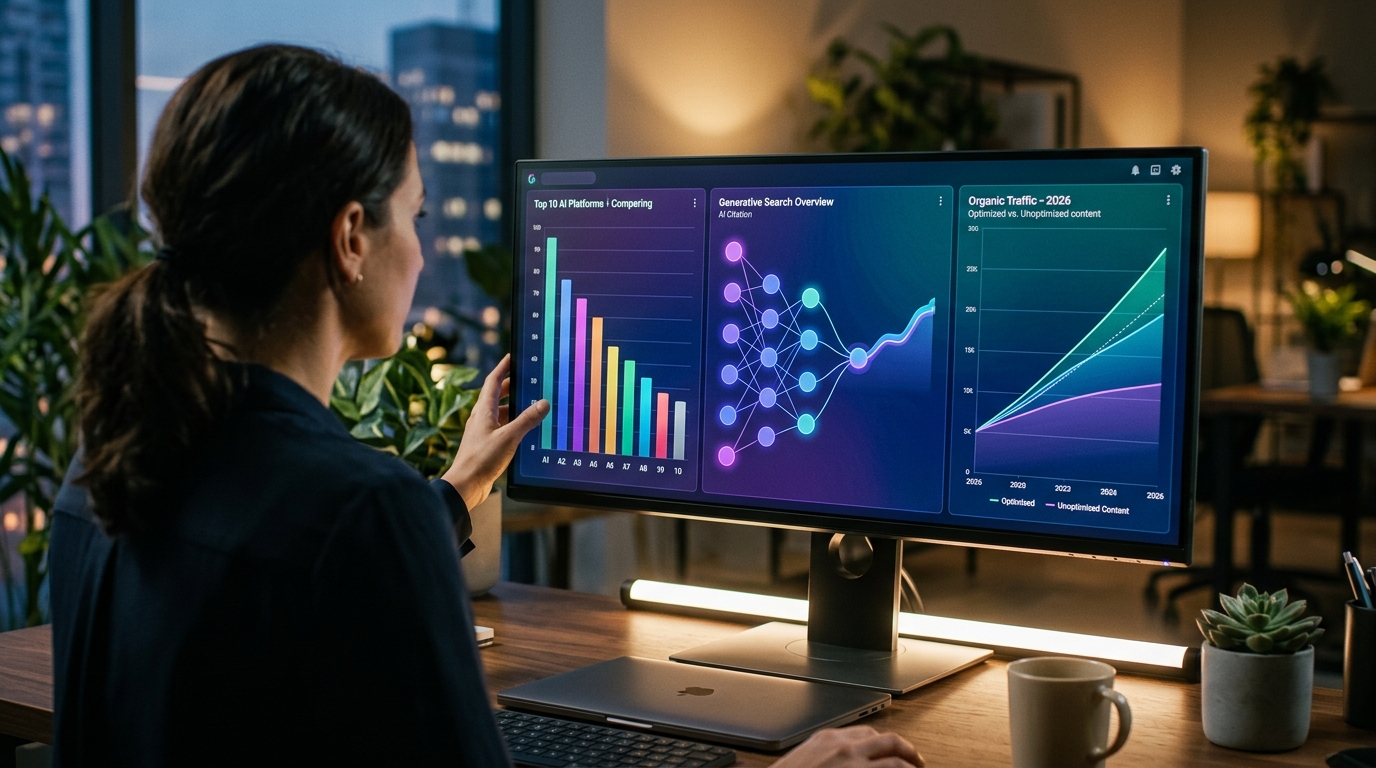
By the end of 2026, Gartner projects that organic search traffic will have plummeted by 50% for those who fail to adapt. We have officially entered the era of 'Zero-Click Dominance,' where 83% of searches are resolved within a single AI-generated summary. In this landscape, traditional rank tracking is a legacy metric; the real battle is for 'Share of Voice' within LLMs. To navigate this, elite marketers are turning to SEO forecasting tools that don't just look at keywords, but predict AI citations and generative ROI. If your brand isn't being cited by Gemini, ChatGPT, or Perplexity, you aren't just losing rankings—you’re losing relevance.
- The Great Search Shift: Why 2026 Demands Predictive SEO
- LLM SEO vs. Traditional Search: Defining the New Metrics
- The 10 Best SEO Forecasting Tools for 2026 Ranked
- Generative Search ROI Modeling: Explaining the 'Why' to the C-Suite
- Technical Infrastructure: Preparing for AI Crawlers and AIO Impact
- The Quick Win Framework: Leveraging GSC and GA4 for 2026
- Key Takeaways for 2026 SEO Strategy
- Frequently Asked Questions
The Great Search Shift: Why 2026 Demands Predictive SEO
In 2024, we talked about AI as an assistant; in 2026, AI is the interface. The transition from Search Engine Optimization (SEO) to Generative Engine Optimization (GEO) and Answer Engine Optimization (AEO) is complete. Users no longer type "best project management software" and click three links. They ask, "Which project management tool integrates with my specific tech stack and has the lowest learning curve for a team of 50?"
AI SEO traffic prediction in 2026 requires understanding how Large Language Models (LLMs) synthesize information. Traditional forecasting models based on "Keyword Volume x CTR" are fundamentally broken because the CTR of a #1 organic result has been cannibalized by Google's AI Overviews (AIO).
"Ranking #1 for a keyword used to drive 10-20x more traffic than a snippet citation. Today, being the 'Cited Source' in an AIO is the only way to capture high-intent users before they exit the search journey."
To survive, your predictive SEO software must account for: 1. Zero-Click Elasticity: How much traffic is lost to the AI summary vs. how much is gained via citations. 2. Brand Sentiment in LLMs: Whether ChatGPT recommends your brand or warns users away from it. 3. Topical Authority Depth: The probability that an AI agent deems your content "authoritative" enough to cite.
LLM SEO vs. Traditional Search: Defining the New Metrics
Before you can forecast, you must measure the right signals. In 2026, the industry has consolidated around a new set of KPIs that distinguish the winners from the laggards.
The 2026 Metric Paradigm
| Metric | Traditional SEO (2024) | AI SEO & GEO (2026) |
|---|---|---|
| Success North Star | Rank #1 for specific keywords | Brand Citations & Share of Voice (SoV) |
| Primary Goal | Drive Clicks | Become the "Cited Source" in AI answers |
| Forecasting Input | Search Volume (Monthly) | Query Fan-Out & LLM Reach |
| Content Strategy | Keyword-dense, long-form | Answer Targets, Chunking & Semantic Depth |
| Success Metric | Click-Through Rate (CTR) | LLM Mention Rate & Sentiment Score |
AIO impact forecasting now involves modeling the "Query Fan-out." This is the process where a single user prompt triggers a cascade of internal AI searches. If your tool doesn't track how often you appear in these "hidden" sub-queries, your traffic forecasts will be off by orders of magnitude.
The 10 Best SEO Forecasting Tools for 2026 Ranked
We have tested the leading platforms based on their ability to handle organic traffic forecasting 2026 requirements, specifically focusing on AI visibility and predictive ROI.
1. LLMClicks.ai (Best for AI Visibility Tracking)
If Google Search Console is your window into the open web, LLMClicks.ai is your dashboard for the black box of AI. It is the premier tool for measuring your true Share of Voice across ChatGPT, Claude, and Gemini. - Killer Feature: "Query Fan-out Coverage." It simulates thousands of conversational variations to see how often your brand is cited. - Verdict: Essential for enterprise SaaS and brand reputation management. It identifies exactly where competitors are stealing your "AI real estate."
2. SE Ranking (Best Overall Hybrid Platform)
SE Ranking has evolved from a standard rank tracker into a comprehensive predictive SEO software suite. - Killer Feature: AI Overview Monitoring. It tracks not just your rank, but whether you are featured in the AIO and which specific citations are being used. - Verdict: The best value for agencies needing to report on both traditional and AI-driven search results.
3. Semrush One (Best for Predictive Intelligence)
Semrush remains a powerhouse by integrating its "AI Copilot" directly into the forecasting workflow. - Killer Feature: Share of Voice (SoV) across AI platforms. It monitors mentions in Perplexity and ChatGPT search modes. - Verdict: The gold standard for market data and competitive gap analysis in the hybrid search era.
4. Surfer SEO (Best for Entity-Based Optimization)
Surfer SEO doesn't just look at keywords; it looks at entities. In 2026, AI models rank content based on semantic completeness. - Killer Feature: AEO Content Score. It predicts the likelihood of your content being used as a citation in Google’s AI Overviews. - Verdict: The best tool for content teams who need to ensure their articles are "machine-readable" for AI agents.
5. Profound (Best for GEO Specialists)
Profound is a specialized platform that focuses entirely on generative search ROI modeling. - Killer Feature: Sentiment Analysis across 15+ AI engines. It tells you if ChatGPT thinks your product is "reliable" or "overpriced." - Verdict: Critical for brand managers who need to influence the "training data" perception of their brand.
6. Ahrefs Brand Radar (Best for Authority Signals)
Ahrefs has leaned into its massive backlink database to predict AI trust. LLMs use high-authority links as a proxy for truth. - Killer Feature: Brand Radar. It monitors brand mentions across the generative landscape, linking them to domain authority scores. - Verdict: Best for technical SEOs who believe (rightly) that links still drive AI citations.
7. Alli AI (Best for Technical Automation)
Forecasting is useless if you can't implement changes fast. Alli AI allows for bulk technical fixes that make your site easier for AI bots to crawl. - Killer Feature: Bulk Schema Deployment. Instantly adds JSON-LD FAQ and Article schema across thousands of pages. - Verdict: A must-have for e-commerce sites with 10,000+ SKUs.
8. MarketMuse (Best for Topical Authority)
MarketMuse uses AI to build "Topical Maps," identifying the exact clusters you need to dominate to be seen as an expert by LLM crawlers. - Killer Feature: Content Gap Analysis. It identifies what your competitors are saying that you aren’t, specifically focusing on ROI-based prioritization. - Verdict: Best for building E-E-A-T (Experience, Expertise, Authoritativeness, Trustworthiness).
9. Frase (Best for Answer Engine Optimization)
Frase focuses on the "Answer" part of AEO. It scrapes real-time data from Reddit and Quora to find the actual questions people are asking. - Killer Feature: Automated Content Briefs. Generates outlines based on the questions currently dominating the AI search landscape. - Verdict: The best tool for informational content and FAQ optimization.
10. Clearscope (Best for Semantic Focus)
Clearscope uses Google’s latest NLP models to score content based on entity coverage and semantic relevance. - Killer Feature: Entity Mapping. It identifies secondary concepts that AI expects to see to trust your authority. - Verdict: The gold standard for high-end editorial teams and enterprise publishers.
Generative Search ROI Modeling: Explaining the 'Why' to the C-Suite
One of the biggest challenges in 2026 is explaining why organic traffic is down while brand influence is up. This is where generative search ROI modeling becomes a survival skill. You must shift the conversation from "Clicks" to "Assisted Conversions."
The "Asymmetrical Cost" Logic
Borrowing from advanced inventory management theory (like the Theory of Constraints), SEOs must realize that the cost of not being in an AI answer is higher than the cost of a traditional rank drop.
- The Cost of Absence: If a user asks an AI for a recommendation and your brand isn't there, you lose the entire top-of-funnel journey.
- The Buffer Strategy: Use your SEO forecasting tools to build "strategic buffers" of content. Instead of chasing a single keyword, build a web of citations across Reddit, YouTube, and niche directories. AI models aggregate these sources to form their "truth."
Actionable Step: When presenting to VPs, use a "Share of Voice" chart from tools like LLMClicks or Profound. Show that even if GSC clicks are flat, your brand's presence in AI summaries has increased, leading to higher direct-to-site branded searches.
Technical Infrastructure: Preparing for AI Crawlers and AIO Impact
Your site must be a "Clean Room" for AI bots. If GPTBot or ClaudeBot hits a wall of messy JavaScript or a convoluted URL structure, your content will never be synthesized into an answer.
The 2026 Technical Checklist
- JSON-LD is the Language of AI: Without proper FAQ, Article, and Local Business schema, AI agents are essentially blind. Use tools like Alli AI to automate this at scale.
- Site Speed is a Trust Signal: AI models are trained to prefer sites that provide a good user experience. A slow site is a "distrust" signal.
- Bot Management: Ensure your
robots.txtisn't accidentally blocking the very AI crawlers (OAI-SearchBot, PerplexityBot) you need for visibility. - URL Hygiene: Avoid "URL splitting." As noted in recent SEO discussions, maintaining two different URL structures for the same content can dilute signals and lead to cannibalization, confusing the AI models that are trying to index your "best" answer.
// Example of Answer-Ready Schema for 2026 { "@context": "https://schema.org", "@type": "FAQPage", "mainEntity": [{ "@type": "Question", "name": "What are the best SEO forecasting tools for 2026?", "acceptedAnswer": { "@type": "Answer", "text": "The best SEO forecasting tools for 2026 include LLMClicks.ai for AI visibility, SE Ranking for AIO tracking, and Semrush One for predictive intelligence." } }] }
The Quick Win Framework: Leveraging GSC and GA4 for 2026
While high-end predictive SEO software is necessary for long-term strategy, quick wins in 2026 still hide in your existing data. Expert practitioners on Reddit and Quora highlight a specific workflow for "low-hanging fruit."
1. The GSC "High Impression, Low Click" Audit
Look for pages ranking in positions 2–8 that have high impressions but abysmal click-through rates. In 2026, this usually means an AI Overview is answering the query. - The Fix: Don't try to out-rank the AIO. Try to become the citation. Rework your H2s into direct questions and provide a concise 40-60 word answer immediately following the heading.
2. The GA4 "Engagement Gap"
Analyze pages where users land but exit quickly. This indicates that your content didn't solve the problem end-to-end. - The Fix: AI models favor "narrow and deep" content. If your page is a generic listicle, replace it with a deep-dive guide that includes real-world expertise and client reviews (E-E-A-T signals).
3. Strengthening Foundational Backlinks
Manual, high-DR directory placements and forum participation (Reddit, Quora) are more important than ever. AI models treat these platforms as "Human Truth" filters. Being mentioned in a trending Reddit thread can trigger a massive spike in AI citations within 48 hours.
Key Takeaways for 2026 SEO Strategy
- The 80/20 Rule of Traffic: 80% of your informational traffic will likely be consumed by AI Overviews. Your goal is to capture the remaining 20% of high-intent clicks by being the primary cited source.
- Entity over Keyword: Focus on topical authority. Use MarketMuse or Surfer SEO to ensure you cover every semantic entity related to your niche.
- Technical Readiness: Implement JSON-LD schema across your entire site. If the AI can't parse your data, it won't recommend your brand.
- Hybrid Stack: Don't rely on a single tool. Pair a traditional powerhouse like Semrush with an AI-native tracker like LLMClicks.ai.
- E-E-A-T is Non-Negotiable: AI cannot replicate real human experience. Use case studies, unique data, and expert quotes to differentiate your content from the "AI fluff" ocean.
Frequently Asked Questions
How do SEO forecasting tools predict AI traffic in 2026?
Modern tools use "Query Fan-out" simulation and LLM monitoring to see how often a brand appears in synthesized answers. They combine this with traditional search volume data to estimate the "Share of Voice" a brand has within a specific AI engine like ChatGPT or Google Gemini.
What is GEO (Generative Engine Optimization)?
GEO is the process of optimizing website content to be accurately indexed, synthesized, and cited by generative AI engines. It focuses on structured data, semantic depth, and "cite-ability" rather than just traditional keyword rankings.
Is traditional SEO dead because of AI Overviews?
No, but it has evolved. Technical SEO and backlinks remain the foundation that earns you the right to be indexed. However, the "Informational Search" layer has been replaced by AEO (Answer Engine Optimization), requiring a shift in how content is structured and measured.
Can I use ChatGPT to write all my SEO content in 2026?
You can, but it is risky. 2026 search algorithms are highly sophisticated at detecting "shallow" AI content. For sustainable rankings and AI citations, you need a "Human-in-the-Loop" approach that adds original research, real-world experience, and unique brand voice.
Which tool is best for tracking mentions in ChatGPT Search?
LLMClicks.ai and Profound are currently the leaders in tracking brand mentions and sentiment across conversational AI platforms. They provide a "Mention Rate" metric that traditional SEO tools like Ahrefs are only beginning to implement.
Conclusion: The Future belongs to the Predictive
The "Great Transition" of search isn't a threat—it's an opportunity for those who have the right data. By moving away from legacy rank tracking and embracing SEO forecasting tools that prioritize AI visibility, you can protect your brand's future.
Don't wait for your organic traffic to hit zero. Start modeling your AIO impact forecasting today, clean up your technical infrastructure for AI crawlers, and ensure your brand is the one the AI trusts to answer the world's questions. The era of the blue link is over; the era of the cited authority has begun.
Ready to dominate the 2026 search landscape? Audit your AI visibility today and start building the topical authority that machines—and humans—can't ignore.