Google Trends recently reported a staggering 2,400% increase in searches for Vibe Coding since the start of 2025. It is no longer just a viral tweet from Andrej Karpathy; it is the defining development paradigm of 2026. Today, 92% of US developers use AI-native tools daily, and the line between 'writing code' and 'prompting intent' has blurred into oblivion. But as the hype reaches a fever pitch, a massive divide has opened: is this the democratization of software, or a high-speed collision with a $1.5 trillion technical debt wall?
- Defining Vibe Coding in 2026
- The 2026 Vibe Coding Tech Stack: A Comparative Review
- The Disillusionment Phase: Is Vibe Coding a Scam?
- Prompt-First Software Engineering: Mastering the 6-Element Skeleton
- Security and the $1.5 Trillion Technical Debt Crisis
- Building Apps with Intent-Based Architecture
- Vibe Coding vs Traditional Coding: The Hybrid Reality
- Agentic Engineering: The Professional Path Forward
- Key Takeaways / TL;DR
- Frequently Asked Questions
- Conclusion
Defining Vibe Coding in 2026
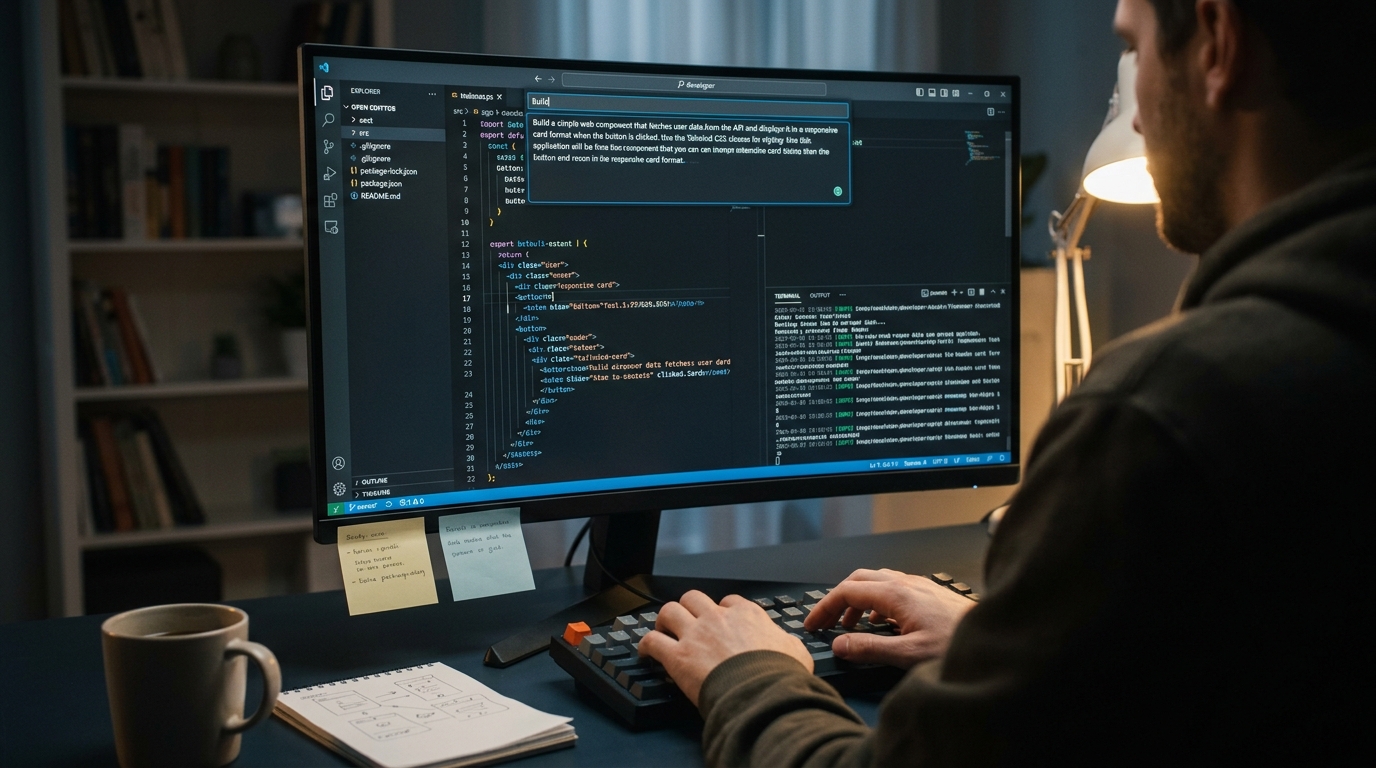
Vibe coding is a software development practice where the developer (or 'viber') describes desired outcomes in natural language, delegating the implementation, debugging, and deployment to autonomous AI agents. Coined by Andrej Karpathy in February 2025, the term describes a state where you "fully give in to the vibes" and stop worrying about the underlying syntax.
The Shift from Syntax to Intent
In 2024, we used AI for autocomplete. In 2026, we use Prompt-First Software Engineering. This means the prompt is the source code. As Karpathy noted, "The hottest new programming language is English." However, industry experts like Simon Willison argue for a distinction: if you don't review and test the output, you aren't developing software—you're just vibing.
Market Adoption by the Numbers
- 92% of developers use AI tools daily.
- 41% of all global code is now AI-generated.
- $4.7 Billion: The estimated market size of vibe coding tools in 2026.
- 63% of vibe coding users are non-developers, illustrating a massive democratization of the SDLC.
The 2026 Vibe Coding Tech Stack: A Comparative Review
The landscape has evolved beyond simple chat interfaces. We now have AI-Native SDLC patterns integrated into full-blown agentic IDEs. Choosing the right tool depends on whether you are building a weekend prototype or an enterprise-grade service.
| Tool | Primary Strength | Best For |
|---|---|---|
| Google Antigravity | Multi-agent parallel execution | Complex, UI-heavy full-stack apps |
| Claude Code | 200k context & 80.8% SWE-bench score | Deep refactoring and multi-file logic |
| Cursor | VS Code-based context awareness | Developers who want a hybrid workflow |
| Lovable | Instant UI-to-Code generation | Rapid MVP prototyping and landing pages |
| Replit Agent | End-to-end hosting & deployment | Solo builders and rapid experimentation |
Antigravity: The Parallel Powerhouse
Antigravity has changed the game with its Manager View. Instead of one agent working linearly, you can assign different features to a team of agents. One handles the PostgreSQL schema via Supabase, another builds the React frontend, and a third writes the integration tests—all simultaneously. This has led to reported 81% productivity gains for senior engineers.
Claude Code: The Logic Specialist
For those moving beyond "vibes" into serious engineering, Claude Code (specifically the Opus 4.6 and Sonnet 4.6 models) remains the gold standard for accuracy. It doesn't just write code; it plans the architecture. Users report it can handle 95% of routine tasks autonomously, provided the context is well-managed through the Model Context Protocol (MCP).
The Disillusionment Phase: Is Vibe Coding a Scam?
Despite the glossy demos, a vocal segment of the community—particularly on platforms like Reddit's r/lovable—is calling out the "vibe coding scam." The critique centers on the 70% Wall: the AI gets you 70% of the way there in minutes, but the remaining 30% (auth, edge cases, data integrity) becomes a debugging nightmare.
"I wasted months and thousands of credits on this hype. These tools are buggy money pits. They hallucinate features, loop on fixing the same error, and the credit systems are predatory." — Reddit User r/lovable
The "AI Slop" Problem
Critics argue that tools like Bolt.new and Emergent often produce "messy, unmaintainable spaghetti code." Without a technical foundation, non-coders often fall into "failure loops," burning through compute credits while the AI confidently breaks its own previous fixes. This has led to a rise in "vibe coding post-mortems," where founders realize that "it works on my screen" does not mean "it works for 10,000 users."
The Counter-Argument: "Skill Issue"
Defenders of the paradigm suggest that these failures are a "skill issue." They argue that vibe coding isn't a genie—it's a tool that requires Natural Language Programming 2026 skills. As one veteran developer put it, "Perfection kills everything. Vibe coders test ideas fast. Developers spend weeks making it perfect while the viber has already found their first customer."
Prompt-First Software Engineering: Mastering the 6-Element Skeleton
To avoid the "scam" trap, successful engineers have moved from vague chatting to structured Prompt-First Software Engineering. The quality of the output is directly correlated to the structural integrity of the input.
The 6-Element Skeleton
Every high-stakes prompt in 2026 should follow this framework:
1. Role: "Act as a Senior Staff Engineer obsessed with performance."
2. Goal: "Implement a real-time notification system using WebSockets."
3. Context: Use @mention or MCP to point to specific files (@schema.sql, @auth-handler.ts).
4. Constraints: "No external libraries except Tailwind and Lucide. Must be compliant with SOC2 data masking."
5. Format: "Provide the output as a multi-file diff with accompanying unit tests."
6. Evaluation: "First, score your logic 1-10. If it's below a 10, rewrite it until it hits a 10."
Context Engineering
Stop prompting harder; start engineering context. Modern tools like Windsurf and Antigravity rely on .rules files. By defining a .antigravity/rules/project.md, you ensure the AI knows your tech stack, naming conventions, and security requirements before you even type a single word. This reduces hallucinations by up to 65%.
Security and the $1.5 Trillion Technical Debt Crisis
This is the most dangerous aspect of the vibe coding era. Gartner predicts that by 2027, the technical debt generated by unreviewed AI code will reach $1.5 trillion.
The Vulnerability Data
- 24.7% of AI-generated code snippets contain security flaws.
- AI code fails security tests 45% of the time.
- AI-generated code has 1.7x more "major issues" compared to human-written code.
Common Vibe Coding Security Risks
- Hardcoded Secrets: AI frequently embeds API keys or database credentials directly in the code.
- SQL Injection: Non-technical users often fail to prompt for parameterized queries, leading to massive data exposure.
- Hallucinated Dependencies: AI might suggest a non-existent npm package, which attackers then create as a "typosquatting" malware trap.
- Exposed .env Files: There are numerous reports of vibe-coded apps being deployed with public access to environment variables.
Pro Tip: Always use a security-first prompt wrapper. Tell the AI: "Review this code for OWASP Top 10 vulnerabilities and suggest hardening measures before I accept the changes."
Building Apps with Intent-Based Architecture
When building apps with intent-based architecture, you aren't just asking for a feature; you are defining the system's behavior. This requires a shift in how we think about the SDLC.
The Objective-Validation Protocol
Instead of the traditional Waterfall or Agile, 2026 teams use the Objective-Validation Protocol: - Objective: Define the high-level goal (e.g., "Users can subscribe to a premium plan"). - Plan: The AI agents propose an architectural plan (DB changes, API routes, UI components). - Execution: The AI writes the code in a sandbox. - Validation: Automated test suites (Playwright, Vitest) run against the sandbox. If they pass, the code is merged.
Modularization is Key
AI struggles with massive, monolithic files. To succeed in vibe coding, you must enforce modularity. Keep components small, use clear interfaces, and document the data flow. This allows the AI to stay within its context window and reduces the chance of "breaking the whole app" with a single change.
Vibe Coding vs Traditional Coding: The Hybrid Reality
The debate isn't about which is better; it's about when to use which. We are entering the era of Hybrid Engineering.
| Feature | Vibe Coding | Traditional Coding |
|---|---|---|
| Speed | 10x - 50x faster for MVPs | Slower, methodical |
| Security | Low (needs expert review) | High (built-in oversight) |
| Scalability | Variable (often messy) | High (architected for growth) |
| Cost | High token/credit burn | High developer salary |
| Best Use Case | Prototypes, internal tools, UI | Core infra, fintech, healthcare |
The "Staff Engineer" Mental Model
Think of the AI as a highly talented but occasionally reckless Junior Developer. As the "Viber," your role has shifted from Author to Editor-in-Chief. You don't need to write the syntax, but you must understand the architecture well enough to know when the AI is lying to you.
Agentic Engineering: The Professional Path Forward
As we move deeper into 2026, the term "Vibe Coding" is being replaced by Agentic Engineering. This is the professionalization of the trend. It involves orchestrating teams of agents with defined roles, quality gates, and automated feedback loops.
The Rise of the "Minion" Patterns
Companies like Stripe and Zapier are now using "Minions"—specialized AI agents that live in their GitHub repos. These agents don't just write code; they monitor performance, suggest refactors, and even handle documentation. This is AI-Native SDLC in action: the system is self-healing and self-evolving.
Why Engineering Skills Still Matter
Non-technical founders are finding that while they can build an app in a weekend, they can't maintain it without technical help. The most successful builders in 2026 are those who use vibe coding to bypass the "boring stuff" (boilerplate, CSS, basic CRUD) but apply rigorous engineering principles to the core logic.
Key Takeaways / TL;DR
- Vibe Coding is a prompt-first development style that prioritizes intent over syntax, seeing massive adoption in 2026.
- The "70% Wall" is real: AI produces prototypes fast, but the final 30% of production-readiness requires technical rigor.
- Prompt-First Engineering requires a structured approach—use the 6-Element Skeleton to get reliable results.
- Security is the biggest risk: Nearly 25% of AI code has vulnerabilities. Never vibe-code auth or payments without expert review.
- The Future is Agentic: We are moving from single-prompt generation to orchestrating teams of specialized AI agents.
- Tools to Watch: Google Antigravity for parallel work, Claude Code for logic, and Cursor for a hybrid developer experience.
Frequently Asked Questions
What exactly is Vibe Coding?
Vibe coding is a term coined by Andrej Karpathy to describe a development style where you use natural language prompts to have AI agents build software. You focus on the "vibe" or the intent of the app rather than writing the specific lines of code yourself.
Is Vibe Coding a replacement for learning to code?
Not entirely. While it allows non-coders to build functional prototypes, maintaining and securing a production-grade application in 2026 still requires a fundamental understanding of software architecture, security, and logic. Most successful "vibers" have a basic technical foundation.
Which are the best Vibe Coding tools in 2026?
The top contenders are Google Antigravity (for multi-agent parallel tasks), Claude Code (for high-accuracy refactoring), and Cursor (for developers wanting AI-integrated into their existing workflow). For non-coders, Lovable and Replit Agent offer the lowest barrier to entry.
How do I avoid high credit costs while vibe coding?
Use "Context Engineering." By providing clear rules in files like .cursorrules or .antigravity/rules, you reduce the number of back-and-forth prompts needed to fix errors, which saves tokens. Also, pulling code to a local environment once the prototype is stable can stop the burn of cloud-hosting credits.
Is AI-generated code secure?
Generally, no. Research shows that roughly 1 in 4 AI-generated code snippets has a security flaw. Common issues include hardcoded credentials and SQL injection. You should always use automated security scanners (like Snyk or GitHub Advanced Security) on any code produced through vibes.
Conclusion
Vibe Coding in 2026 is a double-edged sword. It offers the most significant leap in human productivity since the invention of the compiler, yet it threatens to bury the industry in a mountain of "AI slop" and technical debt. The winners of this era won't be those who blindly trust the AI, nor those who ignore it.
The future belongs to the Agentic Engineer—the builder who uses prompt-first patterns to move at light speed, but applies the timeless principles of security, modularity, and rigorous testing to ensure their "vibes" can withstand the reality of production. Whether you are a solo founder or a staff engineer, your new job isn't writing code. It's orchestrating intelligence. Are you ready to vibe responsibly?