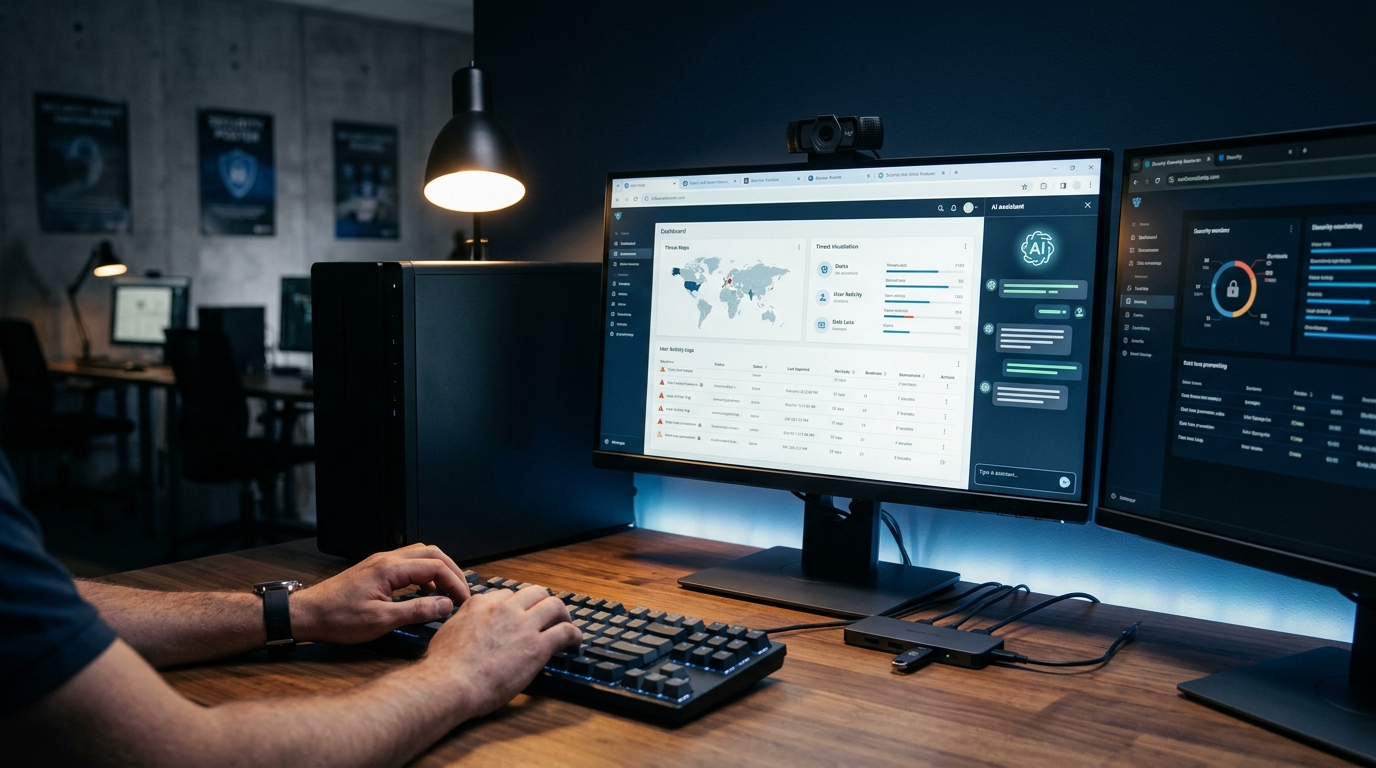
By 2026, the average enterprise Security Operations Center (SOC) is no longer fighting human hackers alone; they are defending against agentic threats—autonomous AI entities that pivot, escalate, and obfuscate at machine speed. Research shows that Tier-1 analysts now process an average of 960 alerts daily, with large enterprises handling over 3,000 alerts from 30+ disparate tools. If your team is still training on static, scripted scenarios, you aren't just behind—you're a target. An AI-native cyber range is the only way to replicate the unpredictability of a world where 'vibe coding' and agentic deployment platforms like Kuberns have fundamentally altered the attack surface.
The Shift from Scripted to Agentic Threat Simulation
Traditional cyber ranges relied on "Capture the Flag" (CTF) events and scripted scenarios that followed a predictable path. In 2026, this is insufficient. The rise of autonomous cyber attack simulation means that threats now use specialized AI agents to probe for vulnerabilities in real-time.
As one senior engineer noted in recent industry discussions, the workflow has shifted: "I run the agent in a tmux session, write a short prompt, let it implement, then review the diff." If developers are using agents to build, attackers are using agents to break. Modern enterprise cybersecurity training AI must account for "mesh agentic architectures" where multiple AI models collaborate to bypass traditional signature-based defenses. The goal is no longer just detecting a file hash; it’s identifying anomalous behavioral patterns in an environment where 60% of SOC workloads have shifted to AI.
1. Conifers.ai CognitiveSOC: The Mesh Agentic Leader
Conifers.ai has emerged as the "company to beat" in 2026, specifically for its mesh agentic architecture. Unlike platforms that rely on a single LLM, Conifers orchestrates multiple specialized AI techniques—including DSLMs, machine learning, and behavioral analytics—to simulate complex, multi-tier investigations.
- Best For: MSSPs and enterprises requiring 99%+ accuracy in autonomous investigations.
- Standout Feature: Patent-Pending Mesh Agentic Architecture that applies specific AI models to specific incident types.
- Performance Benchmark: Investigations are 87% faster, with an average investigation time of 2.5 minutes.
"What distinguishes Conifers is its understanding that successful AI implementation requires more than automating existing processes... it operates as an autonomous agent that can independently investigate incidents."
2. SentinelOne Singularity: Autonomous EDR/XDR Training
SentinelOne remains a powerhouse for best cyber range software 2026 by focusing on the endpoint. Their Singularity platform uses AI to correlate threats across the "Storyline," making it an ideal training ground for analysts learning to hunt ransomware and zero-day exploits.
- Key Features: AI-powered EDR/XDR, autonomous threat hunting, and one-click rollback capabilities.
- Pros: High detection accuracy (14/14 in MITRE ATT&CK steps) and a user-friendly interface.
- Cons: Higher-tier pricing can be prohibitive for smaller labs.
3. Darktrace ActiveAI: Self-Learning Defense Simulation
Darktrace’s "pattern of life" philosophy is critical for training against insider threats. By establishing a baseline of normal behavior, the platform simulates how an AI-driven red teaming platform would attempt to blend into corporate traffic.
- Training Value: Teaches analysts to spot "unknown unknowns" without relying on predefined signatures.
- Standout Feature: Antigena, which provides autonomous responses to neutralize attacks in progress.
4. CrowdStrike Falcon: Charlotte AI & Agentic Workflows
CrowdStrike’s Falcon platform, powered by Charlotte AI, allows users to engage in agentic threat simulation through natural language. It is particularly effective for training "elite threat hunters" who need to manage massive distributed environments.
- Architecture: Cloud-native with lightweight agents that minimize system impact.
- Agentic Capability: Charlotte AI handles complex workflows, allowing trainees to focus on high-level strategy rather than manual log parsing.
5. Palo Alto Networks Cortex XSIAM: The Autonomous SOC Range
Cortex XSIAM is designed to replace the traditional SIEM with an AI-driven data lake. As an enterprise cybersecurity training AI tool, it excels at showing how data correlation across endpoint, network, and cloud can reduce alert fatigue.
- Pros: Strong analytics that reduce noise by up to 85%.
- Cons: Requires a robust existing infrastructure; not a "plug-and-play" solution for small teams.
6. Hoxhunt: Adaptive Behavioral Threat Simulation
Hoxhunt represents the evolution of security awareness. Moving away from "check-the-box" compliance, Hoxhunt uses continuous, adaptive simulations that adjust difficulty based on user behavior.
- Real-World Data: Users handle an average of 960 alerts daily; Hoxhunt trains them to report, not just "not click."
- The Shift: "Mimecast and most platforms are built around campaigns... Hoxhunt runs continuous adaptive simulations... someone who's sharp gets more sophisticated attacks."
| Feature | Traditional SAT | Hoxhunt (AI-Native) |
|---|---|---|
| Frequency | Quarterly/Annual | Continuous |
| Difficulty | Static | Adaptive (User-based) |
| Goal | Compliance Check | Behavioral Risk Reduction |
| Feedback | Delayed | Instant / In-the-moment |
7. Lakera: Red Teaming for LLMs and Prompt Injection
As companies integrate LLMs into their own products, the threat of prompt injection becomes a Tier-1 risk. Lakera provides an AI-driven red teaming platform specifically for testing the vulnerabilities of AI models themselves.
- Training Tool: Lakera Guard filters prompts and simulates "Gandalf" style injection attacks.
- Context: Essential for fintech and regulated industries where AI models touch sensitive PII.
8. Microsoft Security Copilot: Ecosystem-Scale Simulation
For organizations already locked into the Azure/M365 ecosystem, Security Copilot provides the most seamless autonomous cyber attack simulation environment. It leverages 65 trillion daily signals to provide context that other tools simply can't match.
- Efficiency: Improves analyst speed by 22% and accuracy by 7%.
- Constraint: Less effective for multi-cloud or on-prem environments outside the Microsoft stack.
9. Vectra AI Cognito: NDR and Lateral Movement Focus
Vectra AI is the gold standard for simulating lateral movement. In a 2026 cyber range, simulating how an attacker moves from a compromised "vibe coded" SaaS app to the core database is vital.
- Focus: Network Detection and Response (NDR).
- Benefit: Provides detailed attack pattern insights via intuitive dashboards that highlight insider threats.
10. AccuKnox: Zero-Trust Runtime Agentic Security
AccuKnox sits at the intersection of DevOps and Security. It uses eBPF-based monitoring to provide deep runtime visibility, making it a top choice for training on agentic threat simulation in Kubernetes and cloud-native workloads.
- The Tech: Agentless monitoring that reduces alert noise by 85%.
- Use Case: Training for "naughty code" generated by AI agents that might contain hidden backdoors.
The 'Vibe Coding' Risk: Why Your Range Needs Agentic Code Review
In 2026, the term "vibe coding" has moved from Reddit threads to the C-suite. Developers are increasingly using tools like Claude Code, Cursor, and Codex to ship features at a pace that manual security reviews cannot match. This creates a massive security gap.
As one developer noted on r/vibecoding: "I just vibe design and code with Replit. If something gets traction... I export it to Github/AWS then iterate using Claude Code."
This "push now, secure later" mentality is exactly what an AI-native cyber range must simulate. Training scenarios should include: 1. AI-Generated Vulnerabilities: Simulating code that looks functional but contains subtle logic flaws introduced by an LLM. 2. Agentic Deployment Risks: Using platforms like Kuberns to automate environment setup, which may inadvertently expose S3 buckets or API keys. 3. Shadow AI Discovery: Training analysts to find "Shadow AI" instances where employees are inputting corporate financials into retail LLMs without VPC controls.
Key Takeaways
- Agentic Threats are Real: Attackers now use autonomous bots that pivot and adapt; your cyber range must do the same.
- Mesh Architecture Wins: Platforms like Conifers.ai that use multiple AI models outperform single-LLM solutions in accuracy and speed.
- Behavior Over Clicks: Metrics are shifting from "click rates" to "behavioral risk reduction" and "Mean Time to Investigate" (MTTI).
- Developer Speed vs. Security: The "vibe coding" trend requires new red teaming strategies focused on AI-generated code and agentic CI/CD pipelines.
- Runtime Visibility is Essential: Tools like AccuKnox and Vectra AI are critical for spotting lateral movement in cloud-native environments.
Frequently Asked Questions
What is an AI-native cyber range?
An AI-native cyber range is a simulated environment that uses artificial intelligence to generate dynamic, autonomous threats (agentic threats) and provides AI-driven tools for defenders to practice detection, investigation, and response at machine speed.
How does agentic threat simulation differ from traditional red teaming?
Traditional red teaming follows human-scripted playbooks. Agentic threat simulation uses AI agents that can make autonomous decisions, change tactics based on defensive responses, and operate 24/7 without human intervention, mimicking the latest AI-powered malware.
Why is 'vibe coding' a security concern for enterprises?
'Vibe coding' refers to rapid, AI-assisted development where code is generated and deployed quickly based on high-level prompts. This often bypasses traditional security gates, leading to vulnerabilities like prompt injection, insecure API configurations, and PII leaks that AI-native cyber ranges are designed to simulate.
Can AI-native cyber ranges help with compliance like GDPR or SOC 2?
Yes. Many platforms, such as Qualysec and Conifers.ai, include compliance-specific modules that simulate audits and ensure that autonomous responses align with regulatory requirements for data privacy and integrity.
Which platform is best for small-to-medium businesses (SMBs)?
For SMBs, SentinelOne Singularity and CylanceENDPOINT are highly recommended due to their lightweight agents, ease of deployment, and transparent pricing structures that don't require a full-time SOC team to manage.
Conclusion
The cybersecurity landscape of 2026 demands a fundamental shift in how we train. The 10 platforms listed here represent the vanguard of autonomous cyber attack simulation, offering the tools necessary to defend against an increasingly agentic world. Whether you are a CISO looking to reduce behavioral risk with Hoxhunt or a Lead Architect securing a mesh agentic SOC with Conifers.ai, the priority is clear: train for the threat you will face tomorrow, not the one you defeated yesterday.
Ready to upgrade your team's skills? Start by evaluating your current "vibe coding" exposure and integrating an AI-driven red teaming platform into your quarterly drills. The future of security is autonomous—make sure your defense is too.