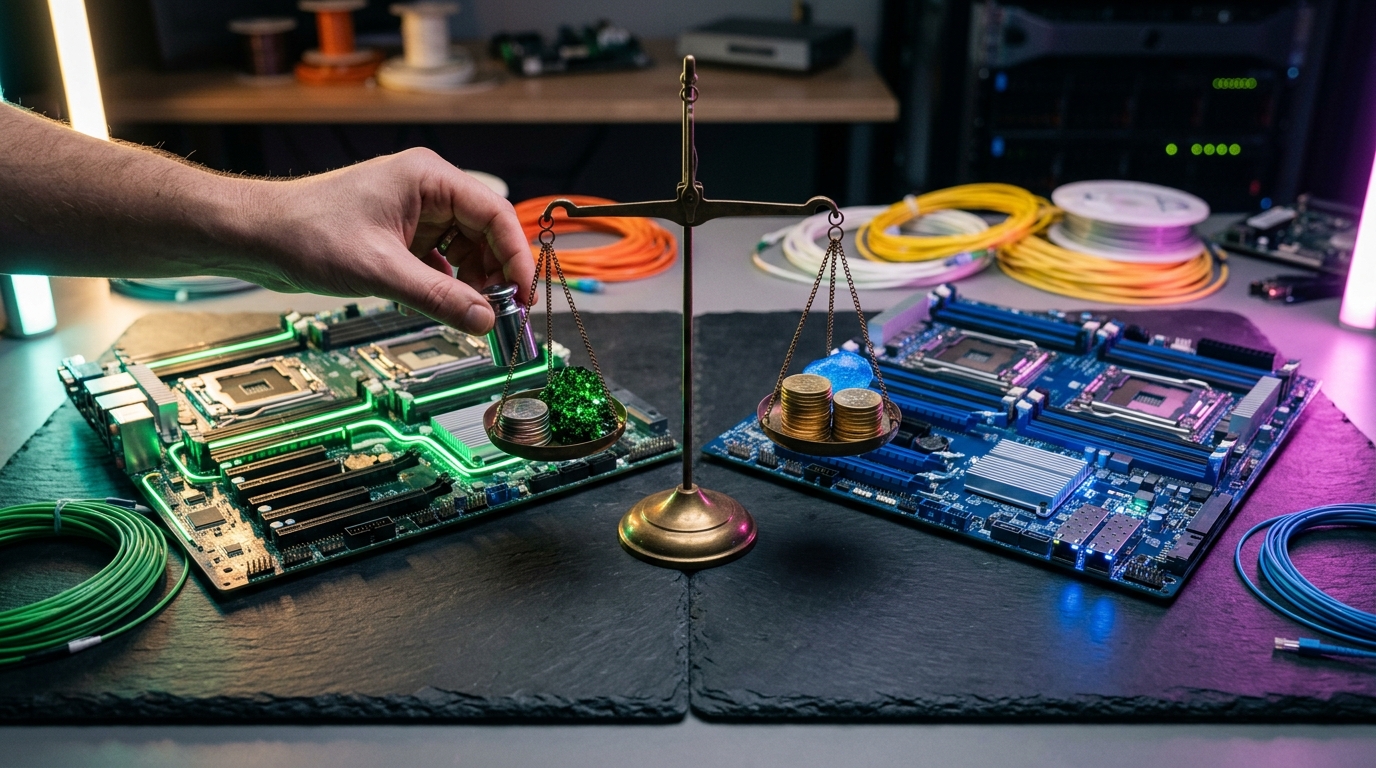
By 2026, the traditional enterprise perimeter has not just dissolved; it has vaporized. As large language models (LLMs) and distributed AI agents become the primary workload for global organizations, the underlying infrastructure has been forced to evolve. We are no longer just connecting virtual machines; we are orchestrating high-bandwidth, low-latency data pipelines across heterogeneous environments. This is the era of AI-Native Multi-Cloud Networking, where the network is no longer a passive pipe but an intelligent, self-healing fabric that anticipates demand before a single packet is dropped.
In this comprehensive guide, we analyze the top 10 platforms defining the next generation of autonomous cloud networking software. Whether you are scaling multi-cloud networking for AI clusters or seeking to optimize cross-cloud agent connectivity, these tools represent the pinnacle of engineering in 2026.
The Evolution of AI-Native Multi-Cloud Networking
The transition from legacy SD-WAN to AI-Native Multi-Cloud Networking (MCN) was driven by one factor: complexity. In 2026, a typical enterprise uses AWS for general compute, OCI for high-performance GPU clusters, and Azure for its integrated OpenAI services. Manually configuring BGP peering, managing IP overlaps, and securing egress traffic across these silos is a recipe for catastrophic downtime.
Modern autonomous cloud networking software leverages machine learning to automate these tasks. We are seeing a shift from "intent-based" networking to "outcome-based" networking. Instead of telling the network how to route (e.g., "use this VPN tunnel"), engineers tell the AI what is needed (e.g., "ensure sub-10ms latency for the training data stream between Frankfurt and Northern Virginia").
"The network is the computer, but the AI is the operator. In 2026, if your MCN platform doesn't have a built-in reasoning engine, you're not managing a network; you're managing a legacy liability."
1. Aviatrix: The Distributed Cloud Pioneer
Aviatrix remains the gold standard for AI-driven network orchestration. By deploying a proprietary data plane (the Aviatrix Gateway) across all major hyperscalers, Aviatrix provides a consistent set of networking and security features that the native cloud providers simply cannot match.
In 2026, their "Distributed Cloud Firewall" has evolved into an AI-native security engine that identifies anomalous traffic patterns in real-time. For organizations running multi-cloud networking for AI clusters, Aviatrix offers a unique "High-Performance Encryption" (HPE) mode that delivers line-rate speeds up to 100Gbps—critical for moving massive datasets between clouds.
Key Features: - CoPilot AI: A generative AI assistant that troubleshoots complex routing issues in seconds. - Cost Control: Granular visibility into egress costs, with AI-suggested routing paths to minimize expenses. - Terraform Integration: Fully programmable infrastructure-as-code (IaC) support.
2. Prosimo: Full-Stack AI Orchestration
Prosimo has taken a different approach by focusing on the application layer. Their platform doesn't just connect clouds; it optimizes the entire stack from the user to the application. In the context of cross-cloud agent connectivity, Prosimo's AXI (Autonomous eXperience Infrastructure) is a game-changer.
Prosimo uses AI to analyze application performance and automatically adjust network paths. If an AI agent in Azure is experiencing high latency while querying a database in GCP, Prosimo can dynamically spin up a private interconnect or shift traffic to a faster transit point without human intervention.
| Feature | Prosimo Capability |
|---|---|
| Network Layer | Multi-cloud transit, peering, and cloud-native integration |
| App Layer | Service mesh, API security, and WAF integration |
| AI Engine | Real-time path optimization based on application health |
| Visibility | End-to-end observability from the user to the microservice |
3. Alkira: The Cloud-Native NaaS Leader
Alkira is the leader in the "Network-as-a-Service" (NaaS) space. Their platform allows engineers to build a global multi-cloud network in a matter of minutes using a drag-and-drop interface. For teams that want to avoid managing virtual appliances, Alkira provides a completely agentless experience.
In 2026, Alkira has integrated advanced autonomous cloud networking software that handles the heavy lifting of IP address management (IPAM) and security policy enforcement across AWS, Azure, and Google Cloud. Their "Cloud Exchange Points" (CXPs) act as high-speed hubs for AI-Native Multi-Cloud Networking, ensuring that traffic never touches the public internet if a private path is available.
4. Cisco + Isovalent: eBPF-Powered Intelligence
Cisco’s acquisition of Isovalent (the creators of Cilium) has fundamentally changed the MCN landscape. By leveraging eBPF (Extended Berkeley Packet Filter), Cisco now offers deep observability and security at the kernel level. This is particularly vital for multi-cloud networking for AI clusters, where traditional sidecar proxies introduce too much latency.
Cilium's ability to provide high-performance networking, load balancing, and network security across Kubernetes clusters in different clouds makes it the preferred choice for cloud-native AI organizations. Cisco has integrated this with their ThousandEyes telemetry to create a truly predictive network fabric.
yaml
Example Cilium Network Policy for Cross-Cloud AI Agents
apiVersion: "cilium.io/v2" kind: CiliumNetworkPolicy metadata: name: "allow-cross-cloud-agent-sync" spec: endpointSelector: matchLabels: app: ai-agent egress: - toEndpoints: - matchLabels: "k8s:io.kubernetes.packet.pattern": "training-data" toPorts: - ports: - port: "8080" protocol: TCP
5. F5 Distributed Cloud: Edge-to-Cloud Synergy
F5 has successfully pivoted from hardware load balancers to a software-defined multi-cloud powerhouse. The F5 Distributed Cloud (F5 XC) is uniquely positioned for AI-Native Multi-Cloud Networking that extends to the edge. As AI inferencing moves closer to the user (in retail stores, factories, and hospitals), F5 provides a unified console to manage both the core cloud and the edge nodes.
Their "AI-Native App Stack" includes automated WAF tuning and bot defense, using machine learning to distinguish between legitimate AI agent traffic and malicious scrapers.
6. Arista CloudVision: Predictive Network Operations
Arista has long been the favorite of high-frequency traders and hyperscalers. In 2026, their CloudVision platform has evolved into a sophisticated AI-driven network orchestration tool. Arista focuses on "Network Data Lakes," aggregating telemetry from every switch and router to build a digital twin of the entire multi-cloud environment.
This allows engineers to run "what-if" scenarios. For example, "What happens to the AI training job if we lose the primary interconnect between OCI and AWS?" CloudVision provides the answer and suggests proactive configuration changes to prevent a bottleneck.
7. Juniper Mist: AI-Driven Campus to Cloud
Juniper Networks, now part of Hewlett Packard Enterprise (HPE), has the most mature AI engine in the industry: Marvis. While Marvis started in the WLAN space, it has expanded to the WAN and the cloud. Juniper’s approach to AI-Native Multi-Cloud Networking is centered on "Experience-First Networking."
Marvis uses natural language processing (NLP) to allow engineers to ask questions like, "Why is the cross-cloud latency high for the LLM inference service?" Marvis then correlates data across the entire path—from the campus Wi-Fi to the cloud VPC—to find the root cause.
8. Graphiant: The Programmable Edge Fabric
Graphiant is the challenger in the space, offering a private, programmable edge fabric that rivals the performance of MPLS with the agility of the cloud. For enterprises worried about the unpredictability of the public internet for cross-cloud agent connectivity, Graphiant provides a "stateless" core that ensures deterministic performance.
Their platform is essentially autonomous cloud networking software that treats the entire global network as a single, programmable entity. It is highly effective for connecting distributed AI clusters that require high-bandwidth bursts without the overhead of traditional VPN tunnels.
9. VMware by Broadcom: VCF Integration
Despite the corporate restructuring, VMware (under Broadcom) remains a powerhouse in the private cloud space. Their VMware Cloud Foundation (VCF) now includes advanced MCN capabilities through the integration of NSX and HCX. For organizations running hybrid clouds, VMware provides the most seamless path for moving AI workloads between on-premises data centers and public clouds.
Their AI-native features focus on "Micro-segmentation for AI," ensuring that sensitive training data is isolated even as it moves across a multi-cloud fabric.
10. Google Cloud Cross-Cloud Interconnect
Google Cloud has recognized that its customers are multi-cloud by default. Their Cross-Cloud Interconnect (CCI) is a native hyperscaler offering that simplifies AI-Native Multi-Cloud Networking by providing direct, high-speed links to AWS, Azure, and OCI.
While it lacks the third-party abstraction of Aviatrix, it offers the lowest possible latency for Google-centric AI stacks (like those using TPU clusters). Combined with Google's Service Directory, it provides a powerful way to discover and connect services across different cloud environments.
Technical Deep Dive: Multi-Cloud Networking for AI Clusters
When we talk about multi-cloud networking for AI clusters in 2026, we are dealing with requirements that would have been unthinkable five years ago. A single training run for a trillion-parameter model might require thousands of GPUs to communicate with sub-microsecond latency.
The Challenge of Data Gravity and Egress
AI models are data-hungry. Moving petabytes of data between clouds to feed a GPU cluster in a different region is both slow and expensive. Modern MCN platforms solve this through: 1. Compression & Deduplication: AI-driven algorithms that identify redundant data in training sets before transmission. 2. Predictive Caching: Using autonomous cloud networking software to move data to the edge before the AI agent requests it. 3. Direct Peering: Automating the setup of private links (like AWS Direct Connect to Azure ExpressRoute) to bypass the internet.
Cross-Cloud Agent Connectivity
In 2026, "Agentic AI" is the norm. These agents are distributed; one might handle natural language processing in Azure, while another manages database lookups in AWS. Cross-cloud agent connectivity requires more than just a pipe; it requires a service mesh that can handle: - Mutual TLS (mTLS): Automatically securing every agent-to-agent communication. - Global Load Balancing: Routing agent requests to the nearest healthy instance, regardless of which cloud it resides in. - Protocol Optimization: Tuning TCP/UDP parameters for the specific needs of AI inference traffic (e.g., small, frequent bursts vs. large data streams).
Key Takeaways
- AI is the New Operator: By 2026, AI-driven network orchestration is no longer optional; it's the only way to manage the complexity of modern cloud environments.
- Latency is the Only Metric: For AI clusters, throughput is secondary to latency. Platforms like Aviatrix and Cisco (Cilium) are winning by optimizing the data plane for speed.
- The Rise of eBPF: High-performance networking is moving into the kernel. eBPF is the technology enabling deep observability without the performance tax of legacy agents.
- Egress Cost Mitigation: Autonomous cloud networking software is now essential for managing the financial impact of multi-cloud data movement.
- Unified Visibility: The best platforms provide a single "pane of glass" that covers AWS, Azure, GCP, OCI, and on-premises hardware.
Frequently Asked Questions
What is AI-Native Multi-Cloud Networking?
AI-Native Multi-Cloud Networking refers to networking platforms built specifically to support AI workloads and managed by AI-driven automation. Unlike traditional networking, it focuses on autonomous path optimization, self-healing capabilities, and high-performance connectivity between different cloud providers.
Why is autonomous cloud networking software important for AI?
AI workloads, especially training and large-scale inference, are highly sensitive to network fluctuations. Autonomous software can detect and remediate congestion or link failures in milliseconds—far faster than a human operator—ensuring that expensive GPU resources are never sitting idle.
How does multi-cloud networking for AI clusters differ from standard MCN?
Standard MCN focuses on general connectivity and security for web apps. MCN for AI clusters prioritizes massive bandwidth (100Gbps+), extremely low latency (RDMA/RoCE), and the ability to move petascale datasets across cloud boundaries efficiently.
Can I use these platforms for developer productivity?
Absolutely. By automating the complex networking setup, these platforms allow developers to focus on building models and applications rather than troubleshooting BGP routes or VPC peering. This is a core part of the modern DevOps and Platform Engineering workflow.
What are the security implications of cross-cloud agent connectivity?
Distributed AI agents increase the attack surface. AI-native MCN platforms address this by implementing Zero Trust Architecture (ZTA), automated mTLS encryption, and AI-driven anomaly detection to identify if an agent has been compromised.
Conclusion
The landscape of AI-Native Multi-Cloud Networking is shifting rapidly. As we move through 2026, the distinction between the network and the application continues to blur. The platforms we've explored—from the established leadership of Aviatrix to the innovative eBPF-driven approach of Cisco and Isovalent—are the essential tools for any enterprise looking to thrive in the age of distributed intelligence.
Choosing the right autonomous cloud networking software is no longer just an infrastructure decision; it's a strategic imperative. By prioritizing AI-driven network orchestration and robust cross-cloud agent connectivity, organizations can build a foundation that is not only scalable but also resilient enough to handle the unpredictable demands of the next AI revolution.
Ready to optimize your stack? Start by auditing your current egress costs and latency benchmarks. The future of the cloud is multi-cloud, and the future of the network is AI-native.