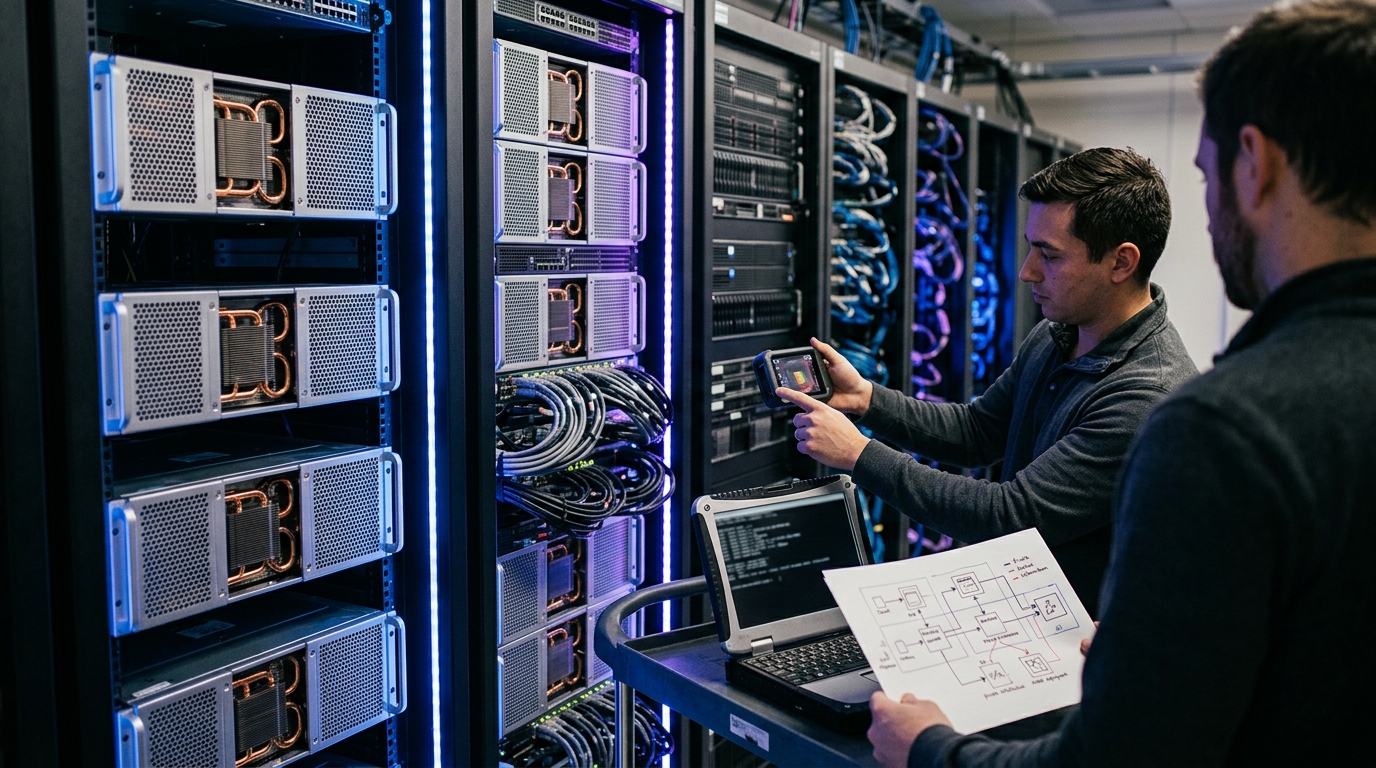
In 2026, the question is no longer whether you can run a 1-trillion parameter model, but whether you can afford to do it on a GPU. While Nvidia’s Blackwell and Rubin architectures continue to push the boundaries of general-purpose compute, the real revolution is happening in the specialized silicon sector. AI ASIC Cloud Providers have officially broken the 'memory wall,' delivering inference speeds that make the H100 look like a legacy mainframe. If your agentic workflow requires sub-50ms latency, the standard GPU cloud is no longer your best bet. You are now entering the era of the LPU and the Transformer-ASIC.
The Great Decoupling: Why ASICs are Dethroning GPUs in 2026
For nearly a decade, the H100 was the gold standard. But as LLMs converged on the Transformer architecture, the industry realized that a general-purpose processor—designed to handle everything from ray tracing to fluid dynamics—is inherently inefficient for the specific math of attention mechanisms. This realization birthed the AI ASIC Cloud Providers movement.
In 2026, we are seeing a 'Great Decoupling.' Training still happens largely on GPUs due to their flexibility, but inference has migrated to ASICs. Why? Because ASICs (Application-Specific Integrated Circuits) like the Groq LPU or the Etched Sohu are hardcoded for the matrix multiplication and KV-cache management that LLMs demand. They don't have the overhead of graphic pipelines or legacy CUDA kernels that they don't use.
According to recent Transformer-ASIC cloud reviews, specialized chips are achieving 10x to 20x the throughput of GPUs at 1/5th the power draw. This isn't just a marginal gain; it’s a shift in the economic physics of AI. When you're building autonomous agents that need to 'think' in real-time, the deterministic nature of an ASIC—where every token generation time is predictable down to the microsecond—is a game-changer for developer productivity.
Top 10 AI ASIC Cloud Providers to Watch
The landscape has matured. We’ve moved past the 'beta' phase of 2024. Here are the best ASIC platforms for AI currently dominating the market in 2026:
- GroqCloud: The pioneer of the LPU (Language Processing Unit). Known for the fastest Llama-3 and Mistral inference on the planet.
- Etched: The world’s first specialized Transformer-ASIC provider. Their Sohu chip is hardcoded for the transformer block.
- Cerebras: Utilizing the Wafer Scale Engine (WSE-3), they offer massive memory bandwidth that treats a whole wafer as a single chip.
- SambaNova Systems: Their Reconfigurable Dataflow Unit (RDU) excels in high-resolution computer vision and long-context LLMs.
- Google Cloud (TPU v6): The gold standard for internal and external scaling, now more accessible via Vertex AI.
- AWS (Inferentia3): Amazon’s custom silicon has become the price-performance leader for mid-sized enterprise models.
- Microsoft Azure (Maia 200): Deeply integrated with OpenAI’s models, offering a bespoke stack for GPT-5 and beyond.
- Tenstorrent: Led by Jim Keller, they provide RISC-V based AI accelerators that offer unparalleled flexibility for evolving architectures.
- d-Matrix: Specializing in 'In-Memory Computing' for edge and data center inference, targeting the highest efficiency for small-to-mid LLMs.
- Untether AI: Focusing on at-memory compute to eliminate the energy cost of moving data, ideal for high-density inference farms.
| Provider | Primary ASIC | Best For | Key Advantage |
|---|---|---|---|
| Groq | LPU | Real-time Agents | Deterministic Latency |
| Etched | Sohu | High-Throughput LLMs | Hardcoded Transformer Logic |
| Cerebras | WSE-3 | Massive Context Windows | No Interconnect Bottlenecks |
| AWS | Inferentia3 | Enterprise Scale | Integrated Ecosystem |
| SambaNova | SN40L | Multimodal Models | Dataflow Architecture |
Groq LPU Hosting: The King of Ultra-Low Latency
When we talk about Groq LPU hosting, we are talking about speed that feels like magic. In 2026, Groq remains the benchmark for 'instant' AI. Their LPU (Language Processing Unit) architecture is unique because it lacks the reactive components of a standard GPU. There are no caches, no branch predictors, and no shared memory contention.
Instead, Groq uses a software-defined hardware approach. The compiler determines exactly where every byte of data will be at every nanosecond. This deterministic performance is why Groq is the preferred choice for AI ASIC Cloud Providers catering to high-frequency trading, real-time translation, and interactive voice agents.
"The Groq LPU isn't just faster; it's more reliable. When we deploy an agentic loop that requires 10 sequential LLM calls, a 200ms variance on a GPU cloud can break the user experience. Groq gives us a flat 30ms every single time." — Senior Architect, Fintech AI
For developers, the transition is seamless. GroqCloud provides an OpenAI-compatible API, meaning you can switch your base URL and see an immediate 10x speedup in token generation.
python import openai
client = openai.OpenAI( base_url="https://api.groq.com/openai/v1", api_key="YOUR_GROQ_API_KEY" )
This call on an LPU returns tokens at 500+ tokens/sec
chat_completion = client.chat.completions.create( messages=[{"role": "user", "content": "Explain the LPU architecture."}], model="llama3-70b-8192", )
Etched Sohu: The Transformer-ASIC Powerhouse
If Groq is the king of latency, Etched is the king of throughput. The Etched Sohu chip represents a radical bet: that the Transformer architecture is here to stay. Unlike other AI ASIC Cloud Providers who maintain some level of programmability, Etched has hardcoded the Transformer block into the silicon.
This means the Sohu chip cannot run a Convolutional Neural Network (CNN) or an LSTM. It can only run Transformers. But it does so with an efficiency that is mathematically impossible for a GPU to match.
Etched Sohu inference pricing has disrupted the market by offering a 'price-per-million-tokens' that is nearly 80% lower than Nvidia-based clouds. Because the chip doesn't waste transistors on general-purpose logic, it can fit more 'Attention' units per square millimeter of silicon. In a 2026 benchmark, a single Sohu-based server outperformed an entire rack of H100s in total tokens per second for Llama-3 400B+ models.
For companies running massive-scale summarization or data extraction, Etched is becoming the default. However, the risk remains: if the industry shifts away from Transformers to a new architecture (like Mamba or State Space Models), the Sohu chip becomes a very expensive paperweight. But for 2026, the Transformer remains the undisputed king, and Etched is its most efficient servant.
LPUs vs GPUs for Inference 2026: A Technical Deep Dive
To understand why you should choose one over the other, we need to look under the hood. The LPUs vs GPUs for inference 2026 debate centers on two things: Memory Architecture and Scheduling.
1. SRAM vs. HBM
GPUs use High Bandwidth Memory (HBM). While fast, HBM still requires data to travel across a bus to the compute cores, creating a bottleneck. Groq’s LPU uses SRAM (Static Random Access Memory) distributed across the chip. SRAM is significantly faster than HBM but much more expensive and lower density. This is why Groq systems require many chips to hold a large model, but once the model is loaded, the data moves at the speed of the processor itself.
2. Temporal vs. Spatial Multiprocessing
GPUs use temporal multiprocessing (CUDA kernels) where tasks are queued and executed. ASICs use spatial multiprocessing, where the model is laid out across the silicon, and data flows through it like water through a pipe. This eliminates the 'jitter' in response times often seen in crowded GPU clusters.
3. Power Efficiency
In 2026, power is the primary constraint of the data center. A Transformer-ASIC can perform the same inference task as a GPU using 1/10th the energy. This is why Transformer-ASIC cloud reviews consistently highlight the 'Green' aspect of specialized compute—it's not just about speed; it's about the bottom line and ESG goals.
AWS, Google, and Azure: The Enterprise ASIC Response
The 'Big Three' haven't sat idly by. While startups like Groq and Etched provide the 'Formula 1' of inference, the hyperscalers provide the 'Workhorses.'
AWS Trainium & Inferentia
AWS has the most mature internal ASIC program. Inferentia3 is now the backbone of Amazon’s own AI services (like Alexa and Rufus). For developers, AWS offers the Neuron SDK, which integrates directly with PyTorch. It’s the best ASIC platform for AI if you are already locked into the AWS VPC and IAM ecosystem. Their pricing is competitive, often 40% cheaper than their P5 (H100) instances.
Google TPU v6
Google practically invented the AI ASIC. The TPU v6 (Trillium) is a monster. It is specifically designed for the massive scale of Gemini. While TPUs were historically hard to program, the 2026 software stack (JAX and OpenXLA) has made them much more accessible. They are the go-to for AI ASIC Cloud Providers when the model size exceeds 2 trillion parameters.
Azure Maia 200
Microsoft’s Maia 200 is the 'Goldilocks' chip. It’s not as fast as a Groq LPU, but it’s more flexible. It’s optimized for the specific 'mixture of experts' (MoE) architecture used by OpenAI. If you are using Azure OpenAI Service, you are likely already running on Maia without even knowing it.
Cost Analysis: Etched Sohu Inference Pricing vs. Nvidia
When evaluating AI ASIC Cloud Providers, the TCO (Total Cost of Ownership) is the only metric that matters. Let's look at the projected 2026 pricing for a 1-million token inference task on a Llama-3 70B equivalent model.
| Platform | Chip Type | Cost per 1M Tokens (Est.) | Latency (P99) |
|---|---|---|---|
| Standard GPU Cloud | Nvidia B200 | $0.60 | 350ms |
| GroqCloud | LPU | $0.45 | 40ms |
| Etched Sohu | ASIC | $0.12 | 110ms |
| AWS Inferentia3 | ASIC | $0.35 | 200ms |
| Google TPU v6 | ASIC | $0.38 | 180ms |
Etched Sohu inference pricing is the clear winner for bulk processing. However, if your application is a customer-facing chatbot where every millisecond counts, the premium for Groq’s speed is easily justified. For internal SEO tools or batch processing of AI writing tasks, the high-throughput, low-cost model of Etched or AWS Inferentia is superior.
Choosing the Best ASIC Platforms for AI: A Buyer’s Guide
How do you choose between these AI ASIC Cloud Providers? Use this decision matrix:
-
Is Latency Your #1 Priority? If you are building voice-to-voice agents or real-time UI interactions, choose Groq. Their LPU is the only tech that provides a human-like response speed consistently.
-
Are You Running Massive Batch Jobs? If you need to process billions of tokens for data mining or legal discovery, Etched or Cerebras will provide the best ROI. Their throughput-per-dollar is unmatched.
-
Are You Already in the Cloud? If your data lives in S3 or BigQuery, stay with AWS Inferentia or Google TPU. The cost of egress (moving data out of the cloud) often negates the savings of a cheaper ASIC elsewhere.
-
Do You Need Flexibility? If your model architecture is experimental (not a standard Transformer), stick to GPUs or Tenstorrent. Hardcoded ASICs do not handle custom CUDA kernels well.
-
What is Your Software Stack? Always check the compiler support. Most providers now support Triton or PyTorch, but some (like older TPUs) may require JAX. Ensure your team’s developer productivity isn't hampered by a steep learning curve.
Key Takeaways
- ASICs are for Inference: In 2026, GPUs are for training; ASICs like LPUs and Transformer-specific chips are for running models at scale.
- Groq Leads on Speed: For sub-100ms latency, Groq LPU hosting is the industry standard.
- Etched Leads on Cost: By hardcoding the Transformer, Etched Sohu offers the lowest price-per-token for high-volume users.
- Hyperscalers are Safe Bets: AWS, Google, and Azure offer custom silicon that is 'good enough' and deeply integrated into existing cloud workflows.
- Architecture Matters: The shift from HBM to SRAM (in Groq) is the technical breakthrough that enabled the current speed records.
- Deterministic is Better: For agentic AI, predictable latency is more important than raw peak flops.
Frequently Asked Questions
What is an AI ASIC?
An AI ASIC (Application-Specific Integrated Circuit) is a microchip designed specifically to accelerate artificial intelligence workloads, primarily matrix multiplication. Unlike GPUs, which are versatile, ASICs are optimized for a single task—like Transformer inference—resulting in much higher efficiency and lower latency.
Why is Groq so much faster than Nvidia GPUs?
Groq uses a Language Processing Unit (LPU) architecture with on-chip SRAM and a deterministic scheduler. This eliminates the memory bottlenecks and processing 'jitter' found in GPUs, allowing tokens to be generated at speeds exceeding 500 tokens per second for popular models.
Can I run any AI model on a Transformer-ASIC?
No. Chips like the Etched Sohu are specifically designed for Transformer architectures. If your model uses a different architecture (like a Gated Linear Unit or a custom CNN), it likely won't run on a hardcoded Transformer-ASIC. Always check the provider's compatibility list.
Is ASIC hosting cheaper than GPU hosting?
Generally, yes. Because ASICs are more power-efficient and have higher throughput, AI ASIC Cloud Providers can offer lower rates per token. For high-volume inference, switching from a GPU to an ASIC can reduce costs by 40% to 80%.
How do I switch my app to an ASIC cloud?
Most top providers, including Groq and Cerebras, offer OpenAI-compatible APIs. In most cases, you only need to change your base_url and api_key in your code. For AWS or Google, you may need to use their specific SDKs (Neuron or XLA).
Conclusion
The transition from general-purpose GPUs to specialized AI ASIC Cloud Providers represents the maturity of the AI industry. In 2026, the 'brute force' approach of throwing more H100s at a problem is no longer a viable business strategy. Whether you prioritize the lightning-fast response times of Groq LPU hosting or the massive economic advantages of Etched Sohu inference pricing, the move to ASICs is inevitable for any scale-up AI company.
As you evaluate the best ASIC platforms for AI, remember that the hardware is only as good as the software stack supporting it. Prioritize providers that offer seamless integration with your existing Python workflows and those that can guarantee deterministic performance. The era of the LPU is here—it’s time to build at the speed of thought.
Looking to optimize your AI stack further? Explore our guides on developer productivity and the latest in DevOps for AI to stay ahead of the curve.