If you are building a Retrieval-Augmented Generation (RAG) pipeline in 2026, and your system is still hallucinating, the problem likely isn’t your LLM—it’s your embeddings. Most developers treat embeddings as a commodity, yet a 5% shift in retrieval accuracy is the difference between a reliable enterprise tool and a 'stochastic parrot' that loses the plot after 50 messages. In 2026, the best AI embedding models 2026 have evolved far beyond simple text-to-vector math; we are now dealing with multimodal giants, Matryoshka-style dimension compression, and cross-lingual alignment that can map a Chinese idiom to an English legal concept with 99.7% precision.
Why MTEB is No Longer Enough in 2026
For years, the Massive Text Embedding Benchmark (MTEB) was the gold standard. But as of 2026, MTEB has a glaring flaw: it only tests single-language text retrieval. In a production environment, your RAG pipeline isn't just processing clean English paragraphs. It’s ingesting PDFs with complex tables, charts, multilingual Slack logs, and technical codebases.
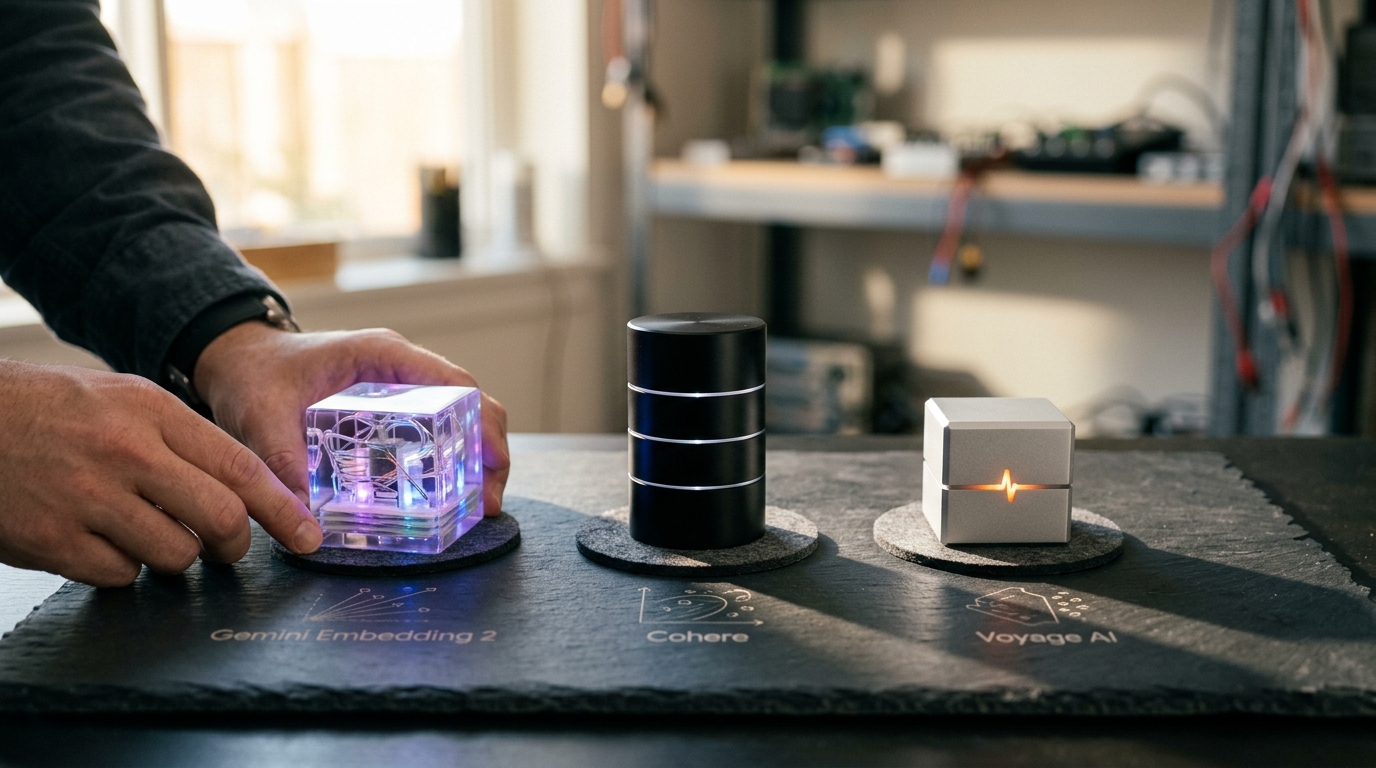
Enter the CCKM Benchmark (Cross-modal, Cross-lingual, Key information, MRL). This is the new gauntlet for the embedding models for RAG 2026. It tests for the "modality gap"—how far apart your text and image embeddings live in vector space—and "context rot," the phenomenon where a model’s retrieval accuracy drops off a cliff after the first 64,000 tokens. As we've seen in the OpenAI vs Cohere vs Voyage AI 2026 wars, the winner isn't the model with the most parameters, but the one that maintains a small modality gap and high semantic alignment across languages.
The Top 10 Best AI Embedding Models for 2026 (Ranked)
1. Gemini Embedding 2 (The All-Rounder)
Google’s Gemini Embedding 2 has emerged as the definitive king of 2026. It is the only model to score a perfect 1.000 across the full 4K–32K "Needle in a Haystack" range. - Best For: Multilingual enterprise knowledge bases and long-document retrieval. - Key Stat: 0.997 score in cross-lingual retrieval, perfectly aligning Chinese idioms like "画蛇添足" with English equivalents. - Pros: Widest modality coverage (Text, Image, Video, Audio, PDF). - Cons: Poor performance in dimension compression (MRL).
2. Voyage Multimodal 3.5 (The Efficiency King)
Voyage AI has carved a niche by focusing on the best multi-modal embedding models that don't break the bank. Voyage 3.5 is specifically optimized for technical documentation and code. - Best For: Code search and technical RAG stacks where storage cost is a factor. - Key Stat: Ranked #1 in Matryoshka quality, retaining 99.3% of its performance even when truncated to 256 dimensions.
3. Qwen3-VL-Embedding-2B (The Open-Source Champion)
Alibaba’s Qwen team shocked the industry by releasing a 2B parameter open-source model that beats closed-source APIs in cross-modal retrieval. - Best For: Self-hosted multimodal RAG and image-heavy datasets. - Key Stat: Modality gap of 0.25 (vs. Gemini’s 0.73), making it the most precise model for text-to-image search.
4. Jina Embeddings v4 (The Long-Context Specialist)
Jina AI’s latest iteration uses LoRA adapters to allow users to switch tasks (retrieval vs. clustering) without re-embedding. It’s the "Swiss Army Knife" of embedding model benchmarks 2026. - Best For: High-volume document processing and long-context RAG. - Key Stat: 8192-token context window with "late chunking" support to prevent loss of meaning at chunk boundaries.
5. OpenAI text-embedding-3-large (The Reliable Default)
While no longer the absolute top of the benchmarks, OpenAI remains the safest choice for teams already in the GPT-5.1 ecosystem. - Best For: Rapid prototyping and teams wanting zero-ops infrastructure. - Pricing: $0.13 per 1M tokens. - Insight: Its Matryoshka support allows you to cut storage costs by 12x with minimal quality loss.
6. Cohere Embed v4 (The Multilingual Leader)
Cohere continues to lead in 100+ language support. If your users are searching in Arabic and your docs are in English, Cohere is your best bet. - Best For: Global products and multilingual customer support bots. - Pricing: $0.10 per 1M tokens (cheaper than OpenAI).
7. BGE-M3 (The Hybrid Search Powerhouse)
Developed by BAAI, BGE-M3 is the strongest open-source model for teams that need hybrid search (dense + sparse + multi-vector) in a single package. - Best For: High-privacy workloads and millions of documents where API costs are prohibitive.
8. DeepSeek-v3.2 (The Price/Performance Disruptor)
DeepSeek has become the "Toyota of LLMs." It’s predictable, incredibly cheap, and surprisingly funny in creative contexts. - Best For: High-volume, low-budget RAG applications. - Reddit Insight: Users on r/SillyTavernAI note that DeepSeek loves "technicality and science," often outperforming Claude in sci-fi roleplay scenarios.
9. Nomic Embed v2 (The Edge/Local Specialist)
At only 137M parameters, Nomic is small enough to run on a CPU or mobile device while still supporting 8192-token context. - Best For: On-device AI, local privacy-first RAG, and edge deployments.
10. GLM-4.7 (The Enterprise Middle-Ground)
GLM-4.7 is the go-to for many developers who find Gemini too filtered and Claude too expensive. It offers a "clean" prose style that avoids the repetitive "LLM-isms" of earlier models.
| Model | Primary Modality | Context Window | Key Strength |
|---|---|---|---|
| Gemini Embed 2 | Multimodal | 32K+ | Cross-lingual Retrieval |
| Voyage MM-3.5 | Multimodal | 8K | Dimension Compression |
| Qwen3-VL-2B | Multimodal | 4K | Text-to-Image Precision |
| OpenAI 3-Large | Text | 8K | Ease of Integration |
| BGE-M3 | Text (Multilingual) | 8K | Hybrid Search Support |
Multimodal Embeddings: The Death of Text-Only RAG
In 2026, running a text-only RAG pipeline is like trying to understand a movie by only reading the subtitles. Real-world data is visually structured. Reddit research and recent benchmarks show that multimodal embeddings significantly outperform text-only pipelines when dealing with tables and charts.
"On visual docs, multimodal embeddings work better. Tables saw a massive gap: 88% vs 76% Recall@1 when comparing multimodal vs text-only pipelines."
If you embed a chart as an image directly using a model like Voyage Multimodal 3.5, the vector captures the spatial relationships between data points. If you convert that chart to a text description first, you lose the "visual logic" of the document. For 2026, the strategy is clear: keep visual docs as images and use a multimodal embedder.
Matryoshka Embeddings: Saving 90% on Storage Costs
One of the most critical trends in matryoshka embeddings is the ability to truncate vectors. Traditionally, if a model produced a 3072-dimension vector, you had to store all 3072 numbers. In a database like Milvus or Pinecone, this gets expensive fast.
Matryoshka Representation Learning (MRL) allows you to take only the first 256 dimensions of a 3072-dimension vector. - Storage Savings: Going from 3072 to 256 dimensions is a 12x reduction in storage. - The Leaders: Voyage Multimodal 3.5 and Jina Embeddings v4 were explicitly trained for this. They lose less than 1% of their retrieval quality even at 256 dimensions. - The Losers: Gemini Embedding 2, while powerful, was not optimized for MRL and loses significant accuracy when truncated.
Long-Context Retrieval: Solving the Needle in a Haystack
There is a massive difference between a model's advertised context window and its effective context window. While Gemini Pro 3.0 boasts a 1M+ context window, the embedding model benchmarks 2026 show that retrieval accuracy begins to degrade for most models after just 8,000 tokens.
For enterprise RAG, the "Needle in a Haystack" test is the only metric that matters. Can the model find a specific quarterly revenue figure buried in a 32,000-character Wikipedia article? - Gemini Embedding 2: 100% accuracy up to 32K. - BGE-M3: Starts slipping at 8K (92% accuracy). - Lightweight models (Nomic/Mxbai): Drop to 40-60% accuracy once you hit 4,000 characters.
Developer Tip: If you are processing legal contracts or research papers, do not use lightweight models. The storage savings aren't worth the "context rot" that will lead to hallucinations.
Roleplay and Creative Writing: Embedding Models for Lorebooks
An unconventional but highly demanding use case for embeddings is AI Roleplay (RP). Users on subreddits like r/SillyTavernAI are using embedding models to power "Lorebooks"—dynamic databases of world-building facts that get injected into the chat context when relevant.
In this space, the "Gold Standard" is a combination of Claude 4.5/Opus for prose and LoreVault (powered by Jina or OpenAI embeddings) for memory.
- Claude 4.5: Unbeatable prose and subtext understanding, but expensive and strict on filters.
- Gemini 3 Pro: The context window is a "superpower" for world-building, but it often requires aggressive prompting to avoid "Gemini-isms" (repetitive dialogue patterns).
- DeepSeek v3.2: The "Toyota of LLMs." It’s reliable, cheap, and handles sci-fi settings better than almost any other model.
The "Wall" Problem: Reddit users report that all models eventually "lose the plot" after about 100 messages. The solution in 2026 isn't a larger context window, but Agentic RAG. This involves using a summarization extension like Memory Books or Qvink Memory to extract key events and store them as embeddings, effectively giving the AI a long-term "autobiographical" memory.
Key Takeaways for 2026
- Best All-Rounder: Gemini Embedding 2 is the powerhouse for cross-lingual and long-document tasks.
- Best for Multimodal: Qwen3-VL-2B (Open Source) has the smallest modality gap for text-to-image search.
- Storage Optimization: Use Voyage Multimodal 3.5 or Jina v4 to leverage Matryoshka embeddings and cut storage costs by 90%.
- Avoid Context Rot: For documents longer than 8K tokens, steer clear of lightweight models like Nomic or Mxbai.
- Multilingual Support: Cohere v4 and BGE-M3 remain the gold standards for non-English retrieval.
- RAG is a System: Your retrieval is only as good as your chunking strategy. Use Jina v3 for "late chunking" to preserve semantic meaning.
Frequently Asked Questions
What is the best AI embedding model for RAG in 2026?
For most enterprise use cases, Gemini Embedding 2 is the best overall due to its perfect long-context retrieval and superior cross-lingual alignment. However, if you are self-hosting, Qwen3-VL-2B is the top choice for multimodal data.
How do Matryoshka embeddings save money?
Matryoshka embeddings allow you to truncate a vector (e.g., from 3072 to 256 dimensions) without losing significant semantic meaning. This reduces the amount of data you need to store in your vector database, leading to up to a 12x reduction in storage costs.
Should I use multimodal embeddings even for text-only data?
If your roadmap includes adding images, PDFs, or charts within the next 6-12 months, start with a multimodal model like Voyage Multimodal 3.5. This prevents the need to re-embed your entire dataset later, which can be costly and time-consuming.
What is a 'modality gap' in AI embeddings?
Modality gap refers to the distance between different types of data (like text and images) in the vector space. A smaller modality gap means the model can more accurately match a text query (e.g., "brown leather suitcase") to an actual image, even with similar-looking distractors.
Can I run the best embedding models locally?
Yes, models like BGE-M3, Qwen3-VL-2B, and Nomic Embed v2 are open-source and can be run on local GPU or CPU infrastructure, providing complete data privacy and zero per-token costs.
Conclusion
In 2026, the landscape of best AI embedding models 2026 is no longer a race to the bottom on price. It is a race to the top on retrieval precision. Whether you are building a legal discovery tool with Gemini Embedding 2, an e-commerce search engine with Qwen3-VL, or a creative writing assistant with Claude 4.5 and LoreVault, the embedding model you choose is the foundation of your AI’s intelligence.
Stop choosing models based on generic leaderboards. Evaluate based on your specific data: Do you have tables? Do you have multiple languages? Do you have 50-page contracts? Match your model to your "needle" and your RAG system will finally stop hallucinating and start delivering value.
Ready to optimize your stack? Check out our latest guides on developer productivity and AI writing tools to stay ahead of the curve.