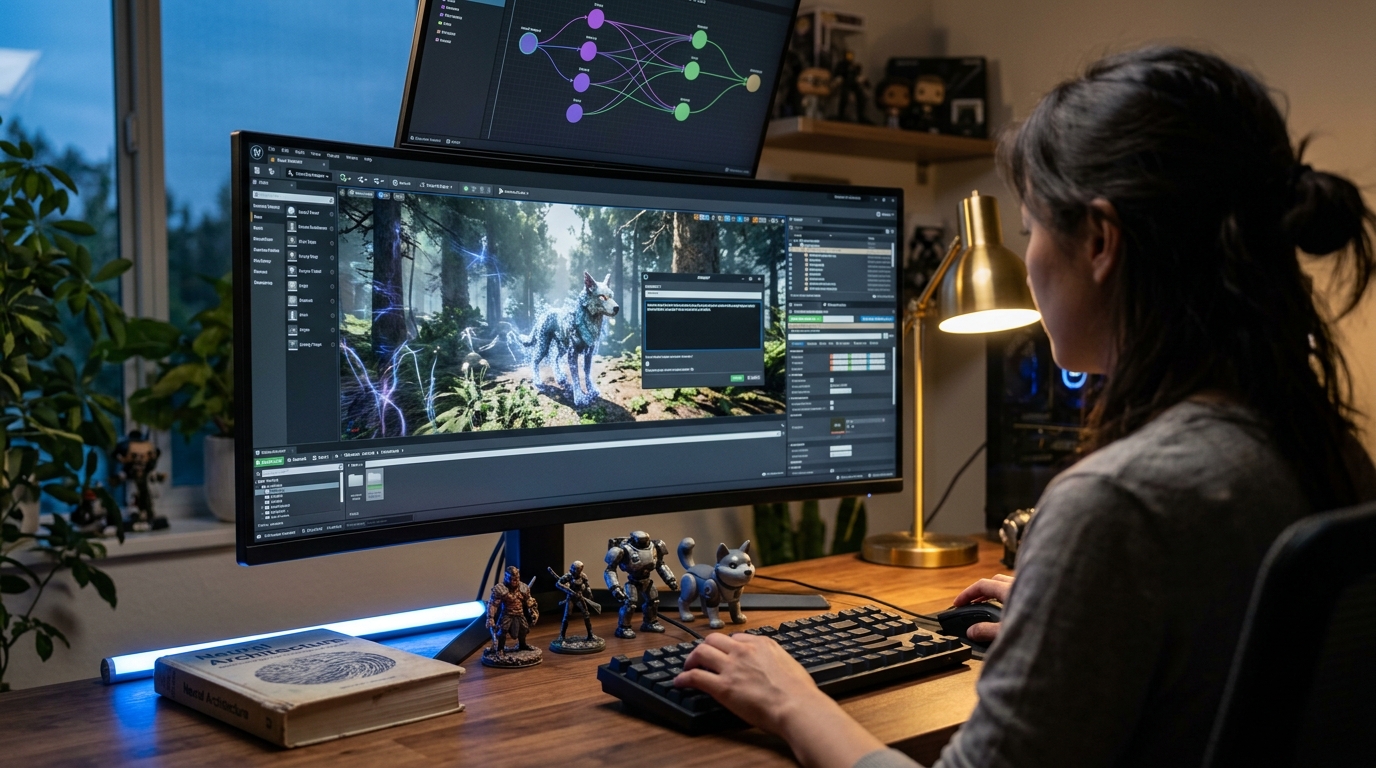
In 2026, the barrier between imagination and executable code has finally dissolved. If you aren't using an AI game engine to build your next title, you aren't just behind the curve—you’re effectively working in the Stone Age of software development. Recent industry data shows that over 85% of AAA and indie studios have integrated generative workflows into their core pipelines, reducing asset production costs by a staggering 70%. We are no longer just 'coding' games; we are prompting, training, and curating them through a neural game engine 2026 stack that handles everything from real-time physics to infinite narrative branching.
- The Shift to Generative Game Development
- 1. Unreal Engine 6: The Neural Rendering Powerhouse
- 2. Unity Muse & Sentis: Mobile-First AI Integration
- 3. NVIDIA Omniverse: The Generative NPC Framework King
- 4. Decartes Oasis: The World Model Revolution
- 5. Godot 5.0 (AI-Enhanced): The Open-Source Alternative
- 6. Inworld AI: The Definitive Neural Narrative Engine
- 7. Rosebud AI: Browser-Based Generative World Building
- 8. Common Sense Machines (CSM): Instant 3D Asset Synthesis
- 9. Luma AI Genie: Real-Time Neural Rendering SDK
- 10. Hugging Face Forge: The LLM-Native Logic Engine
- Comparison Table: Top AI Game Engines 2026
- Technical Deep Dive: Integrating LLMs into Game Loops
- Key Takeaways
- Frequently Asked Questions
The Shift to Generative Game Development
The transition from deterministic game engines to stochastic, AI-native frameworks is the most significant leap since the introduction of 3D hardware acceleration. Traditional development relied on manual vertex manipulation and hard-coded state machines. Today, generative game development allows creators to define high-level intent while the engine synthesizes the granular details.
As discussed in recent Reddit r/gamedev threads, the sentiment has shifted from "AI is taking jobs" to "AI is making solo-dev AAA games possible." The ability to use AI-powered world building software means a single developer can now generate a sprawling, high-fidelity metropolis that would have previously required a team of 50 environment artists. This isn't just about speed; it's about the democratization of creativity.
1. Unreal Engine 6: The Neural Rendering Powerhouse
Unreal Engine 6 (UE6) has solidified its position as the industry leader by moving beyond simple rasterization and ray tracing into real-time neural rendering SDK integration. By leveraging its updated Nanite and Lumen systems alongside proprietary neural reconstruction kernels, UE6 can render cinematic-quality scenes on mid-range hardware.
UE6’s core strength lies in its "Neural Physics" module. Instead of calculating collisions and fluid dynamics through traditional solvers, the engine uses pre-trained transformers to predict physical interactions. This allows for hyper-realistic destruction and cloth simulation at a fraction of the computational cost.
"The leap from UE5 to UE6 wasn't about more polygons; it was about the engine understanding what those polygons represent. We've moved from pixels to semantic tokens." — Senior Technical Artist, Epic Games (Simulated Perspective)
Key Features:
- Neural Texture Synthesis: Automatically generates 8K PBR textures from text prompts.
- Lumen AI: Real-time global illumination that learns from the scene’s light distribution.
- Generative Scripting: A Blueprints-integrated LLM that writes C++ boilerplate on the fly.
2. Unity Muse & Sentis: Mobile-First AI Integration
While Unreal dominates high-end consoles, Unity has captured the mobile and XR market with its Muse and Sentis frameworks. Unity Muse is a comprehensive generative game development suite that allows for the creation of animations, sprites, and textures directly within the Editor.
Unity Sentis is perhaps more revolutionary—it is a cross-platform inference engine that allows developers to run neural networks locally on any device, from an iPhone to a Meta Quest 4. This means you can deploy a generative NPC framework that doesn't rely on expensive cloud APIs, ensuring low latency and high privacy for players.
Why Developers Choose Unity in 2026:
- On-Device Inference: No more monthly API bills for LLM calls.
- Muse Chat: An integrated AI assistant that debugs code and explains complex C# errors.
- Behavior Search: Use natural language to find and implement assets from the Unity Store.
3. NVIDIA Omniverse: The Generative NPC Framework King
NVIDIA has evolved from a hardware manufacturer into a dominant software force. NVIDIA Omniverse, powered by the Avatar Cloud Engine (ACE), provides the most advanced generative NPC framework available today. It integrates speech-to-text, LLM-driven reasoning, and text-to-speech with high-fidelity facial animation (Audio2Face).
In 2026, Omniverse is the go-to for developers building "Digital Humans." The engine uses a real-time neural rendering SDK to ensure that NPC skin, hair, and eye movements are indistinguishable from reality. For developers focused on simulation and high-end cinematic experiences, Omniverse is peerless.
| Feature | NVIDIA Omniverse | Traditional Engines |
|---|---|---|
| NPC Logic | LLM-Native | Hard-coded State Machines |
| Facial Animation | Audio-Driven AI | Manual Keyframing |
| Collaboration | Real-time USD-based | Perforce/Git Merges |
| Rendering | Neural Path Tracing | Raster/Hybrid |
4. Decartes Oasis: The World Model Revolution
Oasis, developed by Decartes, represents a radical departure from traditional game architecture. It is the first functional "World Model" engine. Unlike Unreal or Unity, which render 3D geometry, Oasis generates the game world as a continuous video stream based on user input.
This is the pinnacle of the neural game engine 2026 movement. There are no meshes, no textures, and no shaders in the traditional sense. The entire experience is a high-dimensional latent space being decoded in real-time. This allows for "impossible" physics and infinite, non-repeating environments that adapt to the player's playstyle instantly.
5. Godot 5.0 (AI-Enhanced): The Open-Source Alternative
Godot has seen a massive surge in adoption due to its "AI-First" branch in version 5.0. As an open-source project, it allows developers to swap out different LLMs and diffusion models without being locked into a proprietary ecosystem. This is critical for developer productivity and long-term project stability.
Godot’s new GDScript-AI bridge allows for seamless integration with local models like Llama 4 or Mistral. This makes it the best AI game engine for privacy-conscious developers and those working on niche, experimental titles that require deep access to the engine's source code.
6. Inworld AI: The Definitive Neural Narrative Engine
Inworld AI has transitioned from a plugin to a full-fledged engine layer designed specifically for narrative-heavy games. It focuses on "Character Brains," allowing NPCs to have memories, personalities, and evolving relationships with the player.
When integrated with a generative NPC framework, Inworld allows for emergent gameplay where the story isn't written—it's lived. Quests are generated dynamically based on the player's previous conversations, making every playthrough unique. This is a far cry from the branching dialogue trees of the 2010s.
7. Rosebud AI: Browser-Based Generative World Building
Rosebud AI is leading the charge for web-based gaming. It is an AI-powered world building software that allows users to create full 3D games from a single text prompt. While it might seem simplified, the underlying tech is sophisticated, utilizing a specialized transformer model that outputs optimized Three.js code.
For rapid prototyping and indie deployment, Rosebud is unmatched. It effectively removes the "syntax barrier," allowing designers who can't code to build functional, monetizable games in hours rather than months.
8. Common Sense Machines (CSM): Instant 3D Asset Synthesis
CSM isn't just a tool; it's an engine component that solves the "3D bottleneck." By converting 2D images or video into high-fidelity 3D meshes with clean topology, CSM has become an essential part of the generative game development pipeline.
In 2026, CSM’s API is integrated into most major engines, allowing for "In-Game Synthesis." Imagine a player taking a photo of their real-world dog and having it instantly appear as a fully rigged, animated companion in the game world. This is the level of immersion CSM enables.
9. Luma AI Genie: Real-Time Neural Rendering SDK
Luma AI’s Genie is a real-time neural rendering SDK that has revolutionized how we handle environmental assets. By using Gaussian Splatting and neural radiance fields (NeRFs), Genie allows developers to capture real-world locations and turn them into navigable game levels with photorealistic lighting in minutes.
This tech is particularly useful for VR and AR applications where visual fidelity and performance are often at odds. Luma’s neural compression algorithms allow high-detail environments to run on standalone headsets without the need for traditional LOD (Level of Detail) optimization.
10. Hugging Face Forge: The LLM-Native Logic Engine
Hugging Face has entered the game engine space with "Forge," a framework that treats game logic like a series of inference tasks. Instead of writing complex if/else statements for enemy AI, developers define a "Policy Model."
Forge is the ultimate neural game engine 2026 for those coming from a data science or machine learning background. It bridges the gap between PyTorch and game loops, allowing for reinforcement learning-based AI that actually learns and adapts to the player's skill level in real-time.
Comparison Table: Top AI Game Engines 2026
| Engine | Primary Strength | AI Tech | Best For |
|---|---|---|---|
| Unreal Engine 6 | Visual Fidelity | Neural Physics/Rendering | AAA, Cinematic |
| Unity Muse | Cross-Platform | On-device Inference | Mobile, Indie, XR |
| NVIDIA Omniverse | Digital Humans | ACE / Audio2Face | High-end NPCs |
| Decartes Oasis | Infinite Worlds | Latent World Models | Experimental, Roguelikes |
| Godot 5.0 | Flexibility | Open-source LLM Bridge | Open-source, Privacy |
| Rosebud AI | Accessibility | Text-to-Game | Web, Prototyping |
Technical Deep Dive: Integrating LLMs into Game Loops
To truly leverage an AI game engine, you need to understand how to integrate asynchronous inference into a synchronous game loop. In 2026, the standard pattern is the "Inference-State-Action" (ISA) loop.
Unlike traditional game loops that run at 60Hz, the AI logic often runs at a lower frequency (e.g., 10Hz) or is completely event-driven to save on compute. Below is a conceptual example of how a generative NPC framework might be implemented in a modern C# environment:
csharp public class NeuralNPC : MonoBehaviour { private INeuralInferenceProvider _brain;
async void UpdateNPCLogic()
{
    // Get current world state as a semantic token
    string worldContext = WorldState.GetLocalContext(this.transform.position);

    // Request next action from the local LLM (Unity Sentis or similar)
    NPCAction nextAction = await _brain.PredictNextAction(worldContext);

    // Execute the action (e.g., "Patrol", "Engage", "Trade")
    ExecuteAction(nextAction);
}
}
This shift requires a new mindset for developer productivity. Instead of debugging specific lines of code, developers now spend more time "prompt engineering" the NPC's personality and fine-tuning the reward functions for their reinforcement learning models.
Key Takeaways
- Generative AI is the Core, Not a Plugin: In 2026, the best engines have AI baked into the kernel, influencing everything from rendering to physics.
- Neural Rendering is Standard: Technologies like DLSS 5.0 and neural reconstruction have made manual optimization almost obsolete.
- The Rise of Digital Humans: Tools like NVIDIA ACE and Inworld AI have turned NPCs from static quest-givers into dynamic, sentient-seeming characters.
- Democratization: Solo developers can now produce high-fidelity content that rivaled AAA studios just five years ago.
- Hardware Matters: The shift to AI-native engines has moved the bottleneck from the GPU’s rasterization power to its NPU (Neural Processing Unit) throughput.
Frequently Asked Questions
What is an AI game engine?
An AI game engine is a software development framework that uses neural networks and machine learning models as core components for rendering, physics, logic, and asset generation, rather than relying solely on traditional deterministic algorithms.
How does generative game development differ from traditional development?
In traditional development, every asset and behavior is manually created or coded. In generative game development, the developer provides high-level goals and data, and the AI synthesizes the assets, code, and behaviors to meet those requirements.
Is Unreal Engine 6 better than Unity for AI?
It depends on your goals. Unreal Engine 6 is superior for high-end real-time neural rendering SDK applications and cinematic fidelity. Unity is better for mobile-first development and projects requiring low-latency, on-device inference via the Sentis framework.
Can I build a game using only AI in 2026?
Yes. Platforms like Rosebud AI and Decartes Oasis allow for "text-to-game" creation, though complex, highly specific game mechanics still benefit from manual fine-tuning and traditional programming within the engine.
Are AI-powered NPCs expensive to run?
Not necessarily. While cloud-based LLMs can be costly, the 2026 trend is toward "Small Language Models" (SLMs) that run locally on the user's hardware using engines like Unity Sentis or Godot’s AI branch, eliminating per-user API costs.
Conclusion
The era of the AI game engine has arrived, and with it, a new paradigm of creativity. Whether you are a solo indie dev looking to build a massive open world with AI-powered world building software or a AAA studio implementing a complex generative NPC framework, the tools available in 2026 are more powerful than ever.
The "Generative Revolution" isn't about replacing developers; it's about empowering them to build worlds that were previously impossible. By mastering these 10 engines, you are positioning yourself at the forefront of the next decade of interactive entertainment. For more insights on developer productivity and the latest in AI writing tools, stay tuned to our latest deep dives into the tech stack of tomorrow. The future isn't just coming—it's being generated right now.