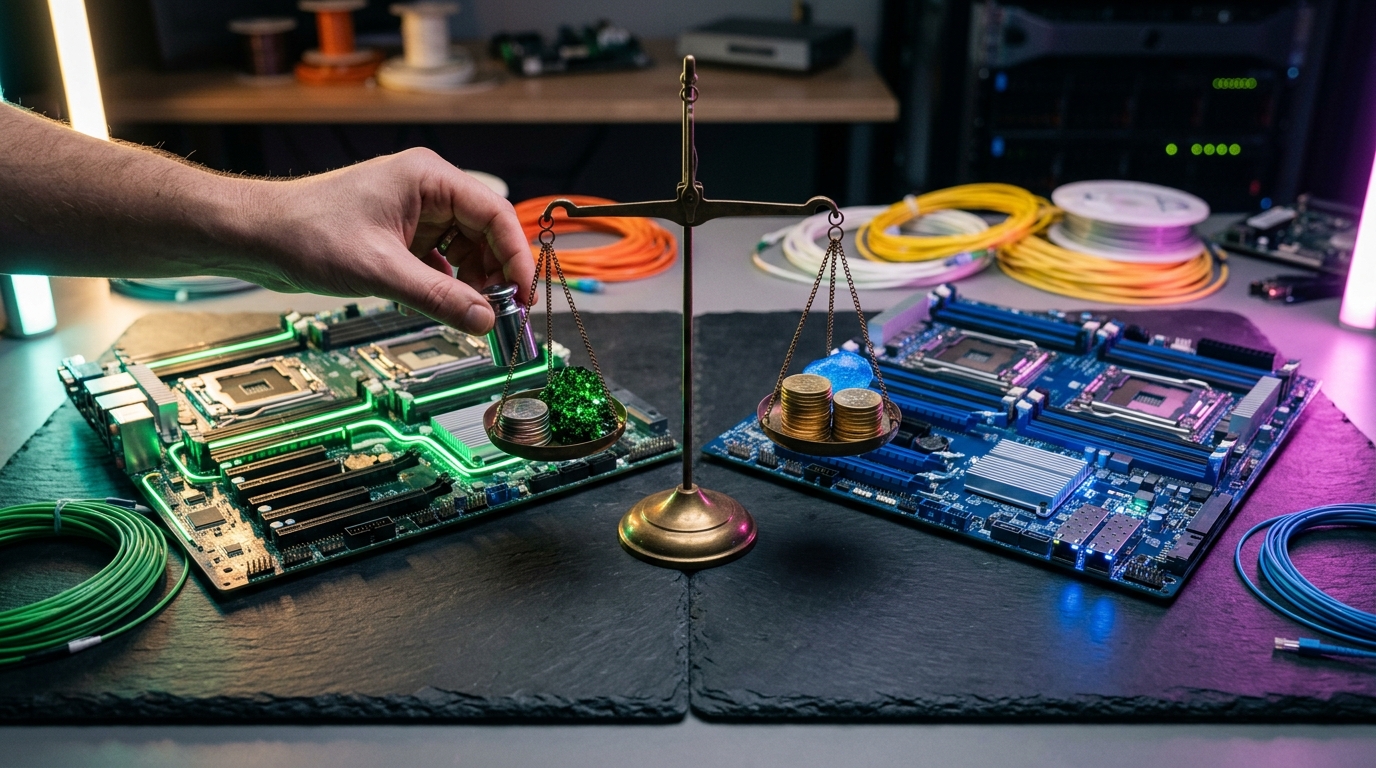
By 2026, the 'Modern Data Stack' has officially been cannibalized by the 'AI Data Stack.' If your enterprise is still debating the nuances of star schemas while your competitors are deploying autonomous agents, you are already behind. The AI-Native Data Lakehouse has emerged as the critical substrate for production-grade Retrieval-Augmented Generation (RAG) and agentic workflows. Research suggests that while 90% of enterprises have experimented with LLMs, only those with a unified, governed data lakehouse are successfully scaling these models without hitting the 'governance wall.'
- The 2026 Shift: Why AI-Native Architecture Matters
- 1. Databricks: The Mosaic AI Powerhouse
- 2. Snowflake: The Cortex and Iceberg Evolution
- 3. Microsoft Fabric: The Ecosystem Integration Play
- 4. Google BigQuery: The Vertex AI Convergence
- 5. AWS Bedrock + S3: The Modular Lakehouse
- 6. StarRocks / CelerData: Real-Time AI Analytics
- 7. MotherDuck: The Edge and In-Process Disruptor
- 8. Dremio: The Iceberg-Native Catalog
- 9. Onehouse: Managed Open Data Foundation
- 10. Confluent: The Streaming Lakehouse
- AI Data Lakehouse vs Data Warehouse: The 2026 Verdict
- The Iceberg Standard: Why Open Formats Won
- Key Takeaways
- Frequently Asked Questions
The 2026 Shift: Why AI-Native Architecture Matters
In previous years, data warehouses were for BI, and data lakes were for 'someday' science. In 2026, that distinction is dead. An AI-Native Data Lakehouse is defined by three core pillars: Managed Apache Iceberg as the standard substrate, Semantic Layers that serve as the intelligence control plane, and Autonomous Data Lakehouse Tools that handle compaction, snapshot hygiene, and governance without human intervention.
As AI agents move from experimental 'talk-to-your-data' bots to production-ready entities, the underlying infrastructure must provide per-task evaluations and lineage-aware semantics. The goal is no longer just storing bytes; it is providing a 'trusted context' for LLMs to act upon. Without this, RAG systems suffer from what engineers call 'contextual drift'—where the AI retrieves stale or unauthorized data, leading to hallucinations or security breaches.
1. Databricks: The Mosaic AI Powerhouse
Databricks remains the undisputed leader in the enterprise AI data architecture space. Since the acquisition of MosaicML, Databricks has fully integrated model training and RAG directly into the lakehouse.
Why it leads in 2026: Databricks Mosaic AI allows teams to build RAG, evaluation, and agent tools right next to their governed data. With Unity Catalog, Databricks solves the 'who-can-access-what' problem across both tabular data and unstructured files.
"Databricks is the most comprehensive platform for both Data and AI... Unity Catalog is a one-stop Data Management shop for introducing LLMs on top of tables," notes a senior engineer on Reddit.
- Pros: Native Spark/Python support, best-in-class MLflow integration, and serverless SQL warehouses that rival Snowflake's performance.
- Best For: Heavy ML workloads and teams that require deep control over the end-to-end AI lifecycle.
2. Snowflake: The Cortex and Iceberg Evolution
Snowflake has successfully pivoted from a pure-play data warehouse to a formidable AI data lakehouse. By embracing Apache Iceberg, Snowflake has removed the 'vendor lock-in' stigma that previously plagued its architecture.
Key Innovations: Snowflake Cortex AI provides fully managed LLMs (like Llama 3 and Mistral) that run directly inside the Snowflake security perimeter. Their support for Managed Iceberg Tables means you can now use Snowflake's world-class compute on data stored in your own S3 or Azure Blob storage in open formats.
| Feature | Snowflake | Databricks |
|---|---|---|
| Primary Language | SQL-first | Python/PySpark-first |
| Storage | Proprietary or Iceberg | Delta Lake or Iceberg |
| AI Suite | Cortex AI | Mosaic AI |
| Ease of Use | High (Managed) | Medium (Requires Engineering) |
3. Microsoft Fabric: The Ecosystem Integration Play
Microsoft Fabric is the fastest-growing best data lakehouse 2026 for organizations already deep in the Azure ecosystem. While early versions were criticized for being 'not production-ready,' the 2026 iteration has matured significantly.
The Direct Lake Advantage: Fabric's Direct Lake mode allows Power BI to query data in OneLake (Parquet/Delta format) without moving or transforming it. This reduces latency for real-time AI dashboards. However, community sentiment remains cautious: "Fabric is an abstraction of what exists in Azure... easy to work in for citizen developers but can be a nightmare to track and develop over time if not governed correctly."
- Primary Benefit: Seamless integration with Power BI and Microsoft 365 Copilot.
- The Catch: Potential for 'sprawling anti-patterns' if not managed by professional data engineers.
4. Google BigQuery: The Vertex AI Convergence
Google has unified BigQuery and Vertex AI into a single 'BigQuery Studio' experience. For organizations leveraging Google's Gemini models, this is the most efficient path to data lakehouse for RAG.
Why it's AI-Native: BigQuery now supports vector search as a native function, and Gemini's 1M+ token context window allows for 'Long-Context RAG' where entire datasets can be processed as context without complex chunking strategies. It is the gold standard for GPU-native analytics where parallel execution fits time-series or vector operations.
5. AWS Bedrock + S3: The Modular Lakehouse
AWS has taken a modular approach to the AI-Native Data Lakehouse. Instead of a single 'one-size-fits-all' platform, AWS offers Amazon Bedrock Knowledge Bases which can be pointed at an S3-based data lakehouse.
The Stack: - Storage: S3 (Iceberg/Parquet). - Catalog: AWS Glue + Lake Formation. - AI: Amazon Bedrock (access to Claude, Llama, and Titan models). - Compute: Amazon Athena or Redshift Spectrum.
This is ideal for teams that want to 'stitch together' their own platform to save on the 'Databricks tax,' though as Reddit discussions highlight, "stitching services together is a different role... lack of a unified UI is a big downer for smaller teams."
6. StarRocks / CelerData: Real-Time AI Analytics
If your RAG application requires sub-second freshness (e.g., fraud detection or real-time recommendation engines), StarRocks is the 2026 leader. It is an OLAP engine that acts as a lakehouse compute layer, specifically optimized for Managed Iceberg.
Technical Edge: StarRocks uses a cost-based optimizer (CBO) and materialized views to provide 10x cost-performance improvements over traditional engines. It is increasingly used for autonomous data lakehouse tools that require real-time data ingestion and immediate vector indexing.
7. MotherDuck: The Edge and In-Process Disruptor
MotherDuck (powered by DuckDB) has changed the game for 'small-to-medium' big data. By using DuckDB + Arrow Flight + WASM, MotherDuck allows for interactive, in-process analytics that run on the developer's laptop or at the edge, while syncing with a central lakehouse.
The Use Case: Interactive RAG applications where latency is critical. Instead of waiting for a cloud cluster to spin up, MotherDuck provides instant compute for local data, making it a favorite for developer-friendly in-process patterns.
8. Dremio: The Iceberg-Native Catalog
Dremio has positioned itself as the 'Easy Button' for Apache Iceberg. In 2026, Dremio’s Arctic catalog acts as a 'Git for Data,' allowing engineers to branch, merge, and version their data lakehouse just like code.
Governance at Scale: For enterprise AI data architecture, Dremio provides a semantic layer that anchors routing and policy enforcement across multiple engines. This ensures that an AI agent querying the data through Dremio follows the same security protocols as a human analyst in Tableau.
9. Onehouse: Managed Open Data Foundation
Onehouse, founded by the creators of Apache Hudi, provides a fully managed 'Onetable' service. It solves the interoperability problem by allowing data to be written once and read as Hudi, Iceberg, or Delta Lake.
Why it matters for RAG: Onehouse automates the 'plumbing' of the lakehouse—ingestion, compaction, and clustering. This allows data teams to focus on scaling your RAG pipelines rather than managing file sizes and metadata cleanup.
10. Confluent: The Streaming Lakehouse
Confluent has moved beyond Kafka to offer a 'Streaming Lakehouse' built on Apache Flink. In 2026, the ability to perform 'continuous RAG'—where the vector store is updated the millisecond an event occurs—is a competitive necessity.
The AI Link: Confluent’s integration with vector databases like Pinecone and Weaviate allows for a seamless flow from stream to search, ensuring that AI agents always have the most current information.
AI Data Lakehouse vs Data Warehouse: The 2026 Verdict
The debate of AI data lakehouse vs data warehouse has shifted. It is no longer about SQL vs. NoSQL; it is about Openness vs. Opacity.
| Feature | Traditional Data Warehouse | AI-Native Data Lakehouse |
|---|---|---|
| Data Format | Proprietary (Locked) | Open (Iceberg, Delta, Hudi) |
| AI Support | Bolt-on / External | Native / Embedded |
| Scaling | Vertical / Expensive | Horizontal / Commodity Storage |
| Governance | Centralized / Rigid | Federated / Lineage-aware |
| Real-time | Batch-heavy | Stream-native |
In 2026, the lakehouse wins because AI models require access to the raw, unstructured data (PDFs, images, logs) that warehouses traditionally struggle to manage. The lakehouse provides a single governed path for both the structured data used in BI and the unstructured data used in RAG.
The Iceberg Standard: Why Open Formats Won
One of the biggest predictions for 2026 was that Managed Iceberg would become the standard lakehouse substrate. This has come true. Hyperscalers now deliver SLA-backed compaction and cross-cloud REST catalogs.
Interoperability Gains: Advances in Arrow/Parquet and cross-format bridges like UniForm (Databricks) and XTable (Onehouse) have shrunk the need for data copies. Governance is now stabilized across engines; you can write data with Spark and query it with Snowflake or StarRocks without moving a single byte. This 'metadata plumbing' is what allows enterprise AI to scale without creating new silos.
Key Takeaways
- Governance is the Bottleneck: 73% of RAG implementations fail because they ignore source ACLs. Platforms like Databricks and Snowflake are winning by integrating governance (Unity Catalog, Purview) directly into the AI workflow.
- Iceberg is the Winner: Apache Iceberg is the 'format of choice' for 2026, supported by every major hyperscaler and platform.
- Multi-Engine is Reality: Intelligent routing now optimizes for cost and performance, using the 'right engine for the job' over a single governed dataset.
- Semantic Layers are the Control Plane: As AI-generated queries proliferate, semantic models anchor explainability and policy enforcement.
- GPU-Native is Niche but Powerful: For specific parallel workloads, GPU-native stacks (like NVIDIA NIM + StarRocks) offer 10x performance gains.
Frequently Asked Questions
What is an AI-Native Data Lakehouse?
An AI-Native Data Lakehouse is a data management architecture that combines the flexibility of a data lake with the performance and governance of a data warehouse, specifically optimized for machine learning and RAG. It natively supports vector search, unstructured data, and integrated AI model serving.
Why is Apache Iceberg important for RAG?
Apache Iceberg provides a table format that allows multiple different engines (like Spark, Snowflake, and Athena) to interact with the same data safely. For RAG, this ensures that the data used to 'ground' the AI is consistent, versioned, and accessible across the entire AI stack.
Should I choose Databricks or Snowflake for my AI project in 2026?
Choose Databricks if you have a strong engineering team that needs deep control over Spark, Python, and custom model training. Choose Snowflake if you want a managed, SQL-first environment where analysts can quickly deploy AI features with minimal infrastructure management.
Can Microsoft Fabric handle real-time RAG?
Yes, through its Direct Lake mode and integration with Real-Time Intelligence (KQL), Fabric can handle low-latency data. However, it requires careful governance to avoid becoming a 'hot mess' of ungoverned silos, as noted by many industry practitioners.
How does a semantic layer help AI agents?
A semantic layer provides a 'translation' between the raw data and the AI. It defines business logic, metrics, and relationships, ensuring that when an AI agent asks for 'revenue,' it gets the same answer every time, regardless of which database it queries.
Conclusion
Selecting the best data lakehouse 2026 is no longer just an IT infrastructure decision; it is a core business strategy. Whether you lean toward the engineering depth of Databricks, the managed simplicity of Snowflake, or the real-time power of StarRocks, the goal remains the same: building a foundation of 'trusted context.'
To succeed in the era of agentic AI, focus on metadata plumbing, embrace open formats like Apache Iceberg, and ensure your governance layer is 'AI-aware.' The platforms that will dominate the next decade are those that treat data not as a passive asset, but as the active intelligence that fuels the enterprise.
Ready to modernize your stack? Start by auditing your data freshness and governance protocols—because even the best LLM is only as good as the lakehouse that feeds it.