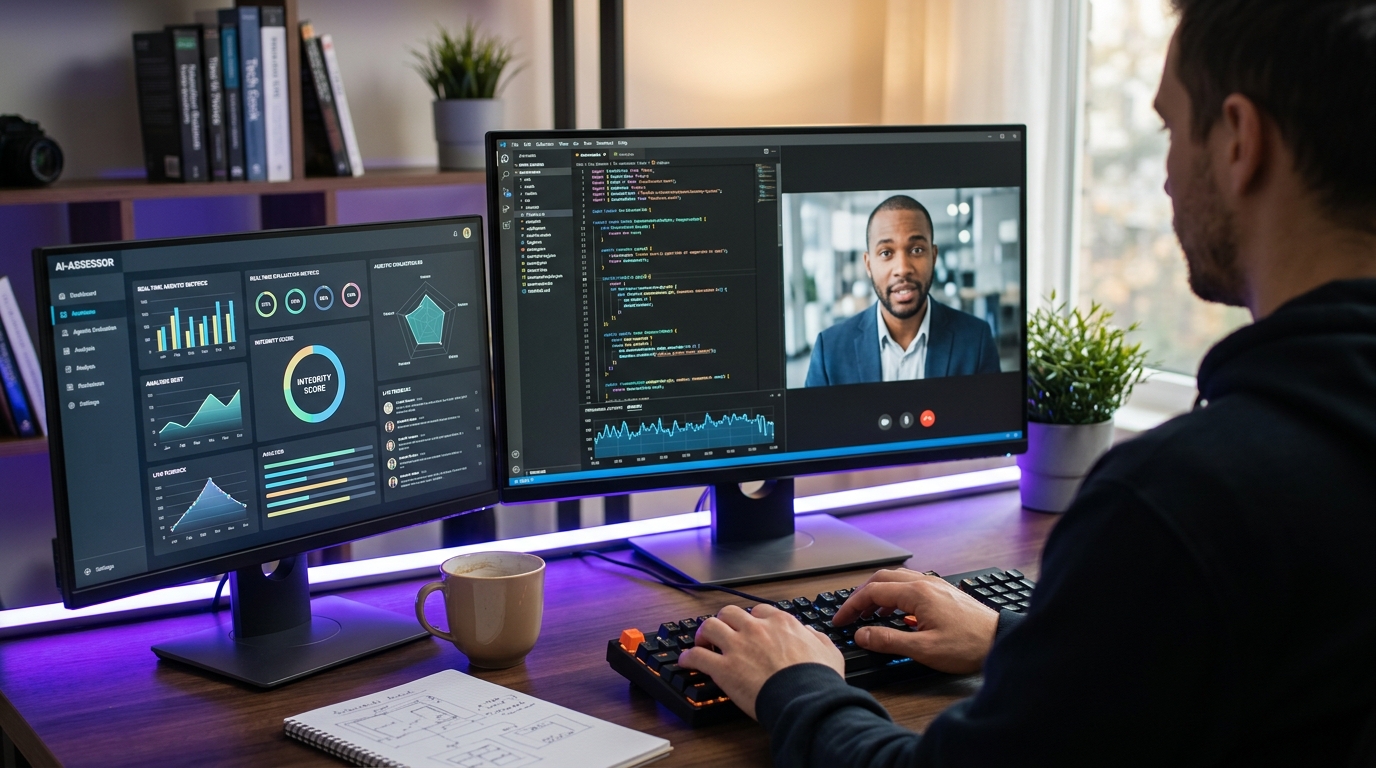
In 2026, the traditional coding interview is dead. Or rather, it has been subsumed by an algorithmic arms race where candidates use real-time streaming bots and recruiters deploy agentic proctors to maintain integrity. As 86% of CIOs report intense competition for qualified talent, the shift toward an AI-native technical interview platform is no longer a luxury—it is a survival requirement. The market has moved beyond simple LeetCode clones into a world of AI-augmented developer assessment tools that can distinguish between a candidate who has memorized a Wikipedia algorithm and one who can actually ship production-grade code.
The 2026 Technical Hiring Landscape: An Algorithmic Arms Race
Technical recruitment has undergone a fundamental transformation. In previous years, a "functioning" test pass was enough to secure a second round. Today, agentic coding test platforms are required to verify the thought process rather than just the output. Why? Because the market is flooded with "AI-assisted" candidates.
Research indicates that candidates interviewed by AI agents are 12% more likely to receive an offer because these agents remove the "vibe check" and focus purely on measurable technical performance. However, this has led to a counter-movement. On forums like r/InterviewHacking, developers are openly discussing tools like InterviewMan and Interviews.chat—desktop apps that stream answers in real-time with sub-second latency.
To counter this, a modern AI-native technical interview platform must look for micro-expressions, eye movements, and "impossible" coding speeds. We are no longer just testing for Python or React; we are testing for the ability to work with AI while maintaining original architectural logic.
1. HackerEarth FaceCode: The Gold Standard for Agentic Evaluation
HackerEarth has successfully pivoted from a simple assessment tool to a comprehensive technical interview software for AI teams. Their FaceCode environment is arguably the most robust platform for senior and staff-level hiring in 2026.
FaceCode leverages an autonomous AI interviewer that draws from a library of 40,000+ questions. Unlike older systems that just dump a text prompt, FaceCode’s agent adapts in real-time. If a candidate struggles with a specific edge case in a system design round, the AI probes deeper into their understanding of distributed systems or KV caching—concepts critical for roles at companies like Nvidia or Meta.
Key Enterprise Features: - PII Masking: Removes gender, accent, and appearance from the initial evaluation to eliminate unconscious bias. - Smart Browser Proctoring: Prevents tab-switching and detects the use of external AI extensions. - Bidirectional ATS Flow: Seamlessly syncs with Greenhouse and Workday, ensuring recruiters never have to leave their primary dashboard.
2. Codility: Science-Backed Skills Intelligence 2.0
Codility has moved beyond the "pass/fail" paradigm with its Engineering Skills Model 2.0. This platform is designed for teams that prioritize AI-augmented developer assessment over raw LeetCode grinding.
Codility’s AI assistant, "Cody," acts as a co-pilot during the interview. It doesn't just score the code; it analyzes the quality of the candidate's interaction with the IDE. For senior roles, Codility focuses on "Skills Intelligence," mapping a candidate's current capabilities against the existing team's gaps. This is vital for AI-native recruitment software looking to build balanced engineering squads.
"Codility gives your team a clear and structured way to evaluate technical skills at every stage... you get research-backed insights that help you build stronger engineering teams with confidence."
3. HackerRank: Real-World IDEs and AI Tool Usage Tracking
As one of the industry titans, HackerRank has adapted to the 2026 market by integrating AI directly into the candidate's workflow. Their "Interview" platform allows for pair programming in a shared IDE that supports over 40 languages.
What sets HackerRank apart is its ability to evaluate how a candidate uses AI. Instead of banning LLMs, HackerRank provides built-in AI assistants and tracks how the candidate prompts them. In 2026, being an "AI-native" developer means knowing how to debug an LLM's hallucination. HackerRank’s scorecards now include a "Prompt Engineering" metric, making it a top-tier AI-native technical interview platform for forward-thinking CTOs.
4. iMocha: The 'Tara' Conversational AI Interviewer
iMocha’s standout feature is "Tara," an AI-powered interviewer designed to automate first-round screening. Tara doesn't just read questions; she engages in contextual dialogue.
For recruiters handling high-volume campus hiring or early-career roles, iMocha reduces time-to-hire by up to 40%. The platform includes a "Skills Data Enrichment" layer that infers a candidate's potential based on their performance across various domains, including full-stack, DevOps, and even niche areas like TensorRT or CUDA optimization.
Platform Ratings (G2): 4.4/5 stars based on 267+ reviews.
5. CodeSignal: Autonomous First-Round Screening
CodeSignal has doubled down on the "AI Interviewer" concept. Their agents are designed to listen, ask follow-ups, and score candidates against strict rubrics. This is the ultimate tool for companies that want to eliminate the "recruiter screen" entirely.
CodeSignal’s agents are particularly good at probing for detail. If a candidate gives a vague answer about "improving latency," the agent will ask for specific metrics or the underlying architectural changes (e.g., "Did you implement a Redis cache or optimize the database indexing?"). This level of detail is why it’s considered a premier agentic coding test platform.
6. CoderPad: Collaborative Real-Time Coding with Integrity Toolkits
CoderPad remains the favorite for developers who value a "no-nonsense" environment. In 2026, they have added an "Integrity Toolkit" that includes keystroke playback. This allows interviewers to see if a candidate suddenly pasted a massive block of perfect code—a clear signal of using an external AI-native recruitment software bot.
CoderPad supports 30+ languages and focuses on the collaborative aspect. It’s less about "testing" and more about "working together," which many senior engineers prefer over the high-pressure environment of proctored AI bots.
7. Qualified.io: Project-Based Simulations for Senior Devs
Qualified.io ignores the "puzzle" style of interviewing in favor of real-world project simulations. Candidates are given a mini-repository and asked to fix bugs, implement features, or refactor code using modern frameworks like Mocha or JUnit.
This approach is highly resistant to simple LeetCode memorization. Since the environment is a full Web IDE, it provides a much better signal for how a developer will perform on day one. For teams hiring for AI-native systems software engineer roles, Qualified.io offers the most realistic testing ground.
8. InterviewFlowAI: The $1-Per-Interview Infrastructure Revolution
A newcomer that is disrupting the market on price, InterviewFlowAI has slashed costs by building its own low-latency voice AI and proctoring systems. While competitors charge $10 to $50 per interview, InterviewFlowAI has brought it down to $1.
Why it’s a sleeper pick for 2026: - In-house LLMs: They don't rely on expensive third-party APIs, reducing latency and cost. - Native Voice Processing: Optimized for tough accents and noisy environments. - Unlimited Resume Screening: Included in the base price, making it ideal for startups.
9. Mercer Mettl: Massive Scale Proctoring and Campus Recruitment
Mercer Mettl remains the king of scale. If you need to interview 10,000 candidates in a single weekend for a global graduate program, Mettl is the platform. Their AI proctoring is world-class, using multi-factor authentication and 360-degree monitoring to ensure the integrity of the AI-augmented developer assessment.
They offer a library of pre-built coding assessments and psychometric tests, allowing for a holistic view of the candidate beyond just their ability to write a Python script.
10. Interviewing.io: The Candidate-Side Mock Intelligence
While technically a practice platform, Interviewing.io is an essential part of the 2026 ecosystem. It allows candidates to perform anonymous mock interviews with engineers from FAANG companies.
They have recently introduced an AI Interviewer that provides instant, actionable feedback. This tool is a double-edged sword for recruiters; while it helps candidates prepare, it also contributes to the "arms race" by training developers to bypass standard AI-native technical interview platform filters.
The Candidate Perspective: Stealth Bots and Detection Logic
As reported on Reddit’s r/ExperiencedDevs, the market is currently a "dev's nightmare." Candidates with 10+ years of experience are being ghosted or asked to solve LC Hards for mid-level roles. This has led to the rise of "Stealth Bots."
The Rise of InterviewMan and Live Streaming
Recent discussions highlight that candidates are using tools like InterviewMan ($12/mo) which run as native desktop apps. These apps use macOS/Windows screen capture exclusion APIs, meaning they do not show up during a Zoom or Google Meet screen share.
The "Streaming" Advantage: - Sub-second Latency: The AI starts typing the answer while the interviewer is still finishing the question. - Audio Integration: The bot "listens" to the call, removing the need for the candidate to type anything manually. - Behavioral Support: Not just for coding; these bots now provide talking points for soft-skill questions.
How Recruiters are Fighting Back
Recruiters are moving away from "code correctness" and toward "code explanation." A candidate who writes a perfect O(n log n) solution in 2 minutes but cannot explain the trade-offs of using a min-heap versus a sorted array is immediately flagged.
Furthermore, modern technical interview software for AI teams now tracks "Time to First Keypress." If a candidate sits silently for 30 seconds and then types 100 lines of code at 200 WPM, the AI proctor will flag the session for manual review.
Comparison Table: Top AI Interview Platforms 2026
| Platform | Primary Strength | Best For | Pricing Hook |
|---|---|---|---|
| HackerEarth | Deep Technical Depth | Enterprise/Niche Roles | 15+ ATS Integrations |
| Codility | Skills Intelligence | Team Building | Science-Backed Rubrics |
| InterviewFlowAI | Cost Efficiency | Startups | $1 Per Interview |
| CodeSignal | Autonomous Screening | High Volume | Agentic Follow-ups |
| CoderPad | Collaborative Feel | Senior/Staff Hires | Keystroke Playback |
| iMocha | Conversational AI | Campus/Entry Level | 'Tara' AI Assistant |
Key Takeaways for 2026 Hiring
- Shift to Agentic AI: The best platforms no longer just host code; they conduct the interview autonomously.
- Latency is the New Proctor: Real-time streaming bots are the biggest threat to integrity; look for platforms with desktop-level detection.
- Practicality Over Puzzles: Senior devs are fleeing LeetCode-heavy processes. Use project-based assessments (Qualified.io) to attract top talent.
- Cost is Crashing: With tools like InterviewFlowAI, the cost of an AI-native technical interview platform is no longer a barrier for small teams.
- Human-in-the-Loop: AI should handle the screen, but humans must handle the final architectural deep-dive to ensure the candidate isn't just a "prompt engineer."
Frequently Asked Questions
What is an AI-native technical interview platform?
An AI-native technical interview platform is a software solution designed from the ground up to use artificial intelligence for conducting, proctoring, and evaluating technical assessments. Unlike traditional tools that added AI features later, these platforms use agentic workflows to adapt questions and analyze candidate behavior in real-time.
How do AI interview platforms detect cheating in 2026?
Modern platforms use a combination of webcam monitoring, tab-switch detection, and behavioral analysis. Advanced tools look for "impossible" typing speeds, eye movement patterns (indicating a candidate is reading a hidden script), and audio-visual sync issues. Some also use keystroke playback to ensure code was written incrementally rather than pasted.
Are AI interviewers biased?
While AI can inherit biases from its training data, many AI-native recruitment software tools now include "PII Masking." This hides the candidate's name, gender, and ethnicity from the evaluation engine, focusing purely on code quality and logic, which often makes them less biased than human recruiters.
Which platform is best for hiring AI and Machine Learning engineers?
For niche roles like AI systems or ML engineering, HackerEarth FaceCode and Codility are top choices. They offer specific environments for testing GPU optimization, TensorRT, and CUDA, which are often missing from general-purpose coding tools.
Can candidates use AI during the interview?
It depends on the company's policy. Some platforms like HackerRank now provide a built-in AI assistant and evaluate the candidate's ability to use it effectively. This reflects the real-world work environment where developers use Copilot or Cursor daily.
Conclusion
Selecting the right AI-native technical interview platform in 2026 requires a balance between rigorous integrity and a frictionless candidate experience. As the "arms race" between candidate bots and recruiter proctors continues, the winners will be the companies that prioritize practical, project-based evaluations over rote memorization.
Whether you are a startup looking for the $1-per-interview efficiency of InterviewFlowAI or an enterprise requiring the deep technical mapping of HackerEarth, the goal remains the same: finding the developer who can solve problems, not just the one who can solve the test.
Ready to upgrade your tech stack? Start by auditing your current time-to-hire and look for where agentic AI can remove the bottleneck in your first-round screens.