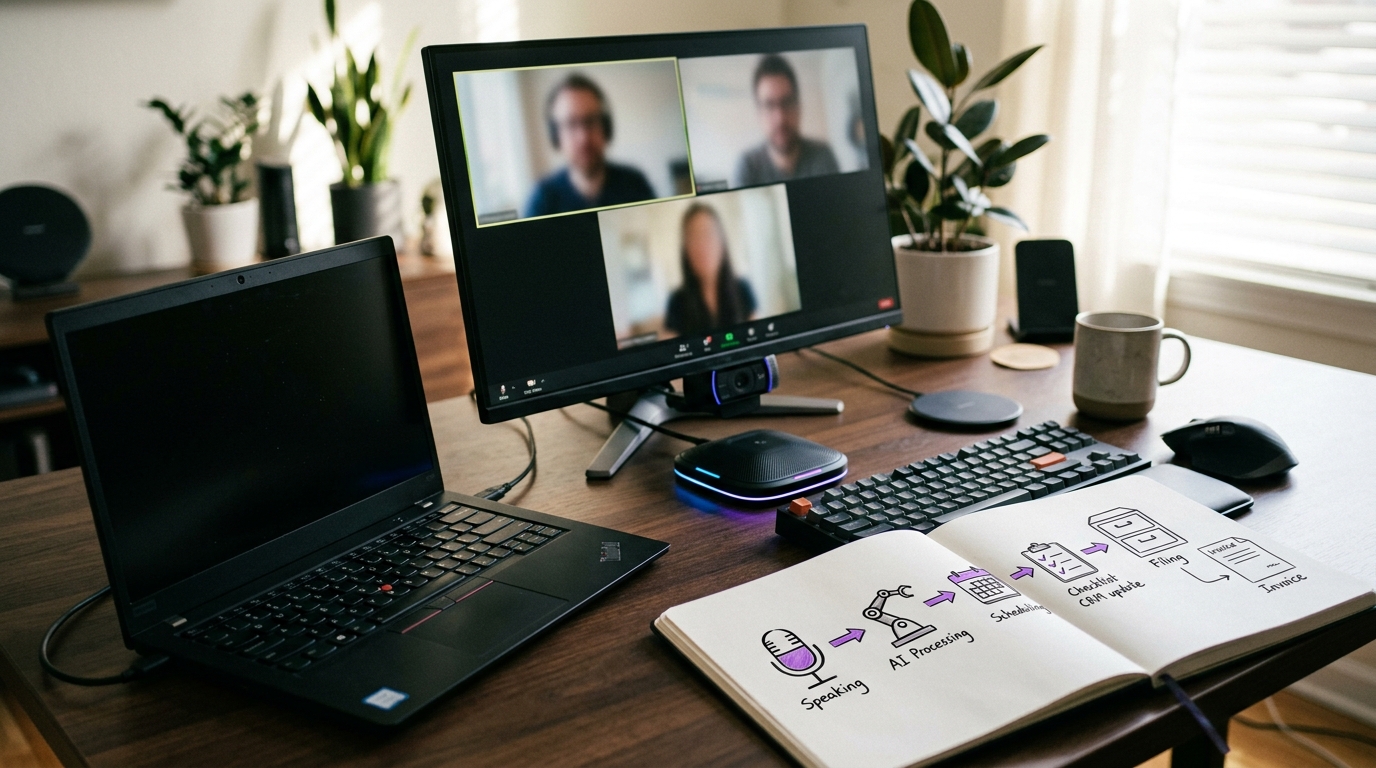
By 2026, the traditional 'video call' is officially dead. If your team is still using a platform that simply records pixels and audio without an active intelligence layer, you are losing approximately 40% of your institutional memory every single week. The market has shifted from video-first to AI-native video conferencing platforms that don't just host meetings—they participate in them. We are no longer looking for 'Zoom with a transcript'; we are looking for agentic meeting assistants that can update Airtable, draft follow-up invoices, and map sentiment analysis directly into our CRM in real-time.
In this comprehensive guide, we evaluate the landscape of AI-powered meeting software 2026, moving beyond the legacy giants to find the tools that actually automate the high-friction gaps in your workflow. Whether you’re a developer looking for Whisper-based foundation models or a sales leader needing real-time coaching, these are the best Zoom alternatives for AI teams currently dominating the tech stack.
- The Paradigm Shift: Why AI-Native Matters in 2026
- 1. BridgeApp: The Agentic Workspace Leader
- 2. Melp App: Multi-Enterprise Linking and Evaluation
- 3. Dialpad Ai Meetings: Real-Time Sales Intelligence
- 4. Otter.ai: The Polished Standard for Team Memory
- 5. Atter AI: Visualizing Conversations with Mind Maps
- 6. Notta: The Multilingual Powerhouse
- 7. Claap: Automating the Sales-to-CRM Pipeline
- 8. Jitsi Meet: The Privacy-First Open Source Choice
- 9. Webex by Cisco: Enterprise-Grade Real-Time Translation
- 10. Whisper & Deepgram: The Developer’s Foundation
- Feature Comparison Table 2026
- The In-Person Use Case: AI Beyond the Screen
- Key Takeaways
- Frequently Asked Questions
The Paradigm Shift: Why AI-Native Matters in 2026
Transitioning to AI-first virtual meeting tools isn't just about convenience; it's about solving the 'context loss' problem that plagues remote work. In 2026, the core differentiator between a legacy tool and an AI-native one is agency.
Legacy tools treat AI as a plugin—a 'sidecar' that summarizes a transcript after the call is over. AI-native platforms, however, are built on top of Large Language Models (LLMs). They understand the context of the conversation as it happens. As noted in recent Reddit discussions on r/remotework, users are tired of tools that 'either do transcription well OR automation well, never both properly.' The industry has responded with platforms where agentic meeting assistants 2026 can auto-create tasks, update databases, and even perform sentiment analysis on customer conversations without human intervention.
1. BridgeApp: The Agentic Workspace Leader
BridgeApp has emerged as a top-tier AI-native video conferencing platform because it refuses to be 'just a meeting app.' It positions itself as a unified workspace where meetings, chat, tasks, and databases coexist in a single intelligence layer.
Why it Wins in 2026
BridgeApp solves the 'fragmentation' problem. Instead of having a meeting in Zoom, a chat in Slack, and a task in Asana, BridgeApp’s agents live across all three. If a client mentions a budget change during a video call, the BridgeApp agent identifies the intent, updates the internal database, and pings the finance lead automatically.
- Key Feature: Visual no-code builder for custom AI workflows.
- Best For: Teams that need to automate complex post-meeting tasks like invoice extraction or lead status updates.
- Pricing: Tiered based on agentic credits and workspace size.
2. Melp App: Multi-Enterprise Linking and Evaluation
Melp App addresses a specific 2026 pain point: cross-company collaboration. Most platforms struggle when two organizations with different tech stacks (e.g., Google vs. Microsoft) try to meet. Melp’s 'Multi-Enterprise Linking' allows seamless collaboration without vendor lock-in.
Business Impact and ROI
Melp isn't just about the call; it's about the Evaluation Mode. This is a game-changer for HR and recruitment teams. It allows for structured interviews with standardized scoring and AI-assisted talent assessment, ensuring that 'what was said' is objectively measured against hiring criteria.
"Melp app works on a unique approach... it supports both internal and external collaboration across departments, vendors, clients, and partners." — Industry Analysis 2026
- Security: HIPAA, GDPR, ISO 27001, and SOC 2 compliant.
- Unique Tech: Intelligent face centering and low-bandwidth optimization for global teams.
3. Dialpad Ai Meetings: Real-Time Sales Intelligence
For sales-heavy organizations, Dialpad remains the gold standard for AI-powered meeting software 2026. While others focus on the summary, Dialpad focuses on the live call.
Real-Time Coaching
Dialpad’s 'Ai Scorecards' and 'Ai Playbooks' provide live coaching. If a prospect mentions a competitor, the AI can instantly surface a 'battle card' on the salesperson's screen with talking points. It tracks sentiment in real-time, flagging calls that are going south so a manager can jump in and save the deal.
- Differentiation: AI is baked into every plan, not sold as a premium add-on.
- Integration: Deep native mapping to Salesforce, HubSpot, and Zendesk.
4. Otter.ai: The Polished Standard for Team Memory
Despite the influx of new competitors, Otter.ai remains the most recognizable name in the space. In 2026, it has matured from a simple transcription tool into a 'Meeting GenAI' that handles the entire lifecycle of a conversation.
The Workflow Advantage
Otter’s strength is its reliability. It joins calls automatically, identifies speakers with high precision, and generates 'Otter AI Chat'—a feature that allows you to ask questions about the meeting while it’s still happening.
- Pros: Extremely easy for non-technical users; best-in-class mobile app.
- Cons: Pricing becomes aggressive at the enterprise scale; multilingual support lags behind competitors like Notta.
5. Atter AI: Visualizing Conversations with Mind Maps
Atter AI has carved out a niche by focusing on structured understanding. While most tools give you a wall of text, Atter AI generates visual mind maps and structured outlines from your meetings.
Moving Beyond the Transcript
As highlighted in r/TranscriptionAI, many users don't actually need every word preserved. They need a faster path to understanding. Atter AI’s mind map output creates a clear differentiation point for students, researchers, and knowledge workers who need to see the hierarchy of ideas discussed in a session.
- Value Proposition: Strong price-to-feature ratio compared to Otter.
- Key Use Case: Academic research, brainstorming sessions, and information-dense interviews.
6. Notta: The Multilingual Powerhouse
If your team operates globally, Notta is likely your best bet. While many AI-native video conferencing platforms struggle with accents and non-English languages, Notta excels in over 100 languages.
Versatility in Format
Notta isn't just for live calls. It handles file-based workflows (uploading recorded media) as gracefully as live meetings. This makes it a favorite for international journalists and researchers who move between different audio formats daily.
- Strength: Superior multilingual accuracy.
- Workflow: Seamlessly bridges the gap between mobile recording and desktop editing.
7. Claap: Automating the Sales-to-CRM Pipeline
Claap is the answer to the Reddit user's prayer: "I want to automate lead status updates directly from the conversation." Claap specializes in post-meeting automation for revenue teams.
The CRM Gap-Filler
Claap’s AI doesn't just summarize; it maps specific parts of the conversation to CRM fields in Salesforce or HubSpot. If a customer mentions their current stack, Claap extracts those entities and populates the 'Competitor Tech' field in your CRM automatically. It eliminates the 'manual data entry' tax that costs sales teams hours of productivity.
- Core Feature: Advanced CRM field mapping from transcripts.
- Target Audience: High-growth sales and customer success teams.
8. Jitsi Meet: The Privacy-First Open Source Choice
For organizations that cannot trust third-party AI clouds, Jitsi Meet remains the leading best Zoom alternative for AI teams that prefer self-hosting. In 2026, the FOSS (Free and Open Source Software) community has integrated local LLM hooks into Jitsi.
Self-Hosted Intelligence
As noted in r/foss, tools like 'Sharkord' allow users to run Jitsi-based environments via Docker with just a few ports. This allows companies to run their own transcription and AI models (like Whisper) on their own hardware, ensuring that sensitive meeting data never leaves their private network.
- Infrastructure Tip: Use a high-performance backend if you plan on doing group calls with 50+ people.
- Best For: Government, legal, and privacy-conscious tech startups.
9. Webex by Cisco: Enterprise-Grade Real-Time Translation
Webex is the infrastructure play. It’s the platform you choose when you need real-time AI translation video calls across 100+ languages with enterprise-grade security (FedRAMP authorized).
The AI Assistant
The Webex AI Assistant is built for the global enterprise. It provides noise removal that can isolate a single voice in a crowded cafe and real-time captions that are accurate enough for legal proceedings. For large organizations already in the Cisco ecosystem, the ROI comes from consolidation and compliance.
- Key Metric: 99.9% reliability in high-latency environments.
- Hardware: Integrates perfectly with Webex Boards and Room Kits for hybrid offices.
10. Whisper & Deepgram: The Developer’s Foundation
Sometimes the best platform isn't a platform at all—it's an API. Whisper (OpenAI) and Deepgram are the engines that power many of the tools above.
Building Your Own Agentic Layer
Developers who want total control over the agentic meeting assistants 2026 workflow often bypass the UI-heavy apps and build directly on Deepgram. It offers the lowest latency for real-time transcription, making it ideal for building custom bots that need to respond to voice commands during a meeting.
- Whisper: Best for high-accuracy, asynchronous processing and local deployment.
- Deepgram: Best for scalable, real-time API integrations.
Feature Comparison Table 2026
| Platform | Primary Focus | AI Strength | Best For | Starting Price |
|---|---|---|---|---|
| BridgeApp | Unified Workspace | Agentic Workflows | Automation-heavy teams | Custom |
| Melp App | Cross-Enterprise | Evaluation Mode | External Collaboration | Free / Premium |
| Dialpad | Sales/UCaaS | Real-time Coaching | Revenue Teams | $15/user/mo |
| Otter.ai | Meeting Memory | Polished Summaries | Internal Teams | Free / $16.99+ |
| Atter AI | Structured Insight | Mind Map Generation | Knowledge Workers | Affordable |
| Notta | Multilingual | Language Support | Global Teams | Free / Paid |
| Claap | CRM Integration | Field Mapping | Sales Ops | $30/user/mo |
| Jitsi Meet | Privacy/FOSS | Self-hosted AI | Security-focused | Free |
| Webex | Enterprise | Real-time Translation | Large Corporations | $14.50+ |
| Deepgram | API/Infra | Real-time Speed | Product Developers | Usage-based |
The In-Person Use Case: AI Beyond the Screen
One of the most surprising trends in 2026 is the use of AI-native video conferencing platforms for in-person interactions. As one Reddit user pointed out, "The new Apple Watch app has actually been useful for conferences, field meetings, and quick client chats... it records quietly and later gives me transcripts, summaries, and action items."
Platforms like Bluedot and Otter have expanded their mobile presence to capture the "hallway track" at conferences. The real value is no longer just the video frame; it’s the ability to turn any conversation into searchable, actionable memory. Whether you are walking a real estate site or having a quick coffee chat, the AI assistant is now an omnipresent layer of the professional experience.
How to Leverage In-Person AI:
- Use Wearables: Apps for Apple Watch and Android Wear allow for discrete recording.
- Contextual Tagging: Use voice commands to tag specific moments as "Action Items" during the live conversation.
- Centralized Hub: Ensure your mobile recordings sync to the same dashboard as your Zoom/Meet recordings to avoid data silos.
Key Takeaways
- Agency is Everything: In 2026, the best tools don't just transcribe; they act. Look for platforms that can update your CRM, send follow-up emails, and manage your database.
- Multilingual is Standard: If you have a global team, Notta and Webex offer the most robust support for non-English speakers.
- Security vs. Convenience: Jitsi Meet and self-hosted Whisper models are the go-to for privacy, while BridgeApp and Otter offer maximum convenience through cloud-native agents.
- Sales Needs Real-Time: For revenue teams, the ability to get live coaching (Dialpad) and automated CRM mapping (Claap) is a massive competitive advantage.
- Beyond the Call: AI meeting tools are now moving into the physical world, capturing in-person value through mobile and wearable integrations.
Frequently Asked Questions
What is the difference between a meeting assistant and an AI-native platform?
A meeting assistant (like Fireflies or Fathom) is typically a bot that joins a legacy platform like Zoom. An AI-native video conferencing platform (like BridgeApp or Melp) is built from the ground up with AI integrated into the core engine, allowing for deeper automation and cross-enterprise linking.
Can AI-native platforms replace my CRM data entry?
Yes. Tools like Claap and BridgeApp are specifically designed to bridge the gap between conversations and databases. They use LLMs to extract entities (like budget, timeline, and pain points) and map them directly into Salesforce, HubSpot, or Airtable fields.
Are these tools secure for legal or medical use?
Many of the platforms mentioned, specifically Webex and Melp App, are built with HIPAA, GDPR, and SOC 2 compliance. However, for maximum security, many legal firms prefer self-hosting open-source solutions like Jitsi Meet combined with local AI models.
Do I still need Zoom if I use an AI-native workspace?
Not necessarily. While Zoom has added an AI Companion, platforms like BridgeApp and Melp offer a more unified experience that reduces tool fragmentation. Many startups are moving entirely to these platforms to save on licensing costs and improve workflow speed.
How does real-time translation work in 2026?
Platforms like Webex and Notta use high-speed LLMs to provide near-instantaneous translation. In 2026, this has evolved into 'voice cloning' technology where the AI can translate your speech into another language while maintaining your original tone and cadence.
Conclusion
Choosing from the sea of AI-native video conferencing platforms in 2026 requires a shift in perspective. Stop asking if the video is clear—that's a solved problem. Start asking how much manual work the platform can take off your plate.
If you're a sales leader, prioritize Dialpad or Claap for their CRM-centric intelligence. If you're an enterprise looking to break down silos between vendors, Melp App is your strategic choice. And if you’re ready to fully embrace the future of agentic work, BridgeApp offers the most flexible vision of what a meeting can actually be.
Don't let your team's most valuable insights vanish the moment the 'End Call' button is clicked. Transition to an AI-first stack today and turn your meetings into a permanent, searchable, and actionable asset.
Looking to build your own custom AI workflow? Check out our latest guides on developer productivity tools and AI-first programming.