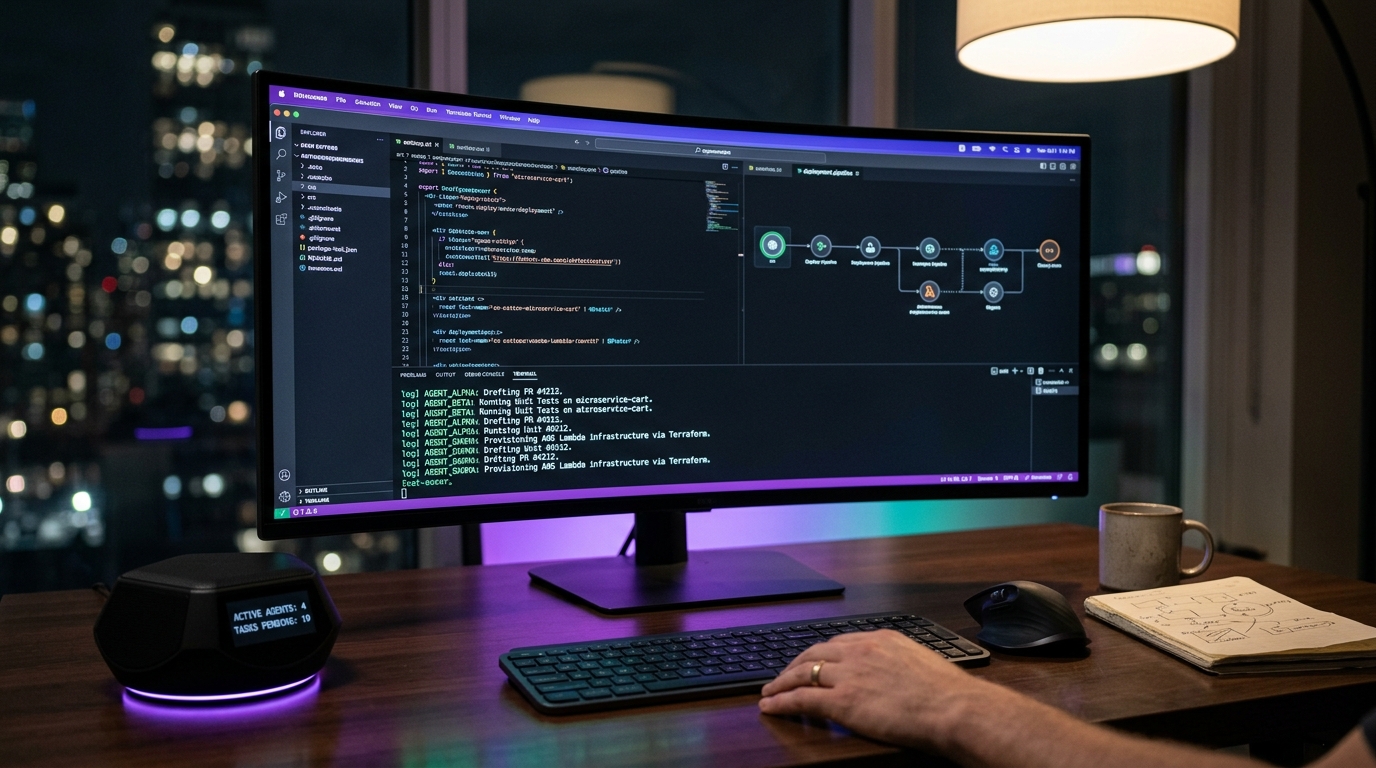
By the end of 2026, Gartner predicts that 40% of enterprise applications will feature task-specific AI agents, a massive leap from the simple chatbots of years prior. We have officially entered 'the flip'—the moment when AI moved from responding to prompts to executing end-to-end software lifecycles autonomously. If you are still using basic autocomplete, you are already behind. The best autonomous ai agents for software development are no longer just 'copilots'; they are digital engineers capable of planning, coding, testing, and deploying entire microservices while you sleep.
This guide ranks the top 10 autonomous agents based on hands-on testing, production reliability, and ROI data from the front lines of the 2026 tech landscape. Whether you are looking for a best devin alternatives 2026 or a robust open source autonomous agents for devops stack, this comprehensive breakdown covers the tools defining the next era of engineering.
- The Great Shift: AI Agent vs GitHub Copilot 2026
- Top 10 Autonomous AI Agents for Software Development Ranked
- Enterprise vs. Open Source: Choosing Your Stack
- The Architecture of Autonomy: Reasoning, Memory, and Tools
- Security and Governance: The AgentPermissionProtocol
- Pricing and ROI: Measuring the Impact of Autonomous Engineering
- The Week Three Problem: Observability and Maintenance
- Key Takeaways
- Frequently Asked Questions
- Conclusion
The Great Shift: AI Agent vs GitHub Copilot 2026
In 2024, we celebrated autocomplete. In 2026, we demand execution. The distinction between an ai agent vs github copilot 2026 comes down to the 'Perception-Decision-Action' loop. While traditional coding assistants wait for your next keystroke to suggest a function, an autonomous agent perceives a Jira ticket, decides on an architectural path, writes the code, runs the unit tests, and submits a PR.
Traditional tools are instruction-driven; modern autonomous agents are goal-driven. As noted in recent senior engineer forums, teams that succeed treat agents as participants, not just tools. This shift requires a move from 'vibe coding' to structured agentic orchestration.
| Feature | GitHub Copilot (Legacy Mode) | Autonomous AI Agents (2026) |
|---|---|---|
| Initiative | Reactive (waits for dev) | Proactive (works on goals) |
| Context | Current file / Open tabs | Entire repository + Documentation |
| Capabilities | Code completion | Planning, Debugging, CI/CD, Research |
| State Management | Session-bound | Persistent across tasks |
| Tool Use | Limited | Terminal, Browser, Cloud APIs, DBs |
Top 10 Autonomous AI Agents for Software Development Ranked
After analyzing hundreds of developer reports and enterprise case studies, we have identified the top rated coding agents for enterprise and individual developers. These tools are ranked by their ability to handle 'long-horizon' tasks without human intervention.
1. Claude Code (Anthropic)
Claude Code has emerged as the gold standard for reasoning-heavy development. Unlike generic LLMs, it is optimized for multi-file refactors and deep architectural understanding. It doesn't just write snippets; it understands the 'why' behind the code, making it the top choice for complex legacy system modernization.
2. Devin (Cognition AI)
As the world’s first fully autonomous AI software engineer, Devin remains a powerhouse for end-to-end task execution. It excels in sandboxed environments where it can plan, execute, and iterate on bugs. While others have caught up, Devin's ability to learn from its own mistakes in real-time sets a high bar for best devin alternatives 2026 to clear.
3. Sweet! CLI
Sweet! CLI represents a new category: the Autonomous Company Platform. It isn't just a tool to help you code; it is a coordinated system of agents that manages the entire software development lifecycle (SDLC). From planning and implementation to deployment and monitoring, Sweet! CLI handles the 'boring' parts of running a software project autonomously.
4. Kilo Code (VS Code / JetBrains)
Kilo Code has become a favorite for 'vibe coding'—where developers describe high-level logic and let the agent handle the implementation. Supporting over 500 models, it offers a flexible, IDE-native experience that bridges the gap between assistant and agent.
5. OpenClaw
A formidable open source autonomous agents for devops contender, OpenClaw provides a full runtime environment. It is configured via JSON and grants agents access to the local terminal, file system, and browser. It is a 'high-code' tool meant for developers who want raw power and local control.
6. Replit Agent
For rapid prototyping and 'idea-to-app' workflows, Replit Agent is unmatched. It allows non-technical founders to build and deploy full-stack applications through a chat interface, handling the infrastructure and deployment hurdles that usually stall early-stage projects.
7. LangGraph (LangChain Ecosystem)
For teams building their own custom agents, LangGraph is the essential framework. It provides 100% control over agent logic and state management. While the learning curve is steep, it is the only way to build production-grade, multi-agent systems that don't spiral into infinite loops.
8. CrewAI
CrewAI excels at multi-agent orchestration. It allows you to define specific roles—such as a 'Security Auditor' agent and a 'Frontend Engineer' agent—and have them collaborate on a single objective. This collaborative approach is vital for enterprise-scale projects requiring diverse expertise.
9. n8n (Agent Nodes)
While primarily a workflow tool, n8n’s new agent nodes make it the best choice for automated software engineering agents price efficiency. Its visual interface allows developers to map out complex logic and integrate with hundreds of third-party APIs without writing boilerplate orchestration code.
10. PydanticAI
A model-agnostic Python framework that focuses on structured outputs and validation. It is the 'boring but reliable' choice for developers who need to ensure their agents adhere to strict data schemas and enterprise compliance standards.
Enterprise vs. Open Source: Choosing Your Stack
When deploying the best autonomous ai agents for software development, the choice between a managed enterprise solution and a self-hosted open-source stack is often a matter of security vs. speed.
Enterprise Solutions (e.g., Salesforce Agentforce, IBM watsonx): These tools offer 'out-of-the-box' compliance, SOC2 Type II security, and deep integration with existing CRMs and ERPs. They are ideal for regulated industries like healthcare and finance where data sovereignty is non-negotiable.
Open Source Stacks (e.g., AutoGPT, OpenClaw, n8n): Open-source tools provide the ultimate flexibility. Developers can modify the underlying logic, swap out models (e.g., using Llama 3 or DeepSeek), and avoid vendor lock-in. However, as noted in Reddit's r/AI_Agents, the 'security is on you.' Misconfiguring a local agent with terminal access can lead to catastrophic data loss or exposed API keys.
The Architecture of Autonomy: Reasoning, Memory, and Tools
To be truly autonomous in 2026, an agent must possess four core architectural pillars:
- Reasoning (The Brain): Usually powered by high-context models like Claude 3.5 Sonnet or GPT-5-preview. This allows the agent to decompose a complex goal (e.g., 'Migrate this app to AWS') into a sequence of actionable steps.
- Memory (The Context): Beyond simple chat history, modern agents use vector databases and 'long-term memory' to remember architectural decisions made weeks ago.
- Tool Access (The Hands): Agents must be able to use a terminal, search the web (via tools like Firecrawl or Scrapeless), and interact with cloud infrastructure.
- Feedback Loops (The Learning): The ability to run code, see an error message, and fix it autonomously is what separates an agent from a script.
"The wins in 2026 aren't coming from better language models; they are coming from better handoffs and loop-closing. An agent that can pull order data, check carrier status, and update a database is worth more than a thousand flashy demos." — Senior Ops Engineer, r/automation
Security and Governance: The AgentPermissionProtocol
One of the most significant risks in 2026 is ambient authority. If you give an autonomous agent access to your AWS environment, how do you prevent it from accidentally deleting a production database while trying to 'optimize' storage?
Enter the AgentPermissionProtocol (APP). Leading enterprises are now treating agents as short-lived participants rather than owners. This involves:
- Execution-time authority: Permissions are granted for a specific task and revoked immediately after.
- Hard cost ceilings: Preventing 'infinite loops' from burning through thousands of dollars in API credits.
- Human-in-the-loop (HITL) checkpoints: Requiring a human signature for high-risk actions like production deployments or large-scale data deletions.
Pricing and ROI: Measuring the Impact of Autonomous Engineering
Understanding the automated software engineering agents price structure is critical for scaling. In 2026, pricing has shifted from simple monthly subscriptions to usage-based or outcome-based models.
- Entry Level: Tools like Replit or n8n might cost $20-$50/month for individual developers.
- Enterprise Level: Platforms like Teneo or Agentforce often charge per 'successful conversation' or 'completed task,' with costs ranging from $0.40 to $5.00 per execution.
The ROI calculation: McKinsey estimates that AI agents can contribute up to $4.4 trillion annually to the global economy. For a standard engineering team, the ROI manifests as: - 85% reduction in manual staffing costs for Tier 1 support and maintenance. - 60% faster deployment cycles by automating the testing and CI/CD pipeline. - Zero-cost scaling: Adding capacity no longer requires hiring; it requires spinning up more agent instances.
The Week Three Problem: Observability and Maintenance
Many teams fall into the trap of 'Day One' excitement. They build an agent, it works once, and they think the job is done. However, real-world engineering happens in Week Three. This is when the agent encounters a legacy bug it doesn't understand, or the external API it relies on changes its schema.
To solve the 'Week Three Problem,' developers are turning to observability tools like LangSmith and Maxim AI. These platforms provide: - Tracing: Seeing exactly where an agent's reasoning went wrong. - Replay: Running a failed task again with a different prompt to test for improvements. - Evaluation Sets: Benchmarking an agent against a set of 'golden' responses to ensure performance doesn't drift over time.
Key Takeaways
- Autonomy is the Goal: Shift from instruction-driven autocomplete to goal-driven agents that own entire outcomes.
- Claude Code & Devin Lead: For pure coding tasks, these tools offer the best reasoning and execution capabilities in 2026.
- Security First: Implement the AgentPermissionProtocol to manage the risks of autonomous tool use.
- Orchestration Matters: Frameworks like LangGraph and CrewAI are essential for building multi-step, reliable systems.
- Focus on ROI: Don't just automate for the sake of it; target high-volume, repetitive tasks like maintenance, debugging, and data enrichment.
Frequently Asked Questions
What are the best devin alternatives in 2026?
While Devin is a pioneer, top alternatives include Claude Code for superior reasoning, OpenClaw for open-source flexibility, and Kilo Code for a more integrated IDE experience. Sweet! CLI is also a major competitor for those seeking a full-lifecycle autonomous platform.
How do autonomous AI agents differ from GitHub Copilot?
GitHub Copilot is primarily a reactive assistant that suggests code snippets. Autonomous AI agents are proactive; they can take a high-level goal, plan the steps, use a terminal to run commands, browse the web for documentation, and fix bugs without human input.
Are there open source autonomous agents for devops?
Yes, OpenClaw and AutoGPT are leading open-source options. Additionally, frameworks like LangGraph allow DevOps teams to build custom, self-hosted agentic workflows that integrate with existing CI/CD pipelines while keeping data private.
What is the typical automated software engineering agents price?
Prices vary from $20/month for basic developer tools to enterprise-grade usage fees that can range from $0.40 to $5.00 per successfully completed task. Many teams find the ROI justifies the cost by reducing manual labor hours by up to 80%.
Is it safe to give an AI agent access to my terminal?
It is only safe if you implement strict governance. Use sandboxed environments (like Docker containers), limit permissions to specific directories, and use an authority layer like the AgentPermissionProtocol to ensure the agent cannot perform destructive actions without oversight.
Conclusion
The era of the 'lone developer' is being replaced by the era of the 'Agent Orchestrator.' The best autonomous ai agents for software development in 2026 are not just tools to make you faster; they are the foundation of a new, scalable engineering architecture. By choosing the right stack—whether it's the reasoning power of Claude Code, the end-to-end autonomy of Devin, or the open-source flexibility of OpenClaw—you can move from manual coding to strategic oversight.
Stop writing boilerplate and start building systems. The future belongs to those who can delegate to the machines. Explore these top-ranked agents today and reclaim your time for the creative, high-impact work that only humans can do.