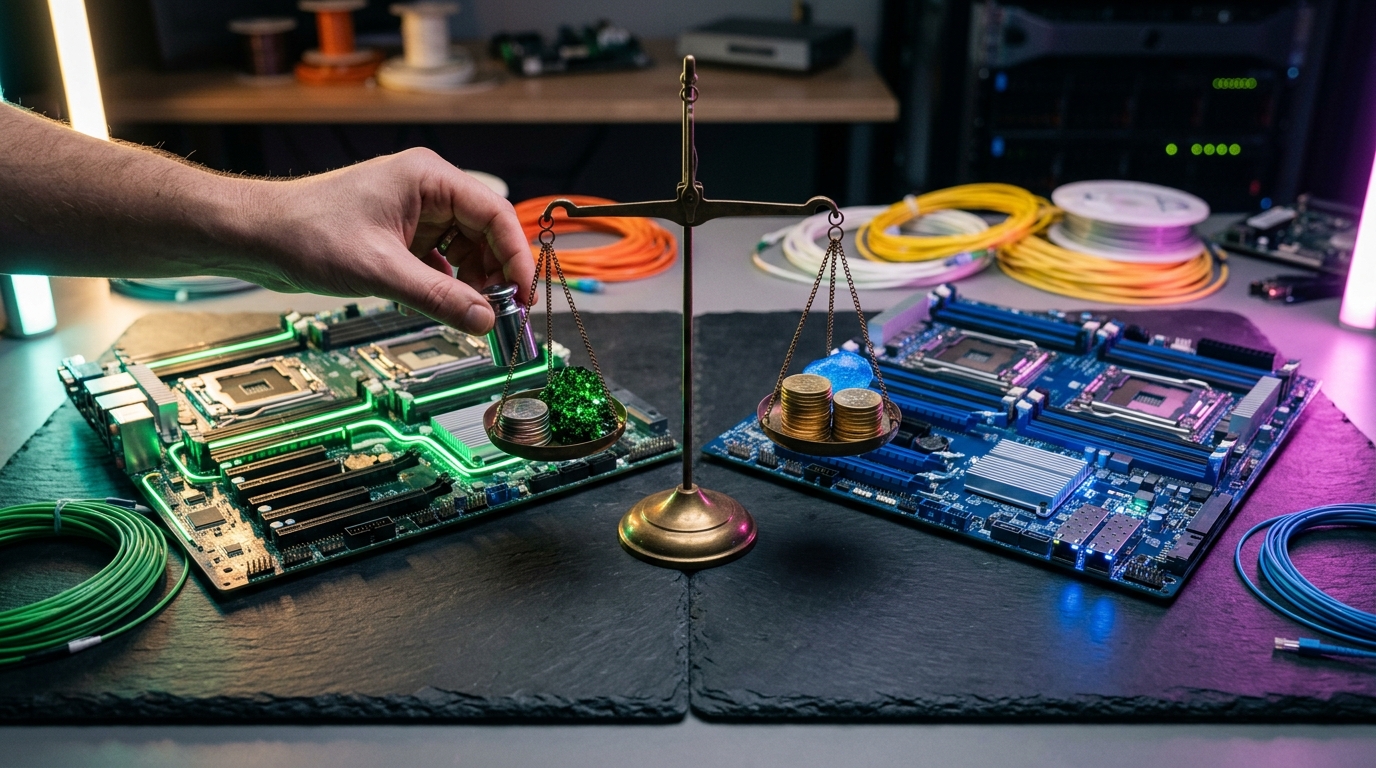
In 2026, the cost of renting the exact same NVIDIA H100 GPU varies by as much as 13.8x depending on which provider you choose. While a legacy hyperscaler might bill you $11.10 per hour, an agile GPU rental marketplace like Verda or Vast.ai can offer the same silicon for as low as $0.80 per hour. For AI startups and researchers, this isn't just a pricing quirk—it is the difference between scaling a frontier model and burning through a seed round in weeks.
With the arrival of the NVIDIA Blackwell architecture, the stakes have evolved. The B200 isn't just faster; its FP4 precision and 192GB of HBM3e memory have redefined the unit economics of LLM inference. However, finding available B200 clusters remains a challenge, with availability on major platforms like Lambda Labs hovering around 4% for certain configurations. This guide breaks down the elite marketplaces where you can actually find stock, secure cheap H100 rental 2026 rates, and deploy decentralized GPU networks to optimize your overhead.
- The 2026 GPU Landscape: Blackwell vs. Hopper
- 1. Vast.ai: The King of P2P GPU Cloud Efficiency
- 2. RunPod: The Developer’s Choice for Per-Second Billing
- 3. Lambda Labs: High-End Clusters with Low Availability
- 4. Verda: The 2026 Price Leader for B200s
- 5. CoreWeave: Enterprise-Grade Kubernetes Clusters
- 6. Civo: Sovereign Cloud and Zero Egress Fees
- 7. Packet.ai: Aggressive Blackwell Promotions
- 8. TensorDock: KVM Flexibility for Windows Workloads
- 9. Netmind.ai: Decentralized GPU Networks for Global Scale
- 10. Qubrid AI: Bare-Metal Access for Deep Profiling
- B200 vs. H100: 2026 Pricing Comparison Table
- Key Takeaways for AI Teams
- Frequently Asked Questions
The 2026 GPU Landscape: Blackwell vs. Hopper
The transition from the H100 (Hopper) to the B200 (Blackwell) has fundamentally shifted how teams rent NVIDIA B200 clusters. While the H100 remains the workhorse for mid-scale training, the B200 offers a 15x gain in inference performance thanks to its specialized FP4 Tensor Cores.
In 2026, the market is bifurcated. On one side, you have "Verified Datacenters" offering 99.9% uptime for enterprise production. On the other, you have P2P GPU cloud marketplaces that utilize under-leveraged hardware from mining rigs or private workstations. The price gap is massive: a B200 on AWS might cost $14.24/hr, while a spot instance on a marketplace like Verda can be found for under $5.00/hr.
"Lambda Labs lists 68 GPU configurations but only 3 are actually available right now (4% availability). RunPod has 77 out of 78 in stock (99%)." — Research Data, Jan 2026.
1. Vast.ai: The King of P2P GPU Cloud Efficiency
Vast.ai remains the most disruptive GPU rental marketplace due to its peer-to-peer architecture. It allows individual hosts to list their hardware, creating a highly competitive bidding environment that drives prices down to near-electricity costs.
For researchers on a budget, Vast.ai is the go-to for cheap H100 rental 2026 options. However, users must be wary of "unverified" hosts. The platform now includes a "Reliable Only" toggle to filter for datacenters with 99%+ uptime.
- Pricing: B200s start at approximately $3.44/hr (on-demand).
- Best For: Checkpoint-friendly training and non-critical inference where cost is the primary driver.
- Features: CLI/API for automation, Jupyter integration, and massive diversity in GPU models (RTX 4090 to B200).
2. RunPod: The Developer’s Choice for Per-Second Billing
RunPod has carved out a massive market share by focusing on developer experience. Unlike legacy clouds that round up to the nearest hour, RunPod offers per-second billing, which is critical for bursty inference workloads or short-lived experiments.
They offer two tiers: Community Cloud (P2P-like) and Secure Cloud (Tier 3/4 Datacenters). Their inventory management is superior to almost any other provider, often showing 99% availability even for high-demand Blackwell cards.
- Pricing: H100 SXM at $2.69/hr; B200 on-demand at $5.49/hr.
- Best For: Building and deploying AI agents that require instant provisioning and high reliability.
- Key Advantage: Pre-built Docker templates for PyTorch, TensorFlow, and Ollama.
3. Lambda Labs: High-End Clusters with Low Availability
Lambda Labs is often cited as the "gold standard" for AI training. Their infrastructure is purpose-built for large-scale foundation models, utilizing InfiniBand networking to link 1x-8x NVIDIA GPUs into massive clusters.
However, in 2026, their "on-demand" availability is notoriously low. Most users find that unless they are willing to sign a 1-year or 3-year reservation, getting access to a B200 is like winning the lottery.
- Pricing: B200 SXM listed at $6.99/hr (when available).
- Best For: Enterprise teams needing high-speed interconnects (NVLink/InfiniBand) for distributed training.
4. Verda: The 2026 Price Leader for B200s
Verda has emerged as a surprise leader in the best GPU marketplaces for AI by optimizing the infra stack for renewable energy and high-density cooling. They currently offer the lowest recorded rates for Blackwell hardware in the industry.
- Pricing: B200 NVL starting at $1.40/hr (Spot) and $4.89/hr (On-Demand).
- Why it's cheap: They filter for high-reliability datacenter nodes but operate with thinner margins than CoreWeave or AWS.
5. CoreWeave: Enterprise-Grade Kubernetes Clusters
CoreWeave is an "AI Hyperscaler" that eschews general-purpose computing to focus entirely on GPUs. They are a Kubernetes-native platform, meaning you don't rent a VM; you deploy a containerized workload directly onto their massive clusters.
They are often the first to receive new NVIDIA silicon, making them a top choice for those looking to rent NVIDIA B200 clusters at scale (e.g., GB200 NVL72 configurations).
- Pricing: B200 on-demand around $8.60/hr per GPU (8x node configuration).
- Best For: Massive scale inference and enterprise-grade security (SOC2, ISO 27001).
6. Civo: Sovereign Cloud and Zero Egress Fees
Civo is a unique player in the GPU rental marketplace because they solve the "hidden cost" problem: egress fees. Many providers charge heavily to move your data out of their cloud, which can double the cost of a training run if your dataset is in the terabytes.
Civo offers zero egress fees and focuses on "Sovereign Cloud," ensuring data residency in the UK or EU—a requirement for many regulated industries.
- Pricing: B200 preemptible starts at $2.69/hr.
- Key Benefit: Provisioning in under 90 seconds and managed Kubernetes (K3s).
7. Packet.ai: Aggressive Blackwell Promotions
Packet.ai is currently using aggressive pricing to capture market share from RunPod and Lambda. In early 2026, they launched a promotion offering $300 in credits for a $100 deposit, effectively lowering the cost of high-end GPUs to pennies on the dollar.
- Pricing: B200 NVL at $2.25/hr (Effective price during promo).
- Best For: Startups looking to stretch their R&D budget during the early stages of model development.
8. TensorDock: KVM Flexibility for Windows Workloads
While most AI marketplaces are Linux-only, TensorDock uses KVM virtualization, allowing for full VM access, including Windows support. This is a niche but vital requirement for certain legacy ML pipelines or graphics-heavy AI workloads.
- Pricing: H100 SXM5 from $2.25/hr (On-demand).
- Best For: Users needing full root access to the hypervisor level and custom OS configurations.
9. Netmind.ai: Decentralized GPU Networks for Global Scale
Netmind.ai represents the future of decentralized GPU networks. By aggregating idle compute from across the globe, they can often beat the lowest prices of centralized providers by 10-15%.
They utilize a blockchain-based verification layer to ensure that the compute you pay for is actually delivered, mitigating some of the trust issues found in traditional P2P marketplaces.
- Best For: Highly distributed inference where low latency to global users is more important than a single massive cluster.
10. Qubrid AI: Bare-Metal Access for Deep Profiling
For senior engineers who need to perform deep hardware profiling using NVIDIA Nsight Compute or Nsight Systems, virtualized instances are a nightmare. Most hyperscalers block register-level access.
Qubrid AI specializes in bare-metal GPU servers, providing full driver/module control. This allows you to run commands like options nvidia NVreg_RestrictProfilingToAdminUsers=0 to unlock deep performance metrics.
- Best For: CUDA developers and performance engineers optimizing kernels for Blackwell.
B200 vs. H100: 2026 Pricing Comparison Table
| Provider | GPU Model | VRAM | Billing Type | Price Per Hour (Est.) |
|---|---|---|---|---|
| Verda | B200 NVL | 180GB | Spot | $1.40 |
| Packet.ai | B200 NVL | 180GB | On-Demand | $2.25 |
| Vast.ai | H100 SXM | 80GB | Marketplace | $1.60 |
| RunPod | B200 SXM | 180GB | On-Demand | $5.49 |
| Lambda Labs | B200 SXM | 180GB | On-Demand | $6.99 |
| AWS | B200 (p6) | 179GB | On-Demand | $14.24 |
| CoreWeave | B200 SXM | 180GB | Reserved | $4.50 |
Key Takeaways for AI Teams
- Price vs. Availability: The cheapest rate is useless if availability is 0%. RunPod and Verda currently offer the best balance of stock and price.
- Egress is the Hidden Killer: If you are moving 100TB of data, Civo’s zero-egress policy might save you more than a cheaper hourly GPU rate elsewhere.
- Blackwell is for Inference: If you are just doing mid-scale training, the H100 at $0.80/hr (Verda) is still the best ROI. Move to B200 for large-scale LLM serving where FP4 precision shines.
- Bare-Metal for Devs: If you are a CUDA engineer, avoid virtualized instances. Use Qubrid or Lambda’s dedicated tiers to ensure you can use Nsight profiling tools.
- P2P for Savings: Use P2P GPU cloud providers like Vast.ai for checkpointable jobs to save up to 80% compared to traditional clouds.
Frequently Asked Questions
What is the cheapest GPU rental marketplace in 2026?
Verda and Packet.ai currently lead the market for B200 and H100 pricing, with Verda offering H100s as low as $0.80/hr and B200s starting at $1.40/hr for spot instances. Vast.ai remains the cheapest for consumer-grade cards like the RTX 4090.
Why is there such a large price difference for the same GPU?
Price variance is driven by three factors: electricity costs (renewable vs. grid), hardware acquisition (bulk enterprise vs. P2P), and overhead (managed services vs. bare-metal). Marketplaces like Vast.ai have lower overhead than hyperscalers like Azure or AWS.
Can I run Llama 3 70B on a single B200?
Yes. With 192GB of VRAM, a single B200 can comfortably run a 70B-class model with significant headroom for long context lengths and KV caching, even in higher precision formats.
What are egress fees in GPU rentals?
Egress fees are the costs associated with transferring data out of a cloud provider's network. In AI, where model weights and datasets are massive, these fees can sometimes exceed the cost of the actual GPU compute. Providers like Civo and RunPod offer zero or very low egress fees.
Is P2P GPU cloud safe for sensitive data?
Generally, P2P clouds are less secure than enterprise clouds like CoreWeave or Lambda. While providers like Vast.ai offer encryption and isolated Docker containers, your data technically sits on a third-party host's machine. For sensitive or regulated data, always choose a SOC2-compliant, dedicated provider.
Conclusion
The GPU rental marketplace of 2026 is no longer a monopoly held by the "Big Three" hyperscalers. Specialized providers have democratized access to the NVIDIA Blackwell architecture, allowing even solo researchers to rent NVIDIA B200 clusters for a fraction of what it cost just two years ago.
When choosing your platform, don't just look at the $/hr rate. Consider the "total cost of ownership," including egress fees, setup time, and billing granularity. For the best value today, we recommend starting with a test run on RunPod or Verda to benchmark your specific workload before committing to a long-term reservation. The era of cheap, on-demand supercomputing is here—make sure you aren't overpaying for it.