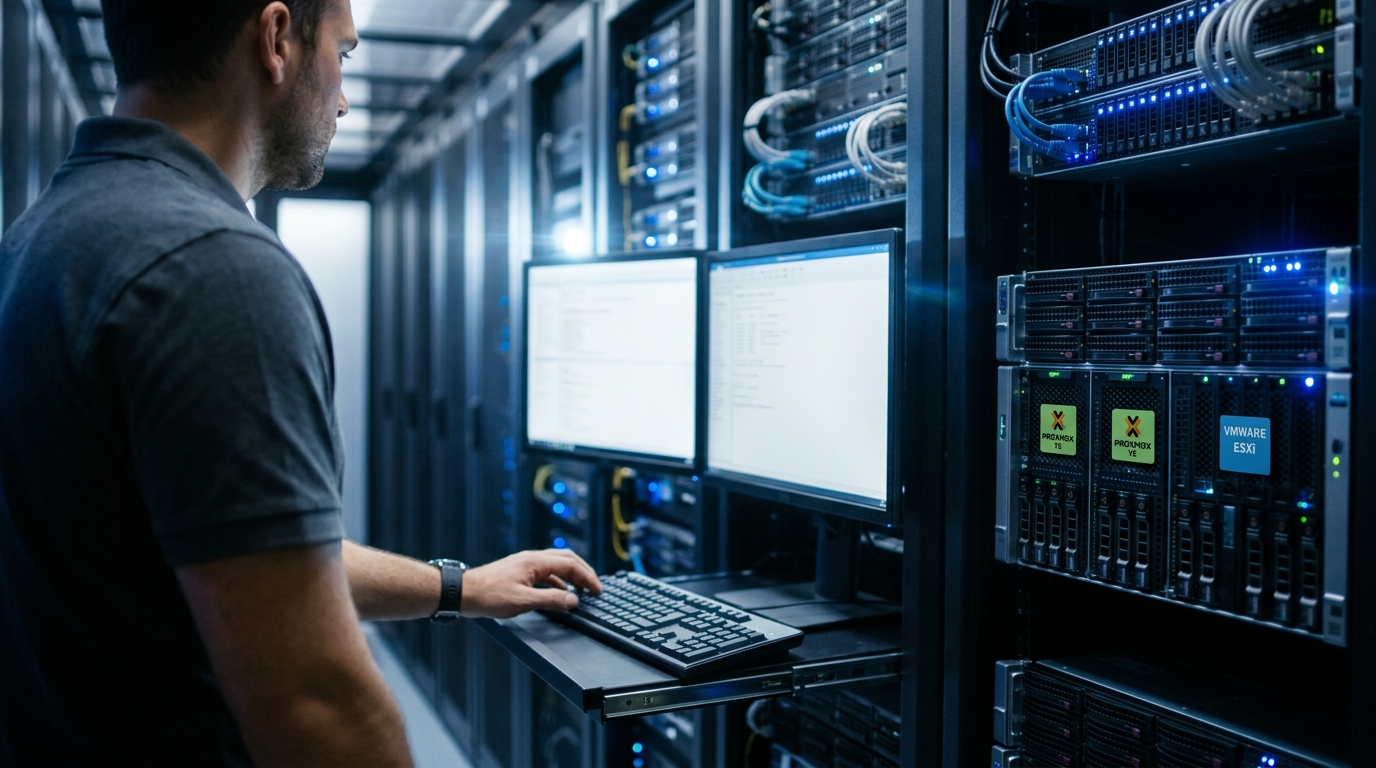
In 2026, the 'Cloud First' mantra has officially been replaced by 'Cloud Rational.' According to recent IDC data, a staggering 86% of CIOs are planning to repatriate at least some of their workloads this year—the highest rate in history. The culprit? An unsustainable gap between AI infrastructure investment and actual revenue. While hyperscalers spent over $600 billion in capex last year, AI services only generated roughly $25 billion in revenue. For many enterprises, the math simply doesn't add up anymore. To survive the next fiscal cycle, organizations are turning to cloud repatriation tools to build high-performance, cost-effective private AI clouds that offer the elasticity of AWS without the 'eye-watering' monthly invoices.
The Great AI Cloud Exit: Why 2026 is the Turning Point
The honeymoon phase with public cloud AI is over. As one IT manager recently noted on Reddit, "Math said this would happen. Every company has their horror story $500K cloud bill for an innocuous query that ran over resource limits." In 2026, the primary driver for moving away from hyperscalers isn't just cost—it's lock-in and data sovereignty.
As LLMs become core to business logic, keeping those models and the data that trains them on "someone else's computer" is increasingly seen as a strategic risk. Furthermore, the AI cloud exit strategy 2026 is being fueled by the realization that "lift and shift" was a financial disaster. Moving unoptimized VMs to the cloud resulted in 24/7 billing for resources that were idle 40% of the time.
The GPU Squeeze
GPU hours on public clouds are brutal. In 2026, sustained utilization of GPUs above 40-50% makes on-premise hardware significantly more economical. When you factor in data egress costs—the hidden tax of the public cloud—repatriation becomes a no-brainer for data-heavy AI inference workloads.
Top 10 Cloud Repatriation Tools for Private AI Clouds
If you are looking for the best private AI cloud platforms, these ten tools and providers are leading the market in 2026 by offering public-cloud-like orchestration on private or bare-metal hardware.
1. Lyceum
Highlighted by industry veterans as a game-changer for those escaping the AWS ecosystem, Lyceum specializes in rapid environment setup for AI workloads. Users report a 63% reduction in GPU costs and an 80% drop in setup time compared to traditional hyperscalers. It is specifically designed for teams that need to move GPU-intensive training and inference tasks to a more predictable cost model.
2. DigitalOcean Gradient™
DigitalOcean’s Gradient is the gold standard for agentic inference clouds. It bridges the gap between public cloud ease-of-use and private cloud control. Gradient allows you to run multiple AI agents in production using models like Llama 3 and DeepSeek without managing complex API keys. It’s ideal for SMBs that have outgrown the "hyperscaler tax" but aren't ready to buy their own racks yet.
3. CoreWeave
CoreWeave is the "neo-cloud" of choice for those needing direct, high-powered GPU access. By focusing on NVIDIA Blackwell and Hopper architectures, they provide a middle ground for repatriation. You get the bare-metal performance required for LLMs with a Kubernetes-native orchestration layer that makes the transition from AWS or GCP seamless.
4. HorizonIQ
For enterprises moving toward a true hybrid model, HorizonIQ offers bare-metal consistency. Their S3-compatible storage has zero egress fees, solving one of the biggest pain points in cloud repatriation. They provide the "public-cloud-like" orchestration that Reddit users claim is the missing link in most on-premise setups.
5. PointFive
Repatriation isn't always about moving hardware; sometimes it's about optimizing the mess you have. PointFive is a specialized GPU cost optimization software that audits cloud waste. Before you pull the plug on AWS, PointFive can often find 30-40% waste in your configuration, helping you decide which workloads actually need to be repatriated.
6. Lambda Labs
Lambda Labs has become the go-to for repatriating LLM workloads from AWS. Their "1-Click Clusters" allow engineers to deploy multi-node GPU environments that feel exactly like public cloud but at a fraction of the cost. They provide the Ubuntu-based stack, CUDA drivers, and PyTorch pre-installed, removing the "sysadmin overhead" that often kills on-premise initiatives.
7. Silk
Silk is a Software-Defined Storage (SDS) platform that acts as a bridge. It allows mission-critical AI applications to maintain cloud-level performance on-premise. By decoupling performance from capacity, Silk ensures that your repatriated databases don't become a bottleneck for your AI inference engines.
8. RunPod
RunPod offers a unique "serverless GPU" model that is perfect for bursty AI workloads. If your repatriation strategy involves keeping some workloads in a private cloud but needing to burst during peak demand, RunPod’s instant clusters provide the necessary elasticity without the long-term contract lock-in of the Big Three.
9. Gigabyte Data Center Solutions
For companies ready to go full on-premise, Gigabyte has emerged as a leader in providing the actual physical infrastructure. They offer pre-configured AI racks that are optimized for high-density GPU compute, essentially allowing you to build a "cloud in a box."
10. CodeConductor
While not an infrastructure provider, CodeConductor is essential for the AI cloud exit strategy 2026. It automates the development of AI-native applications, ensuring they are built with portability in mind. By using CodeConductor, developers can ensure their code isn't tightly wound into proprietary AWS or Azure services, making future repatriation a simple task of moving containers.
Repatriating LLM Workloads from AWS: The Strategy
Moving a large language model (LLM) workload off AWS is not as simple as copying a database. You must account for the specialized orchestration that AWS provides. To succeed, follow this three-step framework:
Step 1: Decouple the Data Layer
Before moving compute, you must address data gravity. Use S3-compatible tools like MinIO or HorizonIQ to create a data layer that exists independently of the hyperscaler. This prevents the "egress trap" where moving your data costs more than the first year of on-premise hosting.
Step 2: Standardize on Kubernetes (K8s)
According to the CNCF 2025 survey, 82% of organizations have standardized on Kubernetes for production. As one DevOps lead noted, "If you deploy to K8s in the cloud and K8s on-prem, there is no difference to the application." Kubernetes serves as the "operating system for AI," abstracting the underlying hardware and making on-premise AI infrastructure management a reality for smaller teams.
Step 3: Implement an Abstraction Layer
Don't use proprietary services like Amazon Bedrock if you plan to leave. Instead, use open-source alternatives like Ollama or vLLM for model serving. These tools can run on any GPU cluster, whether it’s in your basement or a CoreWeave data center.
GPU Cost Optimization Software: Beyond the Hyperscaler
In 2026, managing GPU costs is the difference between a profitable AI product and a bankrupt one. Public clouds charge a premium for the convenience of "instant" scaling, but most AI workloads are predictable.
| Feature | Public Cloud (AWS/Azure) | Private AI Cloud (Colo/On-Prem) |
|---|---|---|
| GPU Hourly Rate | $12.00 - $32.00 (H100) | $2.50 - $6.00 (Amortized) |
| Data Egress | $0.05 - $0.09 per GB | $0.00 |
| Orchestration | Managed (SageMaker/Vertex) | Self-Managed (K8s/OpenStack) |
| Lock-in | High (Proprietary APIs) | Low (Open Source Standards) |
| Scalability | Instant / Unlimited | Finite / Planned |
Using GPU cost optimization software like PointFive or Kubecost allows teams to see exactly where their money is going. Often, the "convenience" of the cloud is actually just paying for idle time. Repatriating these workloads to dedicated hardware can result in 40% to 70% TCO savings over a three-year cycle.
On-Premise AI Infrastructure Management: The New Stack
The "Renaissance of On-Prem" is built on a modern software stack that mimics the public cloud experience. You no longer need a 100-person IT team to manage a private data center. The best private AI cloud platforms in 2026 utilize:
- Ceph & KVM: For robust, scalable storage and virtualization that doesn't require a Broadcom/VMware license.
- OpenStack: To provide the self-service portal and API-driven infrastructure that developers have come to expect from the cloud.
- NVIDIA AI Enterprise: A software suite that makes managing GPU clusters as easy as managing a fleet of VMs.
"The challenge for a global company is that we are not in the data center business. But when the cloud bill hits seven figures a month, you realize you have to be in the data center business to survive." — FMCG Infrastructure Lead on Reddit
Key Takeaways
- The 86% Rule: Most enterprises are now actively pulling AI workloads off the big clouds due to "insane" costs and egress fees.
- GPU Savings: Repatriating sustained GPU workloads to private hardware can cut costs by 60% or more.
- K8s is Key: Kubernetes has become the de facto operating system for AI, making workloads portable across any cloud or on-prem environment.
- Data Egress is the Trap: Always calculate the cost of getting your data out before putting it in to a public cloud.
- Hybrid is the Default: The most successful 2026 strategy is keeping SaaS (M365/Salesforce) in the cloud while moving heavy AI compute (LLM training/inference) to private infrastructure.
Frequently Asked Questions
What are the best cloud repatriation tools for 2026?
Lyceum, DigitalOcean Gradient, and Lambda Labs are currently the top-rated tools for repatriating AI workloads. For storage-heavy moves, Silk and HorizonIQ offer the best performance without egress fees.
Is on-premise AI infrastructure management harder than the cloud?
While it requires more initial setup, modern tools like Kubernetes and NVIDIA AI Enterprise have significantly lowered the barrier to entry. Many teams find that the "complexity" of managing cloud bill sprawl is actually harder than managing physical servers.
How much can I save by repatriating my LLM workloads from AWS?
Users on platforms like Reddit report savings of 40% to 63%. The exact amount depends on your data egress volume and whether you can maintain a high utilization rate (above 40%) on your own hardware.
What is an AI cloud exit strategy 2026?
An exit strategy involves decoupling your data from proprietary cloud APIs, containerizing all AI workloads in Kubernetes, and selecting a secondary "neo-cloud" or on-premise provider to host your steady-state compute.
Can I still use cloud-native tools if I move on-premise?
Yes. Open-source tools like OpenStack and KubeVirt allow you to run cloud-native applications on your own hardware, providing the same API-driven experience your developers are used to.
Conclusion
The move toward cloud repatriation tools in 2026 isn't a retreat—it's an evolution. The first decade of cloud was about growth at any cost; the next decade is about efficiency and control. By leveraging the best private AI cloud platforms, organizations are discovering that they can have the best of both worlds: the agility of modern software development and the fiscal sanity of owned infrastructure.
Whether you are repatriating LLM workloads from AWS or simply looking for better GPU cost optimization software, the tools are now mature enough to make the transition seamless. Don't wait for your next "horror story" cloud bill to start planning your exit. The math has spoken, and the future of AI is private.