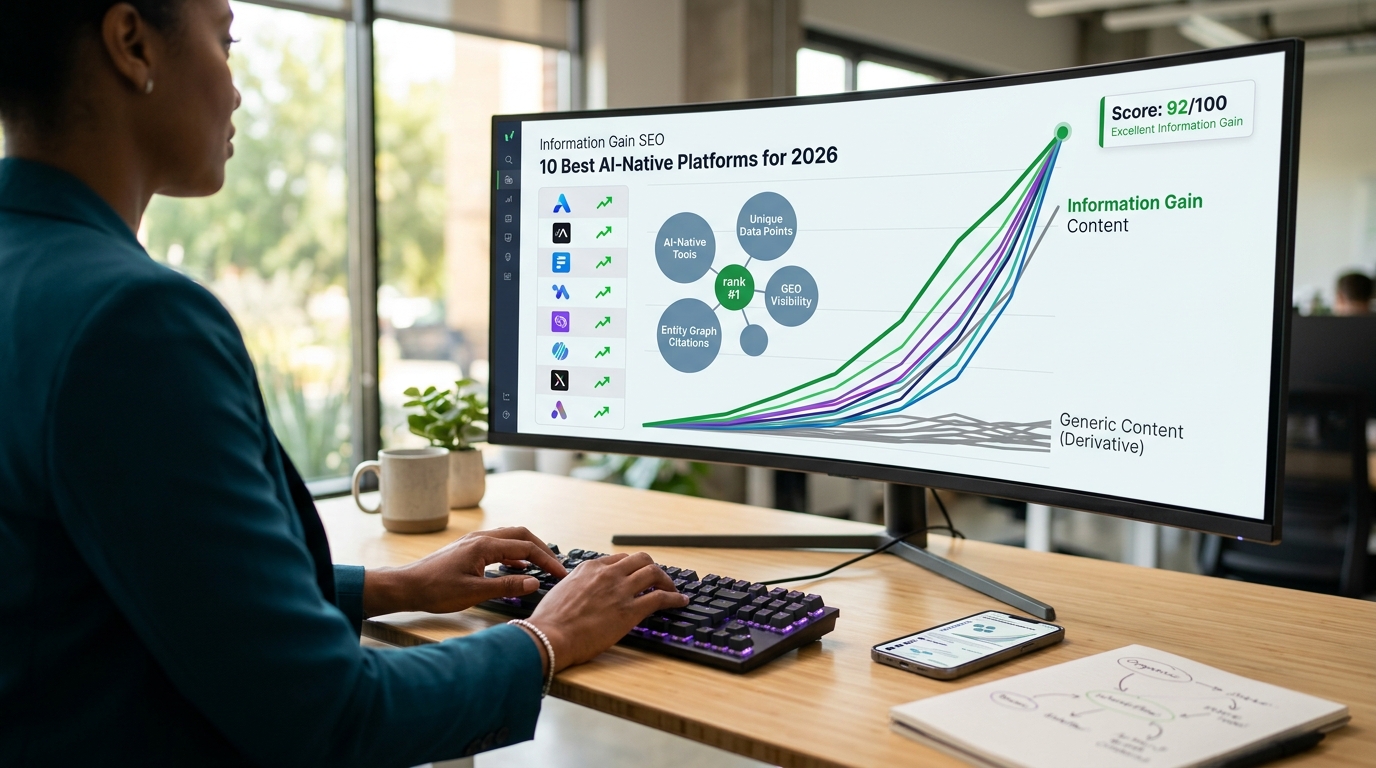
According to recent industry data, over 60% of Google searches now terminate without a single click. As Generative AI models like Search Generative Experience (SGE), Perplexity, and ChatGPT become the primary interface for information retrieval, the traditional SEO playbook has been set on fire. Gartner projects that organic search traffic will plummet by 50% by 2028 for brands that fail to adapt. In this high-stakes environment, the only metric that guarantees survival is Information Gain. If your content merely echoes the existing top 10 results, you are invisible to the algorithms of 2026. To rank today, you must provide unique, non-derivative value that AI models can cite as a primary source. This guide explores the Information Gain SEO Tools and AI-native platforms essential for securing your digital footprint in the age of generative search.
The Information Gain Revolution: Why Uniqueness is the New Keyword
For decades, SEO was a game of mimicry. If the top-ranking page had 2,000 words and used the keyword "best laptop" fifteen times, you wrote 2,100 words and used it sixteen times. In 2026, this strategy is a recipe for algorithmic suppression. Google’s Information Gain patent (US Patent 10,846,326) allows the search engine to score a document based on how much new information it provides relative to documents the user has already seen.
As one Reddit user in the r/DigitalMarketingTools community noted, "Organic clicks dropped ~30% even though rankings stayed the same... ChatGPT were answering questions my articles used to answer." This is the reality of unique content optimization 2026. AI engines do not need a million versions of the same answer; they need one definitive answer and three unique perspectives to synthesize a comprehensive response.
Information gain scoring software has emerged to help marketers identify these "knowledge gaps." Instead of just checking keyword density, these tools analyze the semantic vector space of the current SERP and highlight what is missing—whether that is original data, a contrarian opinion, or a specific technical detail that no one else has covered.
The 10 Best Information Gain SEO Tools for 2026
The following platforms represent the cutting edge of AI content differentiation tools. We have categorized them by their primary utility in the modern hybrid SEO stack.
1. Dageno: The AI Visibility Pioneer
Dageno is widely regarded as the most advanced platform for tracking brand presence in the "black box" of AI. Unlike traditional trackers that look for blue links, Dageno monitors your Share of Voice (SoV) across ChatGPT, Perplexity, and Gemini.
- Core Feature: BotSight AI Crawler Detection. It identifies exactly which AI models (GPTBot, ClaudeBot, etc.) are consuming your content and whether they are interpreting your data correctly.
- Information Gain Utility: It identifies "Prompt Gaps"—queries where competitors are being cited but your brand is missing despite having relevant content.
- Pricing: Enterprise-focused; custom quotes.
2. LLMClicks.ai: The LLM SEO Specialist
If you need to know exactly what an LLM says about your pricing or features, LLMClicks.ai is the industry standard. It provides a Mention Rate metric that shows how often your brand is recommended during conversational queries.
- Core Feature: Hallucination & Sentiment Tracking. It alerts you if an AI is providing false information about your brand (e.g., outdated pricing), allowing you to update the source material immediately.
- Information Gain Utility: It tracks which third-party sites (Reddit, niche forums) the AI uses as citations, helping you build a digital PR strategy that feeds the models.
- Pricing: Starts at $49/month.
3. Surfer SEO: The NLP Powerhouse
Surfer SEO has evolved from a simple on-page tool into a comprehensive entity-based SEO tool. It uses Natural Language Processing (NLP) to ensure your content covers the exact entities Google expects for topical authority.
- Core Feature: Auto-Optimize. With one click, it inserts missing semantic terms to align your content with the "ideal" vector for a specific query.
- Information Gain Utility: Its Content Score provides a real-time benchmark for how well you cover a topic compared to the top 10, but its new "Surfer AI" features now focus on adding unique data points to avoid derivative output.
- Pricing: Starts at $79/month.
4. techPAPA AI: The GEO Optimizer
techPAPA AI is a rising star in the Generative Engine Optimization (GEO) space. It focuses on how content structure influences AI citations.
- Core Feature: Citation Opportunity Mapping. It breaks down a blog post and suggests where to insert data tables, bulleted lists, or direct definitions that AI bots love to scrape.
- Information Gain Utility: It specifically flags "entity gaps"—concepts related to your primary keyword that no one in the top 20 results has mentioned yet.
- Pricing: Mid-market friendly; starts around $99/month.
5. Semrush AI Visibility Toolkit
For teams already invested in the Semrush ecosystem, the AI Visibility Toolkit is a powerful add-on. It merges traditional keyword data with generative search tracking.
- Core Feature: AI Overview Tracking. It monitors whether your site appears in the "carousel" or the expanded text of Google's AI Overviews.
- Information Gain Utility: The Personal Keyword Difficulty score uses AI to determine how hard it is for your specific domain to provide unique value for a keyword.
- Pricing: Toolkit add-on starts around $140/mo on top of Pro plans.
6. Frase: The AEO Architect
Frase excels at Answer Engine Optimization (AEO). It is built to help you answer the specific questions users ask on Reddit, Quora, and People Also Ask (PAA).
- Core Feature: Content Brief Generator. It analyzes the SERP and identifies the "intent fragments" you must address to be considered a comprehensive source.
- Information Gain Utility: By aggregating questions from across the web, it helps you find the "long-tail" information gain opportunities that competitors ignore.
- Pricing: Starts at $38/month.
7. MarketMuse: Semantic Authority at Scale
MarketMuse is the gold standard for unique content optimization 2026. It doesn't just look at one page; it audits your entire site to find topical gaps.
- Core Feature: Topical Inventory. It shows you which topics you have "over-optimized" and where you are missing the unique depth required for high information gain scores.
- Information Gain Utility: Its "Connect" feature suggests internal links that build a semantic web, making it easier for AI crawlers to understand your expertise.
- Pricing: High-end; starts at $499/month (Free tier available for single users).
8. Clearscope: The Content Quality Filter
Clearscope is favored by high-end content agencies for its simplicity and accuracy. It focuses on "Semantic Coverage Strength."
- Core Feature: Content Reports. It provides a list of relevant terms and entities that must be present for a page to be considered authoritative.
- Information Gain Utility: It forces writers to move beyond surface-level content by highlighting technical sub-topics that add depth and uniqueness.
- Pricing: Starts at $170/month.
9. NeuronWriter: The Budget NLP Alternative
For smaller teams or niche site builders, NeuronWriter offers many of the features of Surfer or MarketMuse at a fraction of the cost.
- Core Feature: NLP Term Suggestions. It uses Google's latest BERT and MUM algorithms to suggest terms that improve semantic relevance.
- Information Gain Utility: It includes a "Next Step" recommendation engine that tells you exactly what unique angle to take to differentiate your content.
- Pricing: Often available on lifetime deals or starting at $19/month.
10. Ahrefs AI Radar
Ahrefs remains the king of backlink data, but its new AI Radar (Brand Radar) add-on is a significant step into the GEO world.
- Core Feature: Citations Monitoring. It tracks when your site is used as a source for an AI-generated answer across the web.
- Information Gain Utility: It helps you identify which of your unique data points are being "picked up" by the AI, allowing you to double down on that specific type of research.
- Pricing: Starts at $129/month + add-on fees.
| Tool Name | Primary Strength | Best For | Starting Price |
|---|---|---|---|
| Dageno | AI Visibility & Crawler Detection | Enterprise Brands | Custom |
| LLMClicks.ai | LLM Mention Tracking | SaaS & Reputation Mgmt | $49/mo |
| Surfer SEO | On-Page NLP & Entity Coverage | Content Teams | $79/mo |
| techPAPA AI | GEO & Entity Gaps | Growth Marketers | $99/mo |
| Frase | AEO & Question Research | SEO Writers | $38/mo |
How to Increase Your Information Gain Score: A Technical Workflow
Simply owning information gain scoring software is not enough. You must integrate these tools into a rigorous editorial workflow. Here is the 5-step process used by elite tech journalists and SEOs to ensure every piece of content provides a high information gain score.
Step 1: SERP Deconstruction
Before writing, use a tool like Frase or MarketMuse to deconstruct the current top 10. Identify the "Common Knowledge Baseline." If every article mentions the same five features of a product, those features have zero information gain value for you. Your goal is to find the sixth, seventh, and eighth features that no one is talking about.
Step 2: Entity Injection and Mapping
Use entity-based SEO tools 2026 like Clearscope or Surfer to identify the semantic requirements. However, instead of just checking the boxes, look for Related Entities that are currently under-represented. For example, if you are writing about "Information Gain SEO Tools," ensure you are also discussing "Vector Embeddings," "RAG (Retrieval-Augmented Generation)," and "Knowledge Graphs."
Step 3: Original Data and Primary Research
AI models prioritize primary sources. To increase information gain score, you must include data that does not exist elsewhere. This could be: * Internal case studies and benchmarks. * Proprietary survey results. * Expert interviews with unique quotes. * Technical walkthroughs of a specific, rare edge case.
Step 4: Structural Optimization for AI Scrapers
AI bots like GPTBot prefer structured data. Use techPAPA AI to ensure your unique insights are formatted in a way that is "citation-ready." Use clear H3 headings that ask a question and provide the answer in the first sentence of the following paragraph. Use JSON-LD schema to explicitly define the entities and relationships in your article.
Step 5: Post-Publishing Visibility Tracking
Once live, use Dageno or LLMClicks.ai to see if you are being cited. If you aren't, it’s likely because your information gain wasn't high enough or your domain authority didn't support the claim. Adjust your strategy by adding more first-hand experience (the 'E' in E-E-A-T).
GEO vs. SEO: Navigating the Generative Engine Optimization Landscape
In 2026, we distinguish between Search Engine Optimization (SEO) and Generative Engine Optimization (GEO). While they overlap, their goals are slightly different.
"Traditional rank tracking is no longer just a keyword position checker; it is a comprehensive AI Visibility platform." — Reddit post, r/GEO__AI__SEO
Traditional SEO focuses on keyword rankings and backlinks to drive clicks. GEO focuses on brand sentiment and citation frequency within AI outputs. The challenge is that GEO often results in "zero-click" searches. However, being the cited source in a ChatGPT response is the modern equivalent of a brand impression. It builds the "Trust Model" that ensures when a user is ready to buy, yours is the only brand they consider.
Tools like Dageno and Profound are essential here because they measure sentiment. If Perplexity cites you but says your product is "complex and expensive," you have a GEO problem that traditional SEO tools like Ahrefs cannot detect.
Entity-Based SEO: The Secret to AI Citation Rankings
AI models do not see the web as a collection of pages; they see it as a Knowledge Graph of entities. An entity is a well-defined object or concept (e.g., "Google," "SEO," "Elon Musk").
To master entity-based SEO tools 2026, you must understand how to link entities. If you write about a tool, you must also mention the company that made it, the category it belongs to, and the problems it solves. This "semantic mapping" helps AI models understand exactly where your content fits into their internal world model.
MarketMuse and InLinks are particularly strong in this area. They help you build internal link structures that reinforce these entity relationships, making your site a "Topic Map" rather than just a blog.
Measuring Success: New Metrics for AI Visibility and Share of Voice
If you are still reporting on "Average Position" to your stakeholders in 2026, you are providing an incomplete picture. The new KPIs for the Information Gain era are:
- AI Mention Rate: The percentage of conversational queries in your niche where your brand is mentioned.
- Citation Share: The percentage of AI-generated footnotes that link back to your domain.
- Information Gain Delta: A score (provided by tools like NeuronWriter or Surfer) comparing your content's uniqueness to the SERP average.
- Sentiment Polarity: Whether the AI describes your brand in a positive, neutral, or negative light.
- Prompt-to-Click Rate: A new metric tracking how many users click through from an AI citation to your website.
Key Takeaways (TL;DR)
- Information Gain is the #1 Ranking Factor: Derivative content is being filtered out by Google's patent-driven uniqueness scoring.
- GEO is Mandatory: You must optimize for LLMs (ChatGPT, Gemini) alongside traditional search engines.
- The Hybrid Stack: Successful SEOs in 2026 use a mix of traditional tools (Semrush/Ahrefs) and AI-native visibility tools (Dageno/LLMClicks).
- Entities Over Keywords: Focus on building a semantic knowledge graph of your topic to secure AI citations.
- Technical Bot Management: Ensure your site is crawlable for AI bots (GPTBot, ClaudeBot) using tools like Screaming Frog.
- Original Data Wins: The easiest way to increase your information gain score is to publish proprietary research and first-hand expertise.
Frequently Asked Questions
What are Information Gain SEO Tools?
Information Gain SEO Tools are software platforms that measure how much unique, non-derivative information a piece of content provides compared to existing search results. They use NLP and semantic analysis to identify "knowledge gaps" that help content rank higher in both Google and AI engines like ChatGPT.
How do I increase my Information Gain score for SEO?
To increase your Information Gain score, you must include original research, unique data points, expert quotes, or a contrarian perspective that isn't found in the top 10 search results. Using tools like MarketMuse or techPAPA AI can help you identify specific sub-topics and entities that your competitors have missed.
What is Generative Engine Optimization (GEO)?
GEO is the practice of optimizing content to be cited and recommended by generative AI search engines and LLMs, such as Google AI Overviews, Perplexity, and ChatGPT. It focuses on structure, entity relationships, and brand authority rather than just keyword rankings.
Are traditional SEO tools like Semrush and Ahrefs still useful in 2026?
Yes, but they are no longer sufficient on their own. Traditional tools are excellent for keyword volume and backlink data, which still feed the AI models. However, you need to layer them with AI-native tools like Dageno or LLMClicks to track your visibility inside generative AI responses.
Can AI content differentiation tools help prevent zero-click search losses?
While they cannot stop users from getting answers directly from AI, differentiation tools ensure that your brand is the one cited as the source. This builds brand authority and increases the likelihood that high-intent users will click through to your site for deeper details that the AI cannot synthesize.
Conclusion
The search landscape of 2026 is no longer a simple hierarchy of links; it is a complex ecosystem of synthesized answers and citations. To stay relevant, you must move beyond the "SEO of mimicry" and embrace the "SEO of uniqueness." By leveraging Information Gain SEO Tools, focusing on unique content optimization 2026, and tracking your AI visibility, you can turn the generative revolution into a competitive advantage. The black box of AI search is no longer a mystery—it is a territory waiting to be claimed. Start auditing your information gain today, or risk being filtered out of the conversation tomorrow.