Only 10% to 15% of AI agent pilots successfully scale to production. The rest fall victim to what engineers call the "unreliable agent" crisis: network timeouts, API rate limits, cascading errors, and lost execution states. When transitioning from a prototype to a enterprise-grade system, developers face a critical architectural decision: LangGraph vs Temporal.
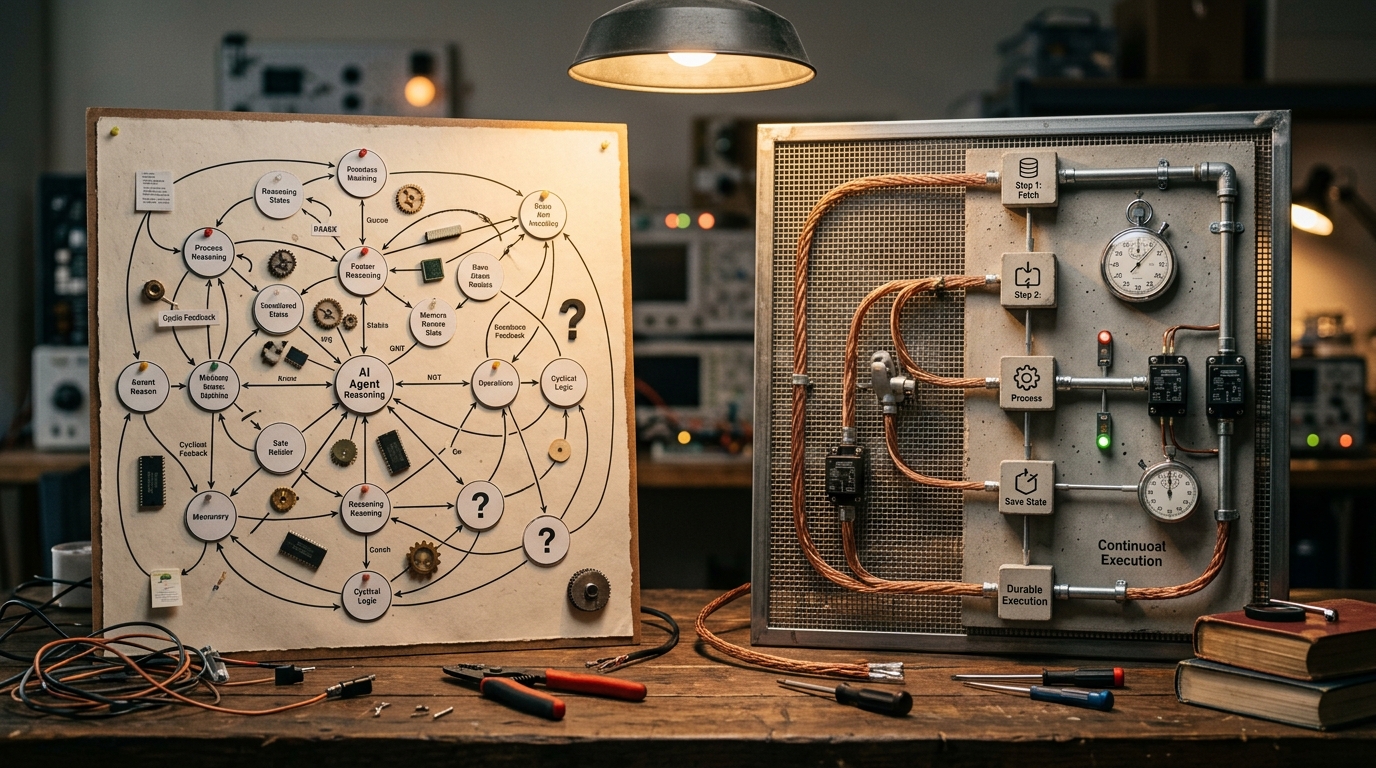
While LangGraph excels at modeling the complex, cyclic reasoning paths of LLMs, Temporal provides the bulletproof, distributed orchestration required to survive infrastructure failures. Choosing between them—or learning how to combine them—is the key to building a reliable ai agent architecture that can run for minutes, hours, or even weeks without losing state. This comprehensive guide breaks down the paradigms, trade-offs, and integration patterns you need to know for your next production deployment.
The Production Crisis: Why 85% of AI Agent Prototypes Fail
Building an AI agent in a Jupyter Notebook is deceptively simple. You write a few lines of Python, import an LLM SDK, define some tools, and watch the agent successfully answer queries. But when you deploy that agent to handle real-world business processes, it immediately encounters the harsh realities of distributed systems.
In production, AI agents are highly vulnerable to external failures. Real-world run data shows that 60% to 80% of agent failures stem from third-party API flakiness, rate limits, or network timeouts. When an LLM call times out on step 8 of a 10-step reasoning loop, what happens to your agent?
- State Loss: In a standard Python runtime, the entire execution state is held in memory. If the container crashes, restarts, or runs out of memory mid-loop, that state is permanently lost. The user is left with a hanging loading spinner, and your database is left in an inconsistent state.
- Runaway Token Burn: Without strict limits, an agent caught in an error loop can rapidly call external LLM APIs, burning hundreds of dollars in tokens within minutes.
- The "Sometimes Things Just Freeze" Energy: Standard web servers and serverless functions (like AWS Lambda or Azure Functions) are designed for short-lived, stateless requests. They are fundamentally unsuited for long-running, multi-step stateful agent workflows that need to wait for human approval or complete slow background tasks.
To bridge this gap, enterprise teams are moving away from simple prompt wrappers toward structured orchestration. They are shifting their focus to durable execution for ai agents—the guarantee that a workflow will execute to completion, surviving server crashes, network outages, and long delays without losing its progress.
"Most AI agents fail in production for the same reason: they're built like prompts instead of systems. A prompt is stateless. It runs, produces output, disappears. We need engineering rigor, not just better prompts."
LangGraph: The Cognitive State Machine
Developed by the LangChain team, LangGraph is an open-source framework designed to build stateful, multi-agent applications using a graph-based mental model. It represents workflows as directed graphs where nodes are computational steps (such as calling an LLM or running a tool) and edges define the execution flow.
[User Input] --> (Node: Agent) --(Conditional Edge)--> (Node: Tools) ^ | |_______|
Core Architecture
LangGraph’s execution is governed by a centralized state schema, typically defined using Pydantic or Python’s TypedDict. As the execution moves from node to node, each node returns a partial update to the state, which LangGraph automatically merges using predefined reducer functions.
Unlike traditional Directed Acyclic Graph (DAG) engines, LangGraph natively supports cycles. This is crucial for agentic behaviors like the ReAct (Reason + Action) pattern, where an agent must iteratively call tools, observe the results, and refine its response until a goal is met.
Here is a simplified example of a stateful agent workflow in LangGraph:
python from typing import Annotated, TypedDict from langgraph.graph import StateGraph, END from pydantic import BaseModel
Define the state schema
class AgentState(TypedDict): messages: list current_task: str is_approved: bool
def agent_node(state: AgentState): # LLM reasoning step response = call_llm(state["messages"]) return {"messages": [response]}
def should_continue(state: AgentState) -> str: last_message = state["messages"][-1] if "FINAL ANSWER" in last_message.content: return "end" return "continue"
Build the graph
workflow = StateGraph(AgentState) workflow.add_node("agent", agent_node) workflow.add_node("tools", tool_node)
Define the edges
workflow.set_entry_point("agent") workflow.add_conditional_edges( "agent", should_continue, {"continue": "tools", "end": END} ) workflow.add_edge("tools", "agent")
app = workflow.compile()
Key Strengths of LangGraph
- Cognitive Control: It gives developers fine-grained control over the agent's decision-making paths. You can explicitly define fallback routes, validation loops, and human-in-the-loop approval gates.
- Rich Ecosystem Integration: Seamlessly connects with LangChain’s vast library of model providers, vector stores, and tools.
- PydanticAI Synergy: Combining LangGraph with PydanticAI allows developers to enforce strict structured outputs from LLMs, drastically reducing formatting errors and schema mismatches in multi-step chains.
- LangGraph Studio: Provides an excellent visualization and debugging UI, complete with "time-travel" debugging to replay and edit historical agent states.
Limitations in Production
While LangGraph is highly capable, it runs as a standard library inside your application process. If your host server suffers a hardware failure, gets restarted during a deployment, or runs out of memory mid-execution, the running process dies.
To make LangGraph resilient, you must manually implement checkpointers (e.g., configuring PostgreSQL or Redis savers) to serialize the state after every step. However, LangGraph does not natively solve infrastructure-level problems like distributed task queuing, rate-limiting external APIs, or managing backpressure across multiple worker nodes.
Temporal: The Durable Execution Engine
Temporal takes a completely different approach. It is not an AI framework; it is an open-source, enterprise-grade durable execution platform designed to run arbitrary code with 100% reliability. Temporal guarantees that your application code will execute to completion, regardless of network failures, server crashes, or long-term resource outages.
Originally built by the creators of Uber Cadence, Temporal is trusted by companies like Netflix, Stripe, and OpenAI (which uses Temporal to orchestrate Codex in production).
[Temporal Server] <--- (gRPC) ---> [Your Worker Process] (Persists Event History) (Executes Workflow/Activities)
Core Architecture
Temporal splits your application into two main concepts:
- Workflows: State-tracking orchestrators written in standard programming languages (Python, Go, Java, TypeScript). Workflow code must be strictly deterministic. Temporal achieves durability by recording every step of your workflow's execution in an external event store (like PostgreSQL, Cassandra, or MySQL) using event sourcing.
- Activities: Non-deterministic execution units where you perform side effects, such as making API calls, querying databases, or running LLM inferences. Activities can fail, timeout, and be retried infinitely according to customizable backoff policies.
When a Temporal worker crashes mid-workflow, a new worker takes over, reads the event history from the Temporal server, and replays the workflow code. It skips the activities that have already succeeded (returning their cached results instantly) and resumes execution exactly at the point of failure.
Key Strengths of Temporal
- Guaranteed Completion: If a server dies, your workflow simply migrates to another worker and continues. It can pause for months waiting for an external webhook or human approval without consuming active compute resources.
- Built-in Resiliency Patterns: Out-of-the-box support for exponential retries, timeouts, heartbeats, and saga patterns (for distributed transactions and rollbacks).
- High Scalability: Handles millions of concurrent, long-running executions with robust backpressure management and rate-limiting.
- Strict Audit Trails: Temporal records a complete, immutable history of every state transition, activity call, and input/output payload, satisfying strict compliance and security requirements.
Limitations for AI Agents
Temporal is a low-level orchestration engine. It does not understand prompt templates, vector embeddings, tool calling, or LLM-specific paradigms. Writing complex, cyclic reasoning loops directly in Temporal can feel verbose and require significant boilerplate.
Because workflow code must be deterministic, you cannot make direct LLM calls inside a Workflow definition; they must be wrapped inside Activities. This architectural constraint can make rapid prototyping of highly dynamic, conversational agents slower compared to using dedicated AI frameworks.
LangGraph vs Temporal: Architectural Head-to-Head
To choose the right tool, we must compare temporal vs langgraph across the engineering vectors that matter most in production deployments.
| Feature | LangGraph (v1.0) | Temporal |
|---|---|---|
| Primary Paradigm | Graph-based cognitive state machine | Event-sourced durable execution |
| State Persistence | Voluntary (via pluggable checkpointers) | Mandatory & automatic (via event history) |
| Fault Tolerance | Application-level (requires manual retry/catch logic) | Infrastructure-level (automatic replay, worker migration) |
| Execution Flow | Cyclic, dynamic routing determined by LLM | Deterministic DAG/imperative code with dynamic Activities |
| Long-Running Support | Moderate (possible with persistent checkpointers) | Excellent (can run for years, natively supports sleep/pause) |
| Latency Overhead | Low (runs in-process) | Low-to-Moderate (gRPC roundtrips to Temporal server) |
| Observability | LangSmith / LangGraph Studio (AI-centric) | Temporal Web UI (infrastructure & history-centric) |
| Best For | Complex agent reasoning, tool routing, and cognitive loops | Mission-critical orchestration, human-in-the-loop, robust API integrations |
Cognitive State vs. Execution State
Understanding the difference between these two systems requires separating cognitive state from execution state.
- Cognitive State is the agent's internal context: "What is the user asking? What tools have I run? What is the current draft of the document?" LangGraph is the master of cognitive state. It makes it easy to update, merge, and branch this context based on LLM outputs.
- Execution State is the operating system and network context: "Which line of code is currently running? What happens if the network drops right now? How do I safely retry this API call without duplicate billing?" Temporal is the master of execution state. It guarantees that the code executing your cognitive loops remains alive and reliable.
The Hybrid Blueprint: Integrating Temporal and LangGraph
For complex, mission-critical AI applications, the question is not LangGraph vs Temporal—it is how to combine them. The most robust enterprise pattern is a two-layer architecture that leverages each tool for what it does best.
[Temporal Workflow (Outer Orchestrator)] | |---> [Activity: Extract Data (Deterministic)] | |---> [Activity: Run LangGraph Agent (Inner Cognitive Loop)] | | | |---> Node 1: LLM Reason | |---> Node 2: Call Tool | |---> Node 3: Validate Output | |---> [Activity: Send Notification / Human Approval]
In this hybrid model: 1. Temporal acts as the Outer Layer: It manages the high-level business workflow, coordinates background data pipelines, handles human-in-the-loop timeouts, and guarantees overall execution durability. 2. LangGraph acts as the Inner Layer: It is packaged inside a Temporal Activity. When called, it runs its dynamic, cyclic reasoning loops to solve a specific unstructured task, then returns the validated result back to the Temporal workflow.
Code Example: A Hybrid Document Processing Agent
Let’s write a production-ready Python example where a Temporal workflow orchestrates an invoice-processing pipeline, calling a LangGraph agent to handle complex data extraction and matching.
1. The LangGraph Agent (Cognitive Activity)
This agent runs inside a Temporal Activity. It uses LangGraph to reason about unstructured invoice text and match it against a purchase order.
python
activities.py
from temporalio import activity from langgraph.graph import StateGraph, END from typing import TypedDict
class InvoiceState(TypedDict): raw_text: str extracted_data: dict is_matched: bool iterations: int
Define cognitive nodes
def extract_invoice_data(state: InvoiceState): # Simulate LLM extracting data # In real life, use PydanticAI / Structured Outputs here extracted = {"amount": 1500, "vendor": "Acme Corp"} return {"extracted_data": extracted, "iterations": state["iterations"] + 1}
def match_purchase_order(state: InvoiceState): # LLM or rule-based matching amount = state["extracted_data"].get("amount") matched = (amount == 1500) # Simulated logic return {"is_matched": matched}
def should_retry(state: InvoiceState): if state["is_matched"] or state["iterations"] >= 3: return "end" return "retry"
Compile the LangGraph cognitive loop
builder = StateGraph(InvoiceState) builder.add_node("extract", extract_invoice_data) builder.add_node("match", match_purchase_order) builder.set_entry_point("extract") builder.add_edge("extract", "match") builder.add_conditional_edges("match", should_retry, {"retry": "extract", "end": END}) cognitive_agent = builder.compile()
@activity.define async def run_invoice_agent_activity(raw_invoice_text: str) -> dict: # Initialize and execute the LangGraph agent inside the Activity initial_state = { "raw_text": raw_invoice_text, "extracted_data": {}, "is_matched": False, "iterations": 0 } result = await cognitive_agent.ainvoke(initial_state) return result["extracted_data"]
2. The Temporal Workflow (Outer Orchestrator)
This workflow is strictly deterministic. It handles the orchestrational orchestration: fetching raw data, running the LangGraph activity, and pausing for human approval if the agent cannot confidently match the invoice.
python
workflows.py
from datetime import timedelta from temporalio import workflow
Import our activity
with workflow.unsafe.imports_passed_threaded(): from activities import run_invoice_agent_activity
@workflow.defn class InvoiceOrchestrationWorkflow: @workflow.run async def run(self, invoice_id: str, raw_text: str) -> str: # Step 1: Run the LangGraph agent as a durable Activity # If the activity crashes or times out, Temporal automatically retries it extracted_data = await workflow.execute_activity( run_invoice_agent_activity, raw_text, start_to_close_timeout=timedelta(minutes=5), retry_policy=workflow.RetryPolicy( initial_interval=timedelta(seconds=5), maximum_attempts=5 ) )
    # Step 2: High-Level Business Logic (Decision Gate)
    # If the amount exceeds $10,000, pause the workflow and wait for human approval
    if extracted_data.get("amount", 0) > 10000:
        # Define a signal handler for human approval
        self.approved = False

        await workflow.wait_condition(lambda: self.approved, timeout=timedelta(days=3))

        if not self.approved:
            return "Workflow timed out waiting for human approval. Escalated to managers."

    # Step 3: Trigger payment API (Another durable activity)
    # await workflow.execute_activity(pay_vendor_activity, extracted_data, ...)
    return f"Invoice {invoice_id} successfully processed and paid."

@workflow.signal
def approve_invoice(self):
    self.approved = True
This hybrid architecture delivers the best of both worlds. The complex, non-deterministic reasoning loop is encapsulated within LangGraph, while Temporal ensures that the entire business process is fault-tolerant, auditable, and capable of running over long horizons.
Agentic Orchestration Patterns 2026
As the AI agent ecosystem matures in 2026, the industry is aligning around several core agentic orchestration patterns 2026 to manage complexity.
1. Single-Agent Harness with Specialized Sub-Agents
Early multi-agent designs often suffered from "the telephone game"—where errors propagated and magnified with each agent-to-agent handoff. The winning pattern in 2026 is a single, highly capable main agent harness (often utilizing advanced reasoning models like GPT-4o or Claude 3.5 Sonnet) that spawns specialized sub-agents purely as "tools."
           [Main Agent Harness]
                    |
     +--------------+--------------+
     | (Tool)                      | (Tool)
     v                             v
[Sub-Agent: Web Search] [Sub-Agent: DB Writer]
This maps directly to Richard Sutton's famous essay, The Bitter Lesson: we should avoid over-structuring agentic communication. Instead, let a powerful central model decide when and how to delegate tasks to simple, specialized sub-agents.
2. Standardized Agent Protocols
To facilitate cross-framework communication, the community is adopting open standards like the LangGraph Agent Protocol. This standardized API allows an agent built in LangGraph to seamlessly trigger and communicate with a worker running the Microsoft Agent Framework, Google ADK, or even a custom-built TypeScript agent.
3. Control Plane / Data Plane Separation
For enterprise deployments, security and compliance require a strict separation of concerns: - Control Plane (Cloud Hosted): Manages metadata, workflow execution status, and orchestration triggers (e.g., LangGraph Cloud or Temporal Cloud). - Data Plane (VPC Hosted): Executes the actual agent code, interacts with internal databases, and accesses sensitive company data, ensuring data residency and security compliance.
Productionizing Your Agent Stack: Observability, Guardrails, and Memory
Orchestration alone does not guarantee a successful production deployment. To build a truly reliable ai agent architecture, you must wrap your orchestrators with observability, runtime guardrails, and persistent memory layers.
+-------------------------------------------------------------+ | Observability (OTel) | | +-------------------------------------------------------+ | | | Guardrails (Caliber) | | | | +-------------------------------------------------+ | | | | | Cognitive Layer | | | | | | (LangGraph + PydanticAI) | | | | | +-------------------------------------------------+ | | | | +-------------------------------------------------+ | | | | | Durable Execution | | | | | | (Temporal) | | | | | +-------------------------------------------------+ | | | +-------------------------------------------------------+ | +-------------------------------------------------------------+
1. Observability: "The Debugger for AI Thoughts"
Debugging multi-step agent runs without proper tracing is nearly impossible. If an agent fails on step 12, you must be able to see the exact prompt, token count, LLM response, and tool outputs for every preceding step.
Integrating tools like LangSmith or Langfuse with OpenTelemetry (OTel) allows you to visualize agent traces in real-time. This observability separates unstable prototypes from production-ready systems.
2. Runtime Guardrails
Never let an agent make raw, unvalidated calls to external systems. Implement a strict constraint layer: - Behavioral Enforcement: Libraries like Caliber act as a proxy between your agent and the LLM, reading business rules from markdown files and blocking any agent actions that violate compliance policies. - Tool Reliability Scoring: Tools like ToolRate can run alongside your agent, checking the historical success rate of external API tools. If a tool's reliability score drops (e.g., due to an outage), the agent can proactively swap to alternative tools instead of looping on a dead endpoint.
3. Persistent Memory Architecture
An agent must remember past interactions to be useful. For production systems, rely on three distinct memory tiers: 1. Short-Term Memory: The active execution state (managed by LangGraph's state schema or Temporal's workflow state). 2. Long-Term Memory (Semantic): A persistent vector database (like Pinecone or pgvector) storing past interactions, allowing the agent to perform RAG over its own history. 3. Experience Memory: Custom frameworks like Hindsight that analyze past execution failures and write "lessons learned" back to the agent's system prompt, dynamically improving performance over time.
LangGraph vs Temporal: The Ultimate Decision Matrix
To help your engineering team make the final decision, use this structured decision framework:
                   Is the process path
               strictly deterministic?
                     /         \
                   YES          NO
                   /             \
         [Use Temporal]      Is the task intensive in
                             reasoning / unstructured data?
                                   /         \
                                 YES          NO
                                 /             \
                    [Use LangGraph]         [Use Traditional Workflows]

               * For complex, mission-critical systems:
                 Wrap LangGraph inside a Temporal Activity (Hybrid Blueprint).
Choose LangGraph when:
- Your workflow is highly dynamic, non-deterministic, and guided by real-time LLM reasoning.
- You are building conversational interfaces, interactive research assistants, or complex RAG pipelines.
- You want deep integration with the Python AI ecosystem (LangChain, PydanticAI, LlamaIndex).
- You need to quickly prototype and visualize complex cyclic loops.
Choose Temporal when:
- Guaranteed execution and absolute fault tolerance are non-negotiable.
- Your workflows involve long-running steps, such as waiting days for human approvals, vendor APIs, or background processes.
- You need robust, out-of-the-box distributed systems primitives: exponential retries, rate-limiting, and backpressure management.
- You are operating in a highly regulated industry requiring strict audit trails and deterministic execution history.
Choose the Hybrid Blueprint when:
- You are building enterprise-grade AI agents that perform high-value, multi-step actions (e.g., processing financial transactions, managing customer onboarding, or automating legal compliance).
- You need the creative, dynamic reasoning of LangGraph to solve unstructured problems, but require the ironclad safety and durability of Temporal to execute those solutions.
Key Takeaways
- The Root of Agent Failure: Most production agent failures are caused by infrastructure issues (network drops, API timeouts, process crashes) rather than bad prompts.
- LangGraph is the Brain: LangGraph is a powerful cognitive state machine that excels at cyclic reasoning, dynamic tool routing, and structured outputs.
- Temporal is the Shield: Temporal is a durable execution engine that guarantees code completion, managing retries, timeouts, and state preservation across distributed systems.
- The Hybrid Pattern Wins: The ultimate production pattern for complex agents is a two-layer architecture: Temporal as the outer orchestrator, and LangGraph running inside Temporal Activities as the inner cognitive loop.
- Observability is Mandatory: You cannot maintain a production agent without a "debugger for AI thoughts" like LangSmith or Langfuse, paired with runtime guardrails like Caliber.
Frequently Asked Questions
What is the difference between LangGraph and Temporal?
LangGraph is an application-level framework for building stateful, cyclic AI agent reasoning loops. Temporal is an infrastructure-level platform that guarantees durable execution for arbitrary code, ensuring workflows survive system crashes and network outages.
Can I use LangGraph without Temporal in production?
Yes, but you must manually implement robust state checkpointing (e.g., using PostgreSQL checkpointers), handle distributed task queues, and write custom logic to manage API rate limits and network retries safely.
Why is Temporal considered "durable" execution?
Temporal uses event sourcing to record every step of a workflow's execution in an external database. If a worker process crashes, another worker reads the event history, replays the workflow, and resumes execution precisely where it left off without losing state.
Does LangGraph support human-in-the-loop workflows?
Yes. LangGraph supports "interrupts," allowing the graph to pause execution and wait for user input or approval before continuing. However, for long-term pauses (days or weeks), Temporal is more efficient as it doesn't consume active compute resources while waiting.
How does OpenAI use Temporal in production?
OpenAI uses Temporal to orchestrate various high-scale background processes, including ChatGPT plugins and Codex execution pipelines, ensuring complex multi-step operations execute reliably at scale.
Conclusion
In the rapidly evolving landscape of agentic AI, the debate of LangGraph vs Temporal highlights a fundamental engineering truth: building a successful AI agent requires both cognitive intelligence and architectural resilience.
By understanding the strengths of each tool—and leveraging the hybrid blueprint to combine them—you can build production-grade AI agents that are not only highly intelligent but also exceptionally reliable. As you scale your agentic systems, ensure you invest in robust observability and runtime guardrails to keep your production deployments stable, secure, and cost-effective.