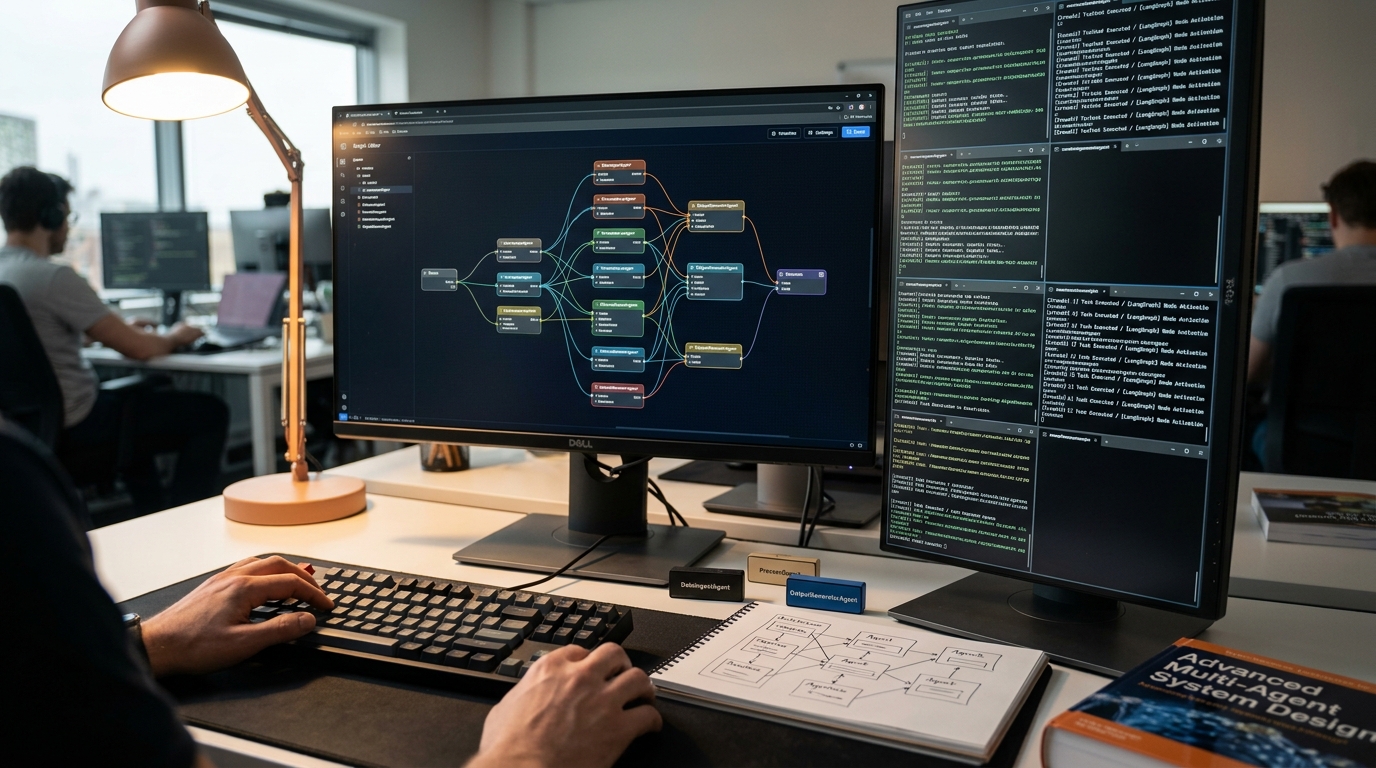
In 2026, the question is no longer whether you should use AI, but how many agents you’ve deployed to handle the work. We have officially moved past the 'chatbot' era and entered the age of the Autonomous Enterprise, where multi-agent systems coordinate complex tasks with minimal human intervention. According to recent industry benchmarks, orchestrated AI agent teams can increase automation efficiency by over 25% while slashing operational costs by nearly 30%. But as the ecosystem matures, the choice of Multi-Agent AI Frameworks has become a high-stakes decision for CTOs and senior engineers.
If you are still using a single LLM prompt for multi-step workflows, you are leaving massive performance gains on the table. Today, we are comparing the titans of the industry: LangGraph vs CrewAI vs PydanticAI, along with emerging powerhouses like Atomic Agents and AutoGen. Whether you need the rigid control of a directed graph or the flexible collaboration of a 'crew,' this guide will dissect the technical trade-offs to help you build production-ready systems that actually scale.
- The State of Multi-Agent AI Frameworks in 2026
- LangGraph: The King of Stateful Orchestration
- CrewAI: Role-Based Collaboration for the Modern Crew
- PydanticAI: Why Type-Safety is Non-Negotiable
- AutoGen and the Microsoft Ecosystem
- Atomic Agents: The Minimalist Alternative for Senior Devs
- Comparative Analysis: Choosing Your Stack
- Agentic Developer Tools: Observability and Memory
- Key Takeaways (TL;DR)
- Frequently Asked Questions
The State of Multi-Agent AI Frameworks in 2026
In early 2024, 'agents' were often just loops of LLM calls that frequently hallucinated or got stuck in infinite loops. By 2026, the industry has coalesced around agentic workflow orchestration. We’ve realized that 'autonomy' without 'controllability' is a recipe for production disasters.
Today’s Best framework for AI agents isn't just about how well it talks to GPT-5 or Claude 4; it’s about how it handles state management, long-term memory, and structured outputs. As noted in recent Reddit developer discussions, the 'best framework' is often the one that gets out of your way and lets you implement traditional software engineering principles—like unit testing and type-safety—into the AI stack.
The Shift from Chains to Graphs
Traditional LangChain 'chains' were linear and brittle. The industry has pivoted toward graphs (cyclic and acyclic) because real-world work isn't linear. It involves loops, retries, and human-in-the-loop (HITL) checkpoints. This is why LangGraph vs CrewAI 2026 is the primary debate: one offers a low-level graph architecture, while the other offers a high-level team metaphor.
LangGraph: The King of Stateful Orchestration
LangGraph has become the industry standard for developers who demand absolute control. Built by the LangChain team, it was a response to the criticism that LangChain was too 'magical' and difficult to debug. LangGraph treats your agentic system as a state machine.
Core Philosophy: The State is God
In LangGraph, you define a State schema (usually a TypedDict or Pydantic model) that is passed between nodes. Each node is a Python function that modifies the state. This architecture allows for:
1. Cyclic Workflows: Unlike standard DAGs, LangGraph allows agents to loop back to previous steps (e.g., a 'Reviewer' agent sending work back to a 'Writer' agent).
2. Persistence: You can 'checkpoint' the state at any node. If the system crashes or requires human approval, it can resume exactly where it left off.
3. Time Travel: Developers can debug by rewinding the state to a previous node and re-executing with different parameters.
Code Snippet: Defining a Simple LangGraph Node
python from langgraph.graph import StateGraph, END
Define the state
class AgentState(TypedDict): messages: list is_approved: bool
Define a node function
def researcher_node(state: AgentState): # Logic for research agent return {"messages": state["messages"] + ["Research complete."]}
Build the graph
workflow = StateGraph(AgentState) workflow.add_node("researcher", researcher_node) workflow.set_entry_point("researcher") workflow.add_edge("researcher", END)
Why it Ranks #1 for Enterprise
For mission-critical applications—like insurance claim processing or automated legal discovery—LangGraph is the preferred choice because it is deterministic. You map the edges; you control the flow. With the addition of LangGraph Studio in 2026, developers now have a visual IDE to debug these complex graphs in real-time.
CrewAI: Role-Based Collaboration for the Modern Crew
If LangGraph is the low-level assembly language of agents, CrewAI is the high-level management layer. CrewAI is built on the metaphor of a 'crew'—a group of agents with specific roles, goals, and backstories.
The "Manager" Pattern
CrewAI excels at Role-Based Collaborative Agents. You don't necessarily map out every single edge of a graph. Instead, you define a 'Manager' agent or use a 'Process' (Sequential, Hierarchical, or Consensual) to dictate how agents talk to each other.
"CrewAI is a good start if you want a mix of customization and ease of use. In many cases, you just set a param to true for memory management, whereas in LangGraph you'd implement it yourself."
Key Features in 2026:
- Agent Operations Platform (AOP): A control plane for deploying and monitoring crews in production.
- YAML/Python Hybrid Configs: You can define your agent roles in human-readable YAML, making it accessible to non-technical project managers while keeping the logic in Python.
- Built-in SOPs: CrewAI is optimized for Standard Operating Procedures. If your business has a 'Researcher -> Writer -> Editor' workflow, CrewAI can spin that up in minutes.
Trade-offs: The "Black Box" Problem
The primary critique of CrewAI in 2026 remains its 'magical' nature. When a crew fails, it can be harder to pinpoint exactly which agent went rogue compared to the explicit nodes of LangGraph. However, for rapid prototyping and SOP-driven automation, its speed-to-market is unmatched.
PydanticAI: Why Type-Safety is Non-Negotiable
One of the most exciting entries into the Multi-Agent AI Frameworks space is PydanticAI, developed by the team behind the Pydantic library. As LLMs become more integrated into traditional software stacks, the need for structured outputs has skyrocketed.
The Developer’s Choice
PydanticAI isn't trying to be a 'graph' or a 'crew.' It is trying to be a developer-first agent framework. It focuses on Agentic developer tools that prioritize type-safety and validation. In a production environment, if an agent returns a JSON object that doesn't match your database schema, your system breaks. PydanticAI prevents this at the code level.
Comparison: PydanticAI vs AutoGen
| Feature | PydanticAI | AutoGen |
|---|---|---|
| Core Focus | Type-safety & Validation | Conversational Patterns |
| Developer Experience | High (FastAPI-like) | Medium (Steeper curve) |
| Production Readiness | High (Strict schemas) | Experimental (Dynamic) |
| Multi-Agent Support | Dependency Injection | Event-driven Messaging |
Why Teams are Switching
Senior engineers are moving to PydanticAI because it treats agents like standard Python objects. It supports Dependency Injection, making it incredibly easy to swap out LLM providers (OpenAI, Claude, Ollama) or test agents with mocked data. It is the framework for those who hate 'abstractions for the sake of abstractions.'
AutoGen and the Microsoft Ecosystem
AutoGen remains the powerhouse for event-driven multi-agent systems. Backed by Microsoft Research, it is designed for scenarios where agents need to have complex, multi-turn conversations to solve a problem.
Conversational Patterns
AutoGen allows for 'Joint Chat' and 'Group Chat' patterns where agents can dynamically decide who speaks next. This is ideal for software engineering agents where a 'Coder' agent writes code, a 'Reviewer' agent critiques it, and a 'Runner' agent executes it in a Docker sandbox.
The 2026 Update: AutoGen Studio
Microsoft has doubled down on AutoGen Studio, a low-code interface that allows you to drag-and-drop agents into a conversation. While powerful, many developers on Reddit still find AutoGen 'unstable' for production compared to the rigid state management of LangGraph.
Atomic Agents: The Minimalist Alternative for Senior Devs
A notable trend in 2026 is the "No-Framework Framework" movement. Atomic Agents has emerged as a favorite among developers with 15+ years of experience who find LangChain and CrewAI too bloated.
The Philosophy of Spite
As the creator of Atomic Agents famously stated, "I made it out of spite and necessity... langchain/langgraph wasn't made by experienced developers and it shows." Atomic Agents focuses on: * Atoms: Every tool and agent is an 'atom' with a structured input and output. * Total Control: No hidden loops. No hidden prompts. You write the logic; the framework just handles the schema validation. * Lightweight: It doesn't come with 101 wrappers. It uses Pydantic for everything, ensuring that your system remains hyper-consistent.
Comparative Analysis: Choosing Your Stack
Choosing the Best framework for AI agents depends entirely on your project's complexity and your team's technical depth.
The Selection Matrix
- Use LangGraph if: You need complex, cyclic logic, human-in-the-loop approvals, and absolute state persistence. (Best for Enterprise/FinTech).
- Use CrewAI if: You want to automate human-like workflows (SOPs) quickly and prefer a role-based abstraction. (Best for Marketing/Sales/Operations).
- Use PydanticAI if: You are building a production API and require strict type-safety, validation, and easy testing. (Best for SaaS/Backend Devs).
- Use Atomic Agents if: You want a minimalist, modular approach with zero bloat and full architectural control.
Agentic Developer Tools: Observability and Memory
A framework is only as good as the tools surrounding it. In 2026, the focus has shifted to observability and long-term memory layers.
Observability: Seeing Inside the Black Box
You cannot debug a multi-agent system without tracing. Tools like LangSmith, Arize Phoenix, and Logfire (built by the Pydantic team) are essential. They allow you to see exactly what prompt was sent, which tool was called, and how much it cost in real-time.
Memory: The Key to Dynamic Agents
Agents need to remember past interactions to be useful. Zep and Letta have become the leading framework-independent memory layers. They use Knowledge Graphs to store business data and message history, allowing agents to retrieve relevant context across different sessions. This is a critical component of Agentic workflow orchestration in 2026.
Key Takeaways (TL;DR)
- LangGraph is the industry leader for stateful, complex graphs with human-in-the-loop requirements.
- CrewAI offers the best speed-to-market for role-based, collaborative agent teams using SOPs.
- PydanticAI is the rising star for production-grade, type-safe agent development with a FastAPI-like experience.
- Atomic Agents is the minimalist's choice for those who want total control without library bloat.
- Observability (tracing) and Memory Layers (Zep/Letta) are now mandatory for production agentic systems.
- MCP (Model Context Protocol) is becoming the standard for how agents interact with external tools and data sources.
Frequently Asked Questions
Which framework is best for a beginner in AI agents?
CrewAI is generally considered the most beginner-friendly. Its role-based metaphor is intuitive, and you can get a multi-agent 'crew' running in just a few lines of code. However, if you have a strong Python background, PydanticAI offers a very clean learning curve due to its familiar syntax.
Can I use LangGraph and CrewAI together?
Technically, yes, but it is often overkill. Some developers use LangGraph as the high-level orchestrator (the 'brain') and call CrewAI 'crews' as specific nodes within that graph. This allows for rigid control at the top level and flexible collaboration at the task level.
Is LangChain deprecated in favor of LangGraph?
LangChain's original 'AgentExecutor' is effectively deprecated. The LangChain team now officially recommends that all new agentic projects be built using LangGraph to ensure statefulness and reliability.
How do I handle agent memory in production?
For simple use cases, built-in checkpointers in LangGraph or memory params in CrewAI work. For enterprise scale, use a dedicated memory layer like Zep or Mem0, which handle long-term persistence and vector-based retrieval across multiple agents.
What is the biggest challenge with multi-agent systems in 2026?
Orchestration overhead and latency. The more agents you have talking to each other, the longer the user has to wait for a result. Optimization in 2026 focuses on parallel execution, token caching, and using smaller, specialized models (like Llama 3.2 3B) for subtasks to reduce costs and latency.
Conclusion
Building with Multi-Agent AI Frameworks in 2026 is a balancing act between abstraction and control. If you are building a simple automation, don't over-engineer it—CrewAI or smolagents will serve you well. But if you are building the core infrastructure of an autonomous enterprise, invest the time to learn LangGraph or PydanticAI.
The most successful developers in this space are those who treat AI agents like any other piece of critical software: with strict validation, deep observability, and a focus on deterministic outcomes. The tools are ready; the question is, which one will you use to build the future of work?
Ready to dive deeper into AI engineering? Check out our latest guides on developer productivity tools and LLM observability to stay ahead of the curve.