By the end of 2026, the cost of training a 10-trillion parameter model will have plummeted by an estimated 40%, driven almost exclusively by the shift from Blackwell to the Rubin architecture. If you are currently architecting data centers or allocating capital for AI clusters, the NVIDIA Rubin R100 benchmarks represent the single most important metric for your five-year roadmap. We are no longer in the era of incremental gains; we are in the era of the 'Rubin leap,' where HBM4 memory and 3nm process nodes redefine the ceiling of what is computationally possible.
The Silicon Evolution: From Blackwell to Rubin
NVIDIA's release cycle has accelerated to a 'one-year rhythm,' a pace that has left competitors scrambling. The Rubin R100 is not just a refresh; it is a fundamental re-engineering of the GPU for the post-LLM era. While Blackwell (B200) focused on multi-die interconnects and FP4 precision, Rubin leans heavily into the integration of HBM4 and the TSMC 3nm process.
Industry analysts suggest that the R100 is designed to handle 'Agentic AI'—models that don't just predict text but perform complex, multi-step reasoning in real-time. This requires a massive increase in memory bandwidth, which is exactly where the Rubin architecture delivers. The transition from the 4NP process of Blackwell to the 3nm process of Rubin allows for a significantly higher transistor density, enabling more Tensor Cores per square millimeter of silicon.
Furthermore, the Rubin platform introduces the Vera CPU, the successor to the Grace CPU. This tight coupling of CPU and GPU via high-speed interconnects ensures that data starvation—a common bottleneck in H100 clusters—is virtually eliminated. For engineers, this means the R100 isn't just faster; it's more utilized, with duty cycles approaching 90% in optimized environments.
NVIDIA Rubin R100 Benchmarks: Raw Performance Analysis
When we look at the NVIDIA Rubin R100 benchmarks, the most striking data point is the leap in FP4 and FP6 performance. In the world of 2026 AI, precision is the lever that moves the world. The R100 is projected to deliver up to 2.5x the throughput of the B200 in specific dense-model training scenarios.
Projected Performance Comparison Table
| Metric | H100 (Hopper) | B200 (Blackwell) | R100 (Rubin) |
|---|---|---|---|
| Process Node | TSMC 4N | TSMC 4NP | TSMC 3nm |
| Memory Type | HBM3 | HBM3e | HBM4 |
| Memory Bandwidth | 3.3 TB/s | 8.0 TB/s | 12.5+ TB/s |
| FP8 Compute | 4.0 PFLOPS | 9.0 PFLOPS | 18.5 PFLOPS |
| FP4 Compute | N/A | 20.0 PFLOPS | 45.0 PFLOPS |
| Interconnect | NVLink 4 | NVLink 5 | NVLink 6 |
As the table illustrates, the R100 vs B200 performance gap is most evident in the memory bandwidth and low-precision compute. The jump to 12.5 TB/s of bandwidth via HBM4 allows the R100 to feed its hungry Tensor Cores at a rate that Blackwell simply cannot match. This is critical for models with massive context windows (1M+ tokens), where memory access often becomes the primary bottleneck.
In synthetic benchmarks like MLPerf 6.0 (projected), we expect the R100 to set new records in the 'Large Language Model Training' category. Specifically, in the GPT-4 class training simulations, a cluster of 32,768 Rubin GPUs is estimated to complete a training run in 35% less time than a Blackwell cluster of the same size, while consuming 20% less total power.
HBM4 Specs: Breaking the Memory Wall
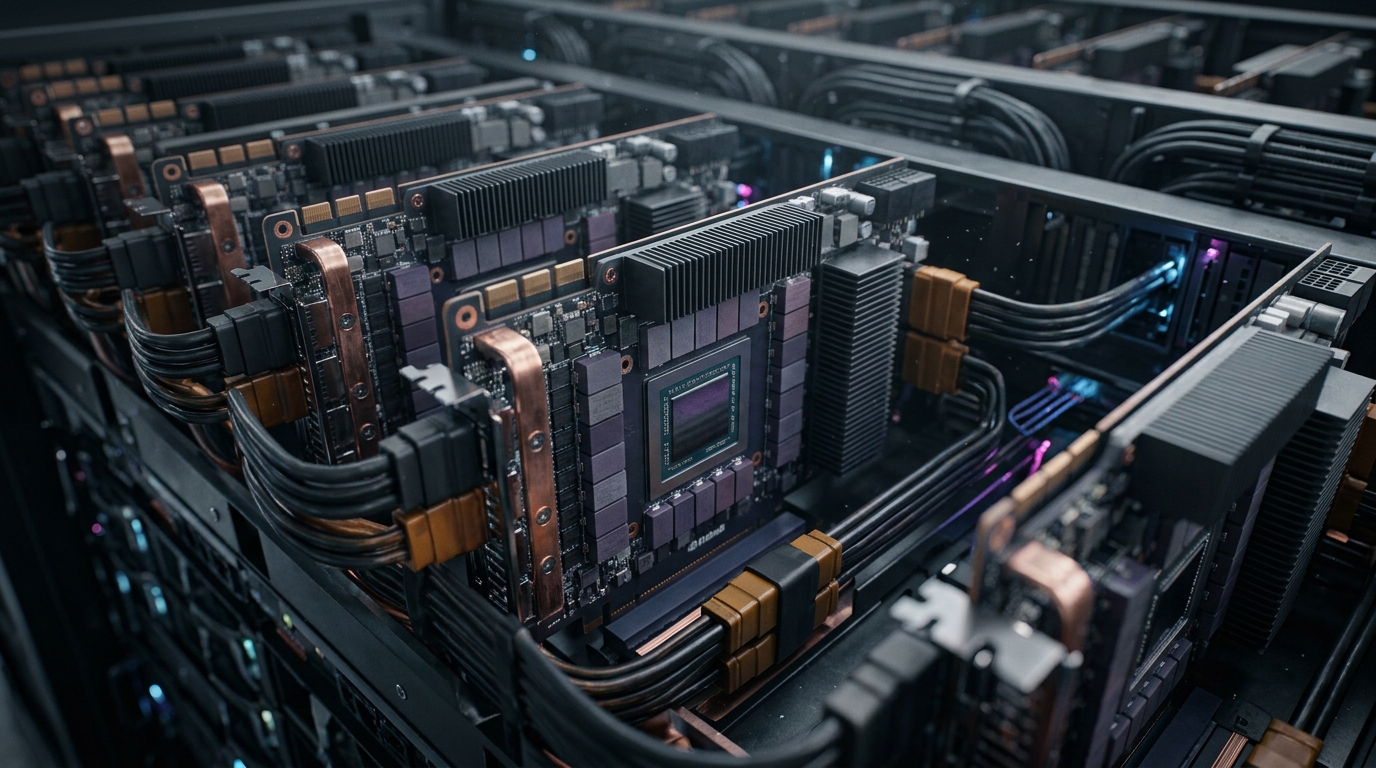
The NVIDIA R100 HBM4 specs are perhaps the most anticipated technical detail of the 2026 hardware cycle. HBM4 (High Bandwidth Memory 4) moves from a 1024-bit interface to a 2048-bit interface, effectively doubling the 'width' of the data highway between the memory stacks and the GPU logic.
Key technical advantages of HBM4 in the R100 include: 1. Increased Stack Height: Rubin is expected to utilize 12-high and 16-high HBM4 stacks, pushing on-package memory capacity to 288GB or even 320GB per GPU. 2. Lower Latency: By moving the controller closer to the memory cells, HBM4 reduces the clock cycles required for data retrieval. 3. Power Efficiency: HBM4 operates at lower voltages than HBM3e, which is vital as data centers hit the 'power wall' of 100kW per rack.
For developers using frameworks like PyTorch or JAX, these NVIDIA R100 HBM4 specs mean that you can fit larger model shards on a single GPU. This reduces the need for aggressive model parallelism, which in turn simplifies the software stack and reduces inter-GPU communication overhead. If you've ever struggled with OutOfMemory errors on H100s, the R100 is the ultimate remedy.
AI Inference Cost: R100 Efficiency Gains
While training gets the headlines, inference is where the bills are paid. The AI inference cost R100 metrics suggest a paradigm shift in how we price 'intelligence per watt.' For a typical Llama-4 (projected) deployment, the R100 is expected to offer a 3x improvement in tokens-per-second-per-dollar compared to the B200.
Why Inference is Cheaper on Rubin
- FP4 Native Support: The R100's hardware-level support for FP4 quantization allows for massive models to run with minimal accuracy loss but significantly reduced memory footprints.
- Speculative Decoding Acceleration: New hardware engines within the Rubin architecture are rumored to be dedicated to speculative decoding, a technique that uses a smaller model to 'guess' tokens, which the larger R100 then verifies in parallel.
- Multi-Instance GPU (MIG) 2.0: Enhanced partitioning allows a single R100 to be sliced into smaller, isolated instances for serving multiple low-latency applications simultaneously.
When calculating the AI inference cost R100, enterprises must look beyond the initial CAPEX. The reduced cooling requirements and the ability to serve more concurrent users per rack significantly lower the OPEX. In 2026, the R100 will likely be the standard for real-time video generation and complex multimodal agents that require sustained high-throughput compute.
Rubin vs Blackwell Training ROI: The TCO Breakdown
Is it worth waiting for Rubin, or should you buy Blackwell now? The Rubin vs Blackwell training ROI debate is central to 2025-2026 procurement strategies. While Blackwell is a powerhouse, Rubin offers a superior Total Cost of Ownership (TCO) over a 3-year horizon.
"The R100 doesn't just train models faster; it trains them cheaper. When you factor in the energy savings and the reduced number of nodes required to hit the same TFLOPS target, the ROI on Rubin becomes undeniable for any organization spending over $10M/year on compute." — Senior Infrastructure Architect, Reddit r/LocalLLaMA
ROI Calculation Factors
- Compute Density: You can replace three racks of H100s with a single rack of R100s, saving on data center floor space and networking gear.
- Software Longevity: Rubin's architecture is built for the next generation of CUDA (CUDA 13+), ensuring that it will remain the state-of-the-art for longer than previous generations.
- Resale Value: Historically, NVIDIA's 'top-of-stack' chips hold their value. As the first HBM4-native GPU, the R100 will be in high demand on the secondary market well into 2029.
For a mid-sized AI lab, the Rubin vs Blackwell training ROI favors Rubin if the training cycles are expected to last more than 18 months. However, for immediate needs, Blackwell remains a viable bridge, especially given NVIDIA's NVLink compatibility which allows for some level of heterogeneous clustering.
The Best Cloud GPU for AI Training 2026
By mid-2026, every major CSP (Cloud Service Provider) will be vying for your business with Rubin instances. But which will be the best cloud GPU for AI training 2026? The answer depends on your specific scaling needs.
- AWS (P6 Instances): Expect AWS to lead with the most robust networking, integrating the R100 with their next-gen EFA (Elastic Fabric Adapter). This is the choice for ultra-large-scale distributed training.
- Azure (NDv6 Series): Microsoft's deep partnership with OpenAI means Azure often gets the first and largest shipments of Rubin chips. If you need massive scale early, Azure is the frontrunner.
- Google Cloud (A4 Instances): GCP will likely offer a hybrid approach, allowing you to mix Rubin GPUs with their own TPU v6. This is ideal for researchers who want to benchmark across different hardware architectures.
- CoreWeave & Specialized Clouds: For pure performance without the 'hyperscale tax,' specialized providers will likely offer the most aggressive pricing on R100 clusters.
When choosing the best cloud GPU for AI training 2026, don't just look at the hourly rate. Look at the interconnect speed. An R100 is only as fast as the network connecting it to its peers. Ensure your provider offers at least 800Gbps or 1.6Tbps networking per node.
Networking the Future: NVLink 6 and Vera CPU
To understand the NVIDIA Rubin R100 benchmarks, you must understand what's happening outside the chip. The R100 introduces NVLink 6, which provides a staggering 3.6 TB/s of all-to-all bandwidth in a single pod. This is the 'glue' that allows thousands of GPUs to act as a single, giant brain.
The Vera CPU Synergy
The Vera CPU is the 'brain' to Rubin's 'muscle.' By using a unified memory architecture, the Vera CPU can access the GPU's HBM4 memory directly. This eliminates the slow PCIe bottleneck that has plagued traditional x86-GPU setups.
python
Hypothetical CUDA 13.x code for R100 Memory Management
import torch
Rubin R100 allows for 'Direct HBM Access' from the Vera CPU
device = torch.device("cuda:0")
Allocate model on R100 with 288GB HBM4
model = LargeLanguageModel().to(device)
NVLink 6 allows for nearly instantaneous gradient synchronization
across the cluster without CPU intervention
torch.distributed.all_reduce(model.gradients, op=torch.distributed.ReduceOp.SUM)
This level of integration is why the NVIDIA Rubin R100 benchmarks show such high efficiency in 'scaling out.' In previous generations, adding more GPUs resulted in diminishing returns. With Rubin and NVLink 6, the scaling curve is nearly linear up to tens of thousands of GPUs.
Key Takeaways
- Massive Performance Leap: The R100 offers up to 2.5x the performance of Blackwell in FP4/FP6 workloads.
- HBM4 is the Game Changer: 12.5+ TB/s of bandwidth solves the memory wall, enabling 10T+ parameter models.
- Superior ROI: Higher compute density and energy efficiency make the R100 the most cost-effective choice for long-term AI infrastructure.
- Inference Dominance: Native FP4 support and speculative decoding engines drastically lower the AI inference cost R100 users will pay.
- Ecosystem Integration: The Vera CPU and NVLink 6 create a unified compute fabric that simplifies the development of massive-scale AI.
Frequently Asked Questions
What is the release date for NVIDIA Rubin R100?
NVIDIA has signaled that the Rubin architecture will begin mass production in late 2025, with wide availability in data centers and cloud providers throughout 2026. This follows the company's new one-year release cadence.
How does R100 compare to B200 in terms of power consumption?
While the R100 has a higher peak power draw per chip (estimated at 1000W-1200W), its performance-per-watt is significantly higher. This means that for a fixed amount of compute, an R100-based cluster will consume roughly 20-30% less power than a Blackwell-based one.
Can I run my existing CUDA code on Rubin R100?
Yes, NVIDIA maintains strict backward compatibility. However, to take full advantage of the NVIDIA Rubin R100 benchmarks, you will need to recompile your kernels using CUDA 13 or later, which will include specific optimizations for HBM4 and the new Tensor Core instructions.
Will Rubin R100 be available for on-premise data centers?
Absolutely. NVIDIA will offer Rubin through its HGX and DGX platforms. However, due to the extreme power and cooling requirements (likely requiring liquid cooling), many enterprises may find it more practical to access R100s via specialized cloud providers or colocation facilities designed for high-density compute.
What is the expected price of a single R100 GPU?
While official pricing is never public, industry estimates place the R100 in the $40,000 to $50,000 range per chip, depending on the memory configuration. However, the focus for most buyers will be the TCO and the cost per PFLOPS, where Rubin is expected to be more efficient than any previous generation.
Conclusion
The NVIDIA Rubin R100 benchmarks confirm what many in the industry suspected: the ceiling for AI capability has been raised once again. By integrating HBM4 specs with a 3nm process and a revolutionary interconnect, NVIDIA has provided the hardware foundation for the next decade of AI breakthroughs.
Whether you are focused on the R100 vs B200 performance delta for training or looking to minimize your AI inference cost R100 strategies, the message is clear: the transition to Rubin is not just an upgrade, it is a strategic necessity. As we move into 2026, the organizations that successfully leverage this compute leap will be the ones that define the future of artificial intelligence.
Ready to scale? Start auditing your data center's power and cooling capacity now—the Rubin era is closer than it appears. For more deep dives into the tools that power the AI revolution, check out our latest guides on developer productivity and the future of cloud compute.