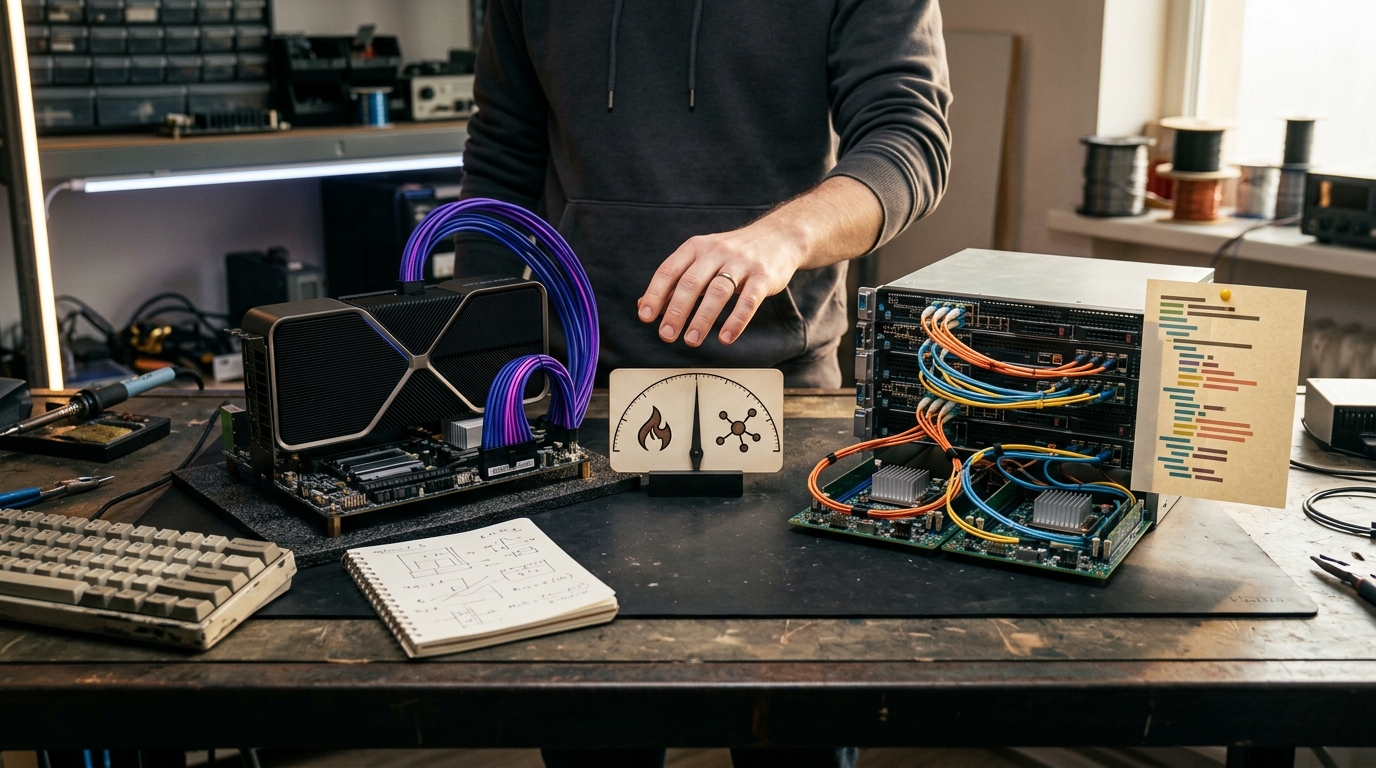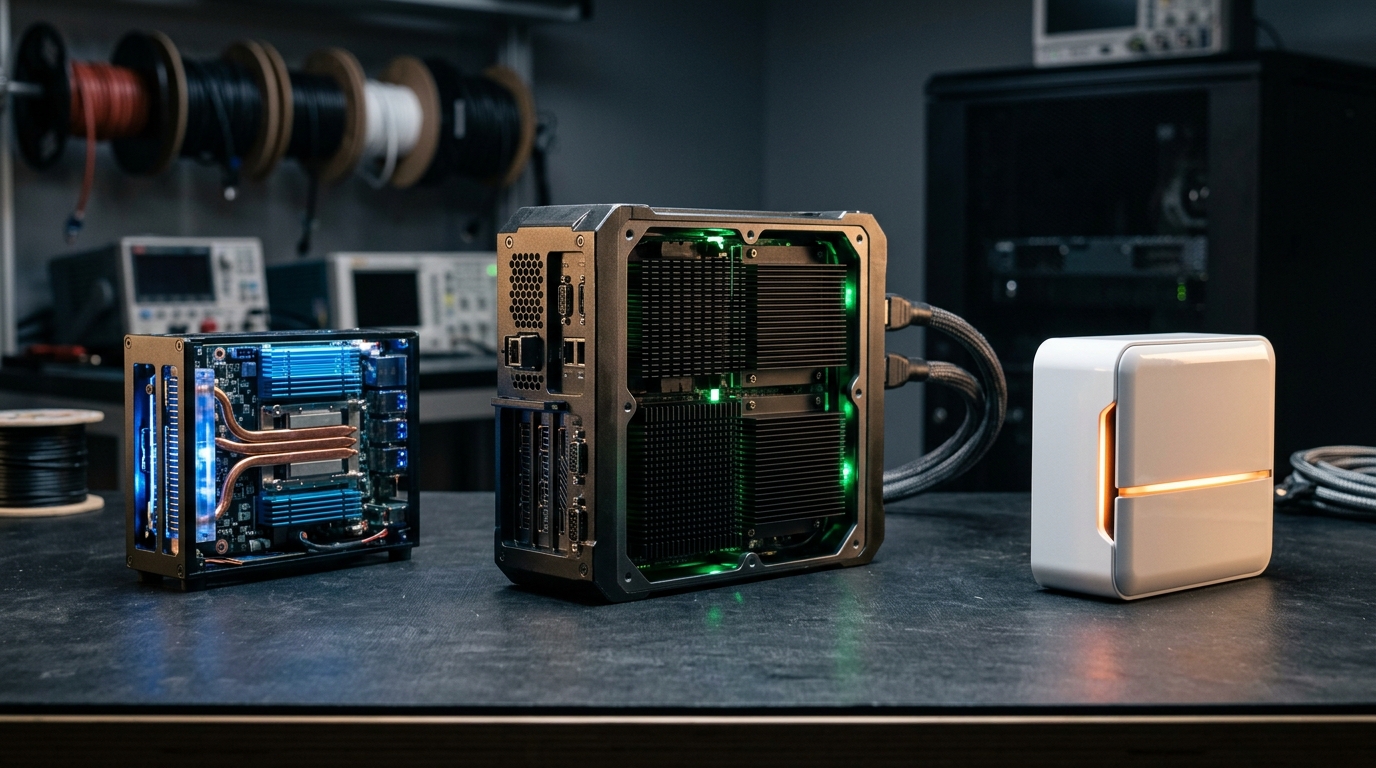
In 2026, the bottleneck of artificial intelligence has officially shifted from training to serving. While the 'GPU rich' spent 2024 and 2025 hoarding H100s to train foundation models, the winners of the current cycle are those who can serve millions of requests per day without bankrupting the business. Inference now accounts for 70–90% of total operational costs in the AI lifecycle. If you are choosing between NVIDIA NIM vs vLLM or Hugging Face TGI, you aren't just picking a software library; you are choosing the economic engine of your company's AI strategy. This guide breaks down the best AI inference server 2026 has to offer, analyzing the technical architecture, hardware synergy, and enterprise readiness of the top three contenders.
The State of LLM Inference in 2026
The landscape of LLM serving has matured significantly. We have moved past the 'Ollama on a laptop' phase into high-concurrency, multi-tenant environments. In 2026, the enterprise LLM serving stack must handle massive memory requirements and intense KV cache pressure.
Traditional inference servers used to reserve contiguous blocks of GPU memory for the maximum sequence length, which wasted up to 80% of available VRAM. Today, techniques like PagedAttention (pioneered by vLLM) and In-Flight Batching (refined by NVIDIA) are industry standards. Organizations like Stripe have reported cutting inference costs by 73% simply by migrating to more efficient serving engines, processing over 50 million daily calls on a fraction of their original GPU fleet. Whether you are running a 70B Llama 3.3 or a massive 671B DeepSeek-R1, your choice of inference server determines your Time to First Token (TTFT) and your total cost of ownership (TCO).
NVIDIA NIM: The Enterprise-Grade Fortress
NVIDIA NIM (NVIDIA Inference Microservices) is not just an inference engine; it is a full-scale production environment. While vLLM and TGI are open-source engines, NIM is a pre-packaged, optimized container that provides a 'batteries-included' experience for the enterprise.
The Core Value Proposition
NIM is built on top of TensorRT-LLM, but it abstracts the complexity of manual optimization. It is designed for 'deployment portability,' meaning it runs identically on AWS, Azure, Google Cloud, or on-prem air-gapped servers.
- Security and Compliance: NIM offers continuous CVE patching and security SLAs that raw open-source projects cannot match. For government agencies or highly regulated industries, NIM is FedRAMP-ready and meets strict OSRB compliance.
- Optimized Profiles: NIM comes with 'model-specific' manifests. Instead of you guessing the best tensor parallelism (TP) or pipeline parallelism (PP) settings, NIM selects the optimal configuration for your specific hardware SKU (e.g., H100 vs. B200).
- Ease of Use: You can launch a NIM container with a single API key, and it handles model downloading, authentication, and caching automatically from NVIDIA NGC or Hugging Face.
"NIM LLM provides production-stable branches... isolating enterprise deployments from the rapid, sometimes unstable churn of upstream open source." — NVIDIA Documentation.
vLLM: The High-Throughput Performance King
If your primary goal is raw throughput and you have the engineering talent to manage it, vLLM remains the gold standard. Developed at UC Berkeley, vLLM's introduction of PagedAttention fundamentally changed how we think about GPU memory.
Why vLLM Dominates High-Concurrency Workloads
In 2026, vLLM has evolved into a multi-vendor powerhouse. While it originally focused on NVIDIA, it now supports AMD (ROCm), Intel (oneAPI), and even Google TPUs.
- PagedAttention: By partitioning the KV cache into small blocks and using a virtual memory-like block table, vLLM reduces internal memory fragmentation to under 4%.
- Continuous Batching: Unlike static batching, which waits for all requests in a batch to finish, vLLM's scheduler pulls new requests into the batch the moment a previous one completes. This eliminates 'head-of-line blocking.'
- Broad Quantization Support: vLLM natively supports almost every format, including GPTQ, AWQ, GGUF, and FP8. This makes it the most flexible tool for developers who want to experiment with the latest community quants.
Code Example: Launching vLLM in 2026 bash python -m vllm.entrypoints.openai.api_server \ --model unsloth/Llama-3.3-70B-Instruct-AWQ \ --tensor-parallel-size 4 \ --max-model-len 32768 \ --gpu-memory-utilization 0.95
Hugging Face TGI: The Reliability Workhorse
Hugging Face TGI (Text Generation Inference) is the backbone of the Hugging Face Hub's own inference API. In the debate of Hugging Face TGI vs vLLM, TGI is often praised for its stability and its 'production-first' mindset.
TGI v3: The Long-Context Specialist
Recent benchmarks show that TGI v3 has made massive strides in long-context performance. For prompts exceeding 200,000 tokens, TGI can process responses up to 13x faster than vLLM by using superior conversation caching and prefix management.
- Weight Streaming: TGI allows for faster cold starts by streaming model weights instead of waiting for a full 150GB download before initialization.
- Production Features: It includes built-in Prometheus metrics, high-quality tracing with OpenTelemetry, and natively supports 'speculative decoding'—using a smaller draft model to predict tokens and accelerate the larger model.
- Ease of Deployment: If you are already deep in the Hugging Face ecosystem, TGI is the most 'natural' fit, offering seamless integration with their model hub and enterprise features.
The 7-Layer Inference Stack: From Silicon to API
To understand the best AI inference server 2026, we must look at the full stack. As tech journalist Vinita Ananth notes, the model is only half the story. The machinery required to serve it is a 7-layer engineering discipline.
| Layer | Component | Key Concern |
|---|---|---|
| 7. Application | SDKs, LangChain, LlamaIndex | Developer experience and agentic logic. |
| 6. Governance | Observability, FinOps, SLAs | Cost tracking and compliance (SOC2/HIPAA). |
| 5. Orchestration | Kubernetes, KServe, Ray | Scaling replicas and GPU scheduling. |
| 4. Serving | Triton, NIM, Dynamo | Disaggregated prefill and decode phases. |
| 3. Pipeline | Tokenization, RAG, LoRA | Context assembly and vector retrieval. |
| 2. Engine | vLLM, TensorRT-LLM, TGI | KV cache management and batching. |
| 1. Optimization | CUDA, ROCm, Triton Kernels | Low-level hardware acceleration. |
| 0. Hardware | B200, H100, NVLink | Memory bandwidth and TFLOPS. |
In 2026, the 'Great Disaggregation' has occurred. High-end stacks now separate the prefill phase (processing the input) from the decode phase (generating tokens). Prefill is compute-bound, while decode is memory-bandwidth-bound. Systems like NVIDIA Dynamo allow these to run on different GPUs, doubling throughput for complex reasoning models.
TensorRT-LLM Benchmarks 2026: Throughput vs. Latency
When we look at TensorRT-LLM benchmarks 2026, NVIDIA's native library usually wins on raw performance for NVIDIA hardware. Because NVIDIA engineers write the kernels specifically for the Hopper and Blackwell architectures, they can exploit hardware features that generic engines cannot.
- Llama 3.1 70B (FP8): On an H100, TensorRT-LLM can achieve up to 1,500 tokens/second in high-throughput mode. This translates to roughly 3 concurrent prompts per second with a 500-token response.
- Speculative Decoding: By using a 1B 'draft' model, TensorRT-LLM can achieve a 2-3x latency speedup for single-user scenarios (like a coding assistant) without any loss in output quality.
- FP4 on Blackwell: The new Blackwell (B200) generation introduces native FP4 support. Benchmarks suggest a 30x throughput improvement over the H100 generation for massive reasoning models like DeepSeek-R1, largely due to disaggregated serving and the high-speed NVLink Switch.
Hardware Foundations: H100, B200, and the RTX 6000 Ada
Choosing your software stack is secondary to your hardware constraints. If you are building an on-prem LLM appliance, you have three primary paths:
1. The Enterprise Gold Standard (H100/H200/B200)
For large-scale deployments (3,000+ employees), an 8x H100 node is the baseline. The H200, with 141GB of HBM3e memory, is particularly valuable because it can fit larger models (like Llama 405B) with enough VRAM left over for a massive KV cache.
2. The 'Prosumer' Workstation (RTX 6000 Ada)
As discussed in recent Reddit threads, the RTX 6000 Ada is a hidden gem for self-hosted AI. While it has half the memory bandwidth of an H100, it offers 48GB of VRAM at a fraction of the cost. Running two of these (96GB VRAM) allows you to serve a 70B model with high precision locally.
3. The Budget Cluster (Consumer GPUs)
For developers on a budget, a cluster of 3090/4090 GPUs running llama.cpp or vLLM with GGUF/EXL2 quants is viable. However, these lack the reliability and interconnect speeds (NVLink) required for true enterprise-scale concurrency.
Self-Hosted AI Inference Guide: Building the 'LLM Appliance'
Many organizations are banning ChatGPT due to security concerns, leading to a surge in the 'LLM Appliance' market. If you are tasked with building a self-hosted AI inference guide for your company, follow this roadmap:
Step 1: Model Selection
Don't default to the biggest model. Llama 3.1 70B or Qwen 2.5 72B are the 'sweet spots' for 2026. They offer GPT-4 level intelligence for most business tasks (coding, summarization, RAG) while being small enough to run at high throughput on a single node.
Step 2: The UI Layer
Forget Gradio for production. Use Open WebUI or LibreChat. These offer: - SSO/SAML Integration: Critical for enterprise security. - Built-in RAG: They can index company PDFs and wikis out of the box. - Role-Based Access Control (RBAC): Ensure HR data stays in HR.
Step 3: Networking and Cabling
For a proper appliance, you need more than just a GPU. - ToR Switch: A Top-of-Rack switch with at least 100GbE for data ingestion. - Bonding/LACP: For network redundancy. - BMC/IPMI: For remote hardware management.
Step 4: The RAG Stack
Reliable on-prem RAG requires a robust vector database. Qdrant or pgvector are highly recommended for on-prem stability. Pair these with a high-performance reranker like BGE-Reranker to ensure the LLM gets the most relevant context.
Decision Matrix: Which Stack Should You Choose?
| Feature | NVIDIA NIM | vLLM | Hugging Face TGI |
|---|---|---|---|
| Target User | Fortune 500 / Gov | Research / Scale-ups | Dev-heavy Teams |
| Primary Engine | TensorRT-LLM | PagedAttention | Rust-based Router |
| Hardware Support | NVIDIA Only (mostly) | Multi-vendor (AMD/Intel) | NVIDIA / Gaudi / TPU |
| Security | Enterprise SLAs / CVE Patch | Community-driven | Enterprise Hub Support |
| Quantization | FP8 / FP4 Optimized | AWQ / GPTQ / GGUF | AWQ / EETQ |
| Best For | Compliance & Reliability | Raw Throughput / Flexibility | Long Context / Ease of Use |
Key Takeaways
- NVIDIA NIM is the definitive choice for enterprises requiring security, compliance, and guaranteed performance on NVIDIA hardware. It simplifies the 7-layer stack into a single microservice.
- vLLM is the king of throughput and flexibility. It is the best choice for developers who want to maximize GPU utilization across diverse hardware (NVIDIA and AMD).
- Hugging Face TGI excels in long-context scenarios and offers the most stable integration with the open-source model ecosystem.
- Hardware matters: The transition to Blackwell (B200) in 2026 introduces FP4 precision, which will likely make previous-generation benchmarks obsolete.
- Self-hosting is viable: Using an 'LLM Appliance' approach with Open WebUI and a 70B model can replace ChatGPT for 90% of corporate use cases while keeping data within the firewall.
Frequently Asked Questions
What is the primary difference between NVIDIA NIM vs vLLM?
NVIDIA NIM is a commercial enterprise microservice that includes a production-ready container, security patching, and optimized TensorRT-LLM profiles. vLLM is an open-source inference engine focused on high-throughput memory management via PagedAttention. NIM is for 'set-it-and-forget-it' enterprise use; vLLM is for custom, high-performance engineering.
Which is the best AI inference server 2026 for long context?
Hugging Face TGI (v3) is currently the leader for long-context prompts, offering significant speedups over vLLM for prompts exceeding 100k tokens. However, NVIDIA's disaggregated serving in the latest NIM releases is closing this gap for reasoning-heavy models.
Can I run vLLM on AMD GPUs?
Yes. In 2026, vLLM has strong support for AMD GPUs via the ROCm backend and the Triton attention kernel, making it the most portable high-performance engine for heterogeneous data centers.
Is Llama 3.1 405B too big for a single-node on-prem server?
Yes, for most practical applications. Serving the 405B model in FP16 requires over 800GB of VRAM just for the weights, leaving no room for the KV cache. Most enterprises should use the 70B model or use FP8/FP4 quantization on an 8x H200/B200 node to run the 405B model effectively.
Does NVIDIA NIM support air-gapped environments?
Yes. One of NIM's core features is its support for air-gapped deployments. You can pre-stage model assets to a local store, and the NIM container will run without any outbound internet access, which is a key requirement for defense and cybersecurity sectors.
Conclusion
The choice between NVIDIA NIM vs vLLM vs TGI ultimately comes down to your organization's risk tolerance and engineering depth. If you have a team of CUDA experts and need to squeeze every last token out of a diverse GPU fleet, vLLM is your best friend. If you are building a specialized application with massive context windows, TGI is the way to go.
However, for the vast majority of enterprises in 2026, NVIDIA NIM represents the most logical path. It solves the complexity of the 7-layer inference stack, provides a hardened security posture, and ensures that you are always getting the most out of your expensive hardware investment. As AI agents become the primary interface for work, the reliability and scale of your inference stack will be what separates the market leaders from the experiments. Start by auditing your VRAM availability and concurrency needs, then choose the engine that fits your budget—and your future.