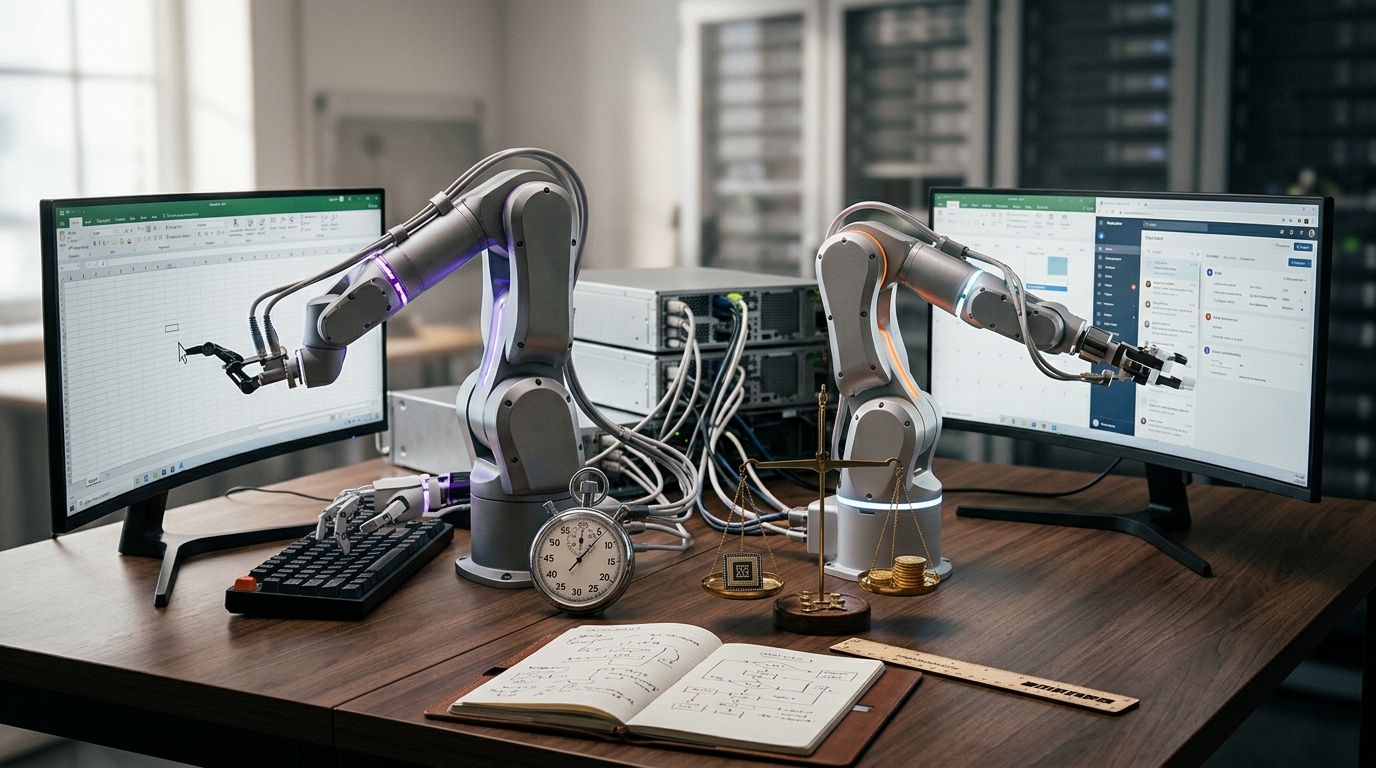
Manual data entry costs U.S. companies an average of $28,500 per employee every single year. In the high-stakes landscape of 2026, where efficiency is the only currency that matters, the battle for the best Large Action Model API has moved beyond simple text generation into the realm of raw execution. As enterprises scramble to automate the "boring" recurring workflows that consume 19% of a knowledge worker's day, the industry has consolidated around two primary titans. In this comprehensive guide, we analyze OpenAI Operator vs Anthropic Computer Use, leveraging the latest agentic API benchmarks 2026 to determine which autonomous agent actually delivers ROI and which is merely a high-priced demo.
The State of Agentic AI in 2026
By early 2026, the tech world shifted its focus from Large Language Models (LLMs) to Agentic AI. We are no longer impressed by an AI that can write a poem; we demand an AI that can log into a CRM, reconcile disparate invoices, and book a multi-city flight itinerary without human intervention. This shift represents a fundamental paradigm change: AI has transitioned from outputting information to outputting action.
However, the gap between a "cool demo" and "stable production reality" remains wide. Gartner recently projected that over 40% of agentic AI projects will be canceled by the end of 2027 due to escalating costs and inadequate risk controls. This makes the autonomous agent API comparison more critical than ever. Developers are moving away from brittle, scripted RPA (Robotic Process Automation) toward Large Action Models (LAMs) that can navigate messy, unpredictable user interfaces.
As one senior engineer on Reddit noted, "The real gap now is still demo vs actual production use. Most tools look great until the workflow gets messy, then they start falling apart." This guide aims to cut through that noise by looking at the hard numbers behind Anthropic Computer Use vs OpenAI Operator.
OpenAI Operator vs Anthropic Computer Use: Architectural Deep Dive
To choose the right tool, you must understand the underlying philosophy of how these agents interact with a computer. While both aim for the same result, their paths are divergent.
OpenAI Operator: The Cloud-Native Browser Agent
Launched in January 2025 and later integrated as "Agent Mode" within ChatGPT, OpenAI Operator is designed primarily as a browser-first executor. It operates within OpenAI's cloud infrastructure. When you give it a task, it spins up a virtual browser session on OpenAI's servers.
- Execution Model: Cloud-based virtualized browser.
- User Interface: Integrated into the ChatGPT Pro/Enterprise dropdown.
- Strength: Seamless for one-off web tasks like booking or form filling.
- Weakness: It feels limited to "one-shot" tasks. It lacks persistent memory between sessions and cannot access local files or non-web applications natively.
Anthropic Computer Use: The OS-Level Controller
Anthropic took a more technical, developer-centric approach. Instead of a sandboxed browser, Claude's "Computer Use" capability allows the model to "see" a desktop (via screenshots) and move the cursor, click buttons, and type just like a human.
- Execution Model: Direct OS-level interaction via API.
- User Interface: Developer-oriented; requires implementation via SDKs or MCP (Model Context Protocol) servers.
- Strength: Can operate any software—not just browsers. It can read a QuickBooks window, copy data to Excel, and draft an email in a desktop client.
- Weakness: High technical barrier to entry. It is not "plug-and-play" for non-developers and requires significant setup for security and reliability.
"Claude's approach is essentially 'be the user' while OpenAI builds abstraction layers. For ad-hoc desktop tasks, Claude is brilliant, but for chained API calls, orchestration models still win." — Industry Insight from r/Singularity
2026 Agentic API Benchmarks: OSWorld and WebArena Performance
When evaluating the agentic API benchmarks 2026, the industry relies on two primary gold standards: OSWorld (for general computer tasks) and WebArena (for web-specific navigation). The results for the big players are surprisingly modest, highlighting how difficult "computer use" actually is.
| Agent Platform | OSWorld Score (2026) | WebArena Score (2026) | Primary Use Case |
|---|---|---|---|
| Coasty | 82.0% | 85.5% | High-reliability Enterprise Automation |
| Anthropic Claude 3.5/4.5 | 61.4% | 72.0% | Developer-led OS Automation |
| OpenAI Operator (CUA) | 43.0% | 68.0% | Casual Browser Tasks |
| UiPath Screen Agent | 58.0% | 65.0% | Legacy RPA Integration |
| Vellum | 79.0% | 81.0% | Cross-tool Assistant with Memory |
Why OpenAI Operator Scores Lower
Despite the brand name, OpenAI Operator vs Anthropic Computer Use benchmarks show OpenAI trailing in raw reliability. Independent reviews have documented Operator failing on tasks as simple as locating a value in a dropdown menu. Because it runs in a cloud sandbox, it often struggles with "messy" real-world UI states that don't conform to its training data. At a 43% success rate on OSWorld, it fails more than half the time on complex, open-ended tasks.
The Anthropic Edge
Anthropic's Claude Sonnet and Opus models have shown superior performance in technical execution. By focusing on a screenshot-based perception loop, Claude is better at recovering from unexpected pop-ups or UI shifts. However, even at 61.4%, it is not yet ready for fully "unattended" high-stakes operations without a human-in-the-loop checkpoint.
Enterprise Implementation: OpenAI Operator Enterprise Pricing and Costs
Budgeting for agentic AI is a moving target. Unlike standard LLM chat, which is relatively cheap, computer use agents consume massive amounts of tokens because they must constantly "see" and "reason" about the screen state.
OpenAI Operator Pricing
- Individual: Requires a ChatGPT Pro subscription ($200/month for full Agent Mode access in 2026).
- Enterprise: OpenAI Operator enterprise pricing typically follows a seat-based model but adds a premium for "Action Tokens." Large organizations report costs scaling quickly when agents are used for high-frequency data scraping or monitoring.
- Hidden Costs: Since Operator resets every session, you often pay to "re-teach" the agent the context of your task every time you trigger it.
Anthropic Computer Use Pricing
- API Model: Purely usage-based. You pay for the input tokens (screenshots) and output tokens (actions).
- Cost Efficiency: While the per-token cost is lower than a flat $200/month for low-volume users, high-volume automated workflows can easily exceed thousands of dollars monthly due to the high frequency of screenshot processing required to maintain a "real-time" feel.
The ROI Reality Check
Manual data entry costs ~$28k/year. If an agent like Coasty or Vellum (with 80%+ success rates) can automate 50% of an employee's repetitive load, the $200-$500 monthly cost is an easy sell. However, for a 43% success rate tool like Operator, the cost of "babysitting" the AI often negates the productivity gains.
The Always-On Advantage: Recurring Agents vs One-Shot Tasks
A critical distinction emerged in 2026: One-Shot Agents vs. Always-On Agents.
- One-Shot (Operator, Claude): You give a command, it executes, and it dies. Good for: "Book me a table at Nobu for 7 PM."
- Always-On (MuleRun, OpenClaw, Zapier Agents): These run on dedicated infrastructure 24/7. Good for: "Monitor my competitors' prices every hour and alert me if they drop below $50."
Why "Always-On" is Winning the Enterprise
As one Reddit user in r/automation pointed out: "I spent a while trying to force one-shot agents into recurring tasks and it was a mess—you'd get the result once but then have to manually re-trigger everything, which defeats the whole point of automation."
Tools like MuleRun and OpenClaw (the open-source favorite) allow for cron-scheduling and heartbeat polling. This is where the "boring" but valuable business work happens: routing tickets, syncing records, and triggering follow-ups. If you are building a production workflow, look for a platform that supports Always-On persistence.
Security and Governance: Credential Isolation in the Agentic Era
Giving an AI control over your mouse and keyboard is, quite literally, like installing a rootkit voluntarily. The security implications are massive. If an agent is susceptible to prompt injection, a malicious website could theoretically trick the agent into deleting your files or exfiltrating your browser cookies.
The Vellum Security Model
Vellum has set the standard for security in 2026 through Credential Isolation. In this architecture: * The AI model performs the reasoning. * A separate, secure process handles the actual authentication tokens and API keys. * The model never "sees" your passwords; it only sends a command to the secure executor to "click the login button using the stored token."
Privacy: Cloud vs. Local
- OpenAI/Anthropic: Your entire browsing session (including sensitive data on screen) is processed on their servers.
- OpenClaw/PyGPT: These allow for local-first execution. You can run the agent on your own hardware or a private VPS, ensuring your data never leaves your perimeter. For industries like finance or healthcare, local-first is often the only viable path.
The Best Large Action Model API: Top 10 Alternatives Ranked
Based on the autonomous agent API comparison data from 2026, here are the top 10 platforms ranked by their OSWorld performance, reliability, and enterprise readiness.
- Vellum (Score: 100): The gold standard. Offers persistent memory, cross-tool action (Email, Slack, Browser), and credential isolation. Best for full-stack assistants.
- Manus (Score: 87): Acquired by Meta. Exceptional at complex, multi-step web research.
- Coasty (Score: 82): Purpose-built for computer use. Highest OSWorld score for raw task completion. Best for specialized data workflows.
- OpenClaw (Score: 80): The top open-source choice. Local-first, always-on, and highly extensible via its skill system.
- MuleRun (Score: 78): The leader in "Always-On" recurring tasks. Unbeatable for 24/7 monitoring.
- Anthropic Claude (Score: 75): Best for developers who want to build their own custom agentic loops from scratch.
- AGI-0 (Score: 74): Formerly MultiOn. The leader in mobile-native agents for smartphones.
- Microsoft Copilot Studio (Score: 70): The best choice for heavy Microsoft 365 shops requiring strict corporate governance.
- Lindy AI (Score: 68): Highly specialized for executive assistant tasks (calendar/email).
- OpenAI Operator (Score: 65): Best for casual users who need a simple browser agent within the familiar ChatGPT interface.
Key Takeaways: TL;DR
- Performance Gap: OpenAI Operator scores ~43% on OSWorld benchmarks, while specialized competitors like Coasty and Vellum hit 80%+.
- Architecture: Anthropic is developer-first (API), while OpenAI is consumer-first (integrated into ChatGPT).
- Always-On vs. One-Shot: Most business value comes from recurring "Always-On" agents (MuleRun, OpenClaw) rather than one-off tasks.
- Pricing: OpenAI Operator costs $200/month for Pro users; Anthropic uses a usage-based API model that can scale significantly with screenshot frequency.
- Security: Credential isolation (pioneered by Vellum) is mandatory for enterprise use to prevent prompt injection from compromising sensitive accounts.
- Best for Developers: Anthropic Computer Use + MCP (Model Context Protocol) provides the most flexibility for builders.
Frequently Asked Questions
Is OpenAI Operator better than Anthropic Computer Use?
It depends on your technical skill. OpenAI Operator is better for non-technical users who want to book flights or fill forms within ChatGPT. Anthropic Computer Use is significantly more powerful for developers who need to control desktop applications or build complex, custom automation workflows.
What are the best agentic API benchmarks for 2026?
OSWorld and WebArena are the industry standards. OSWorld measures general computer use (files, apps, web), while WebArena focuses specifically on browser navigation. In 2026, a score above 75% on OSWorld is considered "Production Ready."
How much does OpenAI Operator cost for businesses?
OpenAI Operator is typically included in the $200/month ChatGPT Pro tier for individuals. For enterprises, pricing is negotiated based on seat count and "Action Token" volume, often requiring a ChatGPT Enterprise agreement.
Can AI agents work on my local computer without the cloud?
Yes. Open-source frameworks like OpenClaw and PyGPT allow you to run agents locally using models through Ollama. This is the preferred method for privacy-conscious users who do not want their desktop screenshots sent to a third-party server.
What is a Large Action Model (LAM) API?
A Large Action Model API is a specialized AI interface designed not just to predict text, but to predict and execute the sequence of clicks, keystrokes, and navigations required to complete a digital task. It is the "execution" layer of modern AI.
Conclusion
The choice between OpenAI Operator vs Anthropic Computer Use—and the wider field of 2026 agents—comes down to a trade-off between convenience and capability. OpenAI offers the most polished, user-friendly experience for simple web tasks, but its 43% benchmark score suggests it isn't yet ready for the heavy lifting of enterprise operations.
For serious builders and organizations looking to solve the $28,500/year manual data entry problem, the path forward involves Anthropic's developer-centric API or specialized platforms like Vellum and Coasty. These tools provide the persistence, memory, and security protocols required to move beyond "flashy demos" and into real-world ROI.
Whether you are looking for the best Large Action Model API for a custom build or an out-of-the-box assistant, the 2026 landscape proves one thing: the era of AI that just talks is over. The era of AI that acts has arrived. For more insights on optimizing your tech stack, explore our deep dives into SEO tools and developer productivity frameworks at CodeBrewTools.